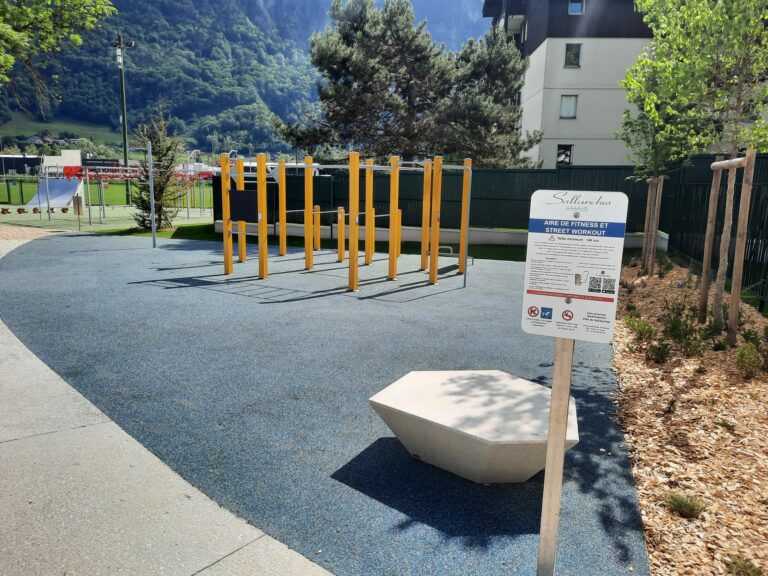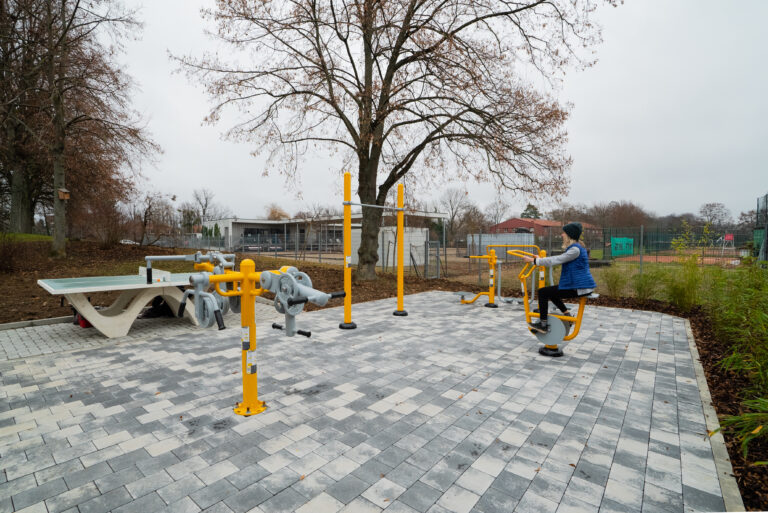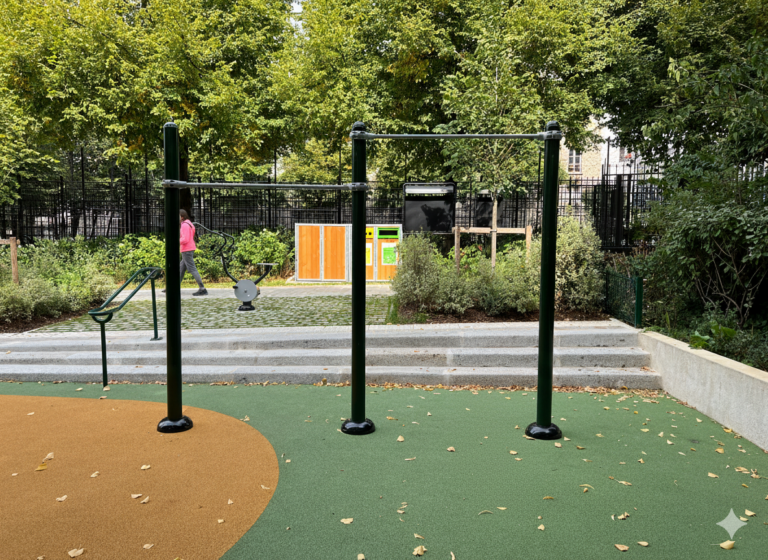

Quartiers Prioritaires de la Politique de la Ville (QPV) (Priority Urban Neighborhoods) face major social, economic and health challenges. Faced with these challenges, local authorities are looking for concrete solutions to improve the daily lives of residents. One of the most effective and accessible levers of action is outdoor fitness trails.
Much more than just a sports facility, a well-designed fitness trail becomes a real catalyst for social cohesion. It creates links, promotes generational diversity, improves public health and revitalizes public spaces. In disadvantaged neighborhoods, where inequalities in access to sport are particularly marked, these facilities represent a pragmatic yet ambitious response.
Herkules Fitness, a specialist in outdoor sports facilities, explains why and how a fitness trail can transform the social dynamic of a disadvantaged neighborhood.
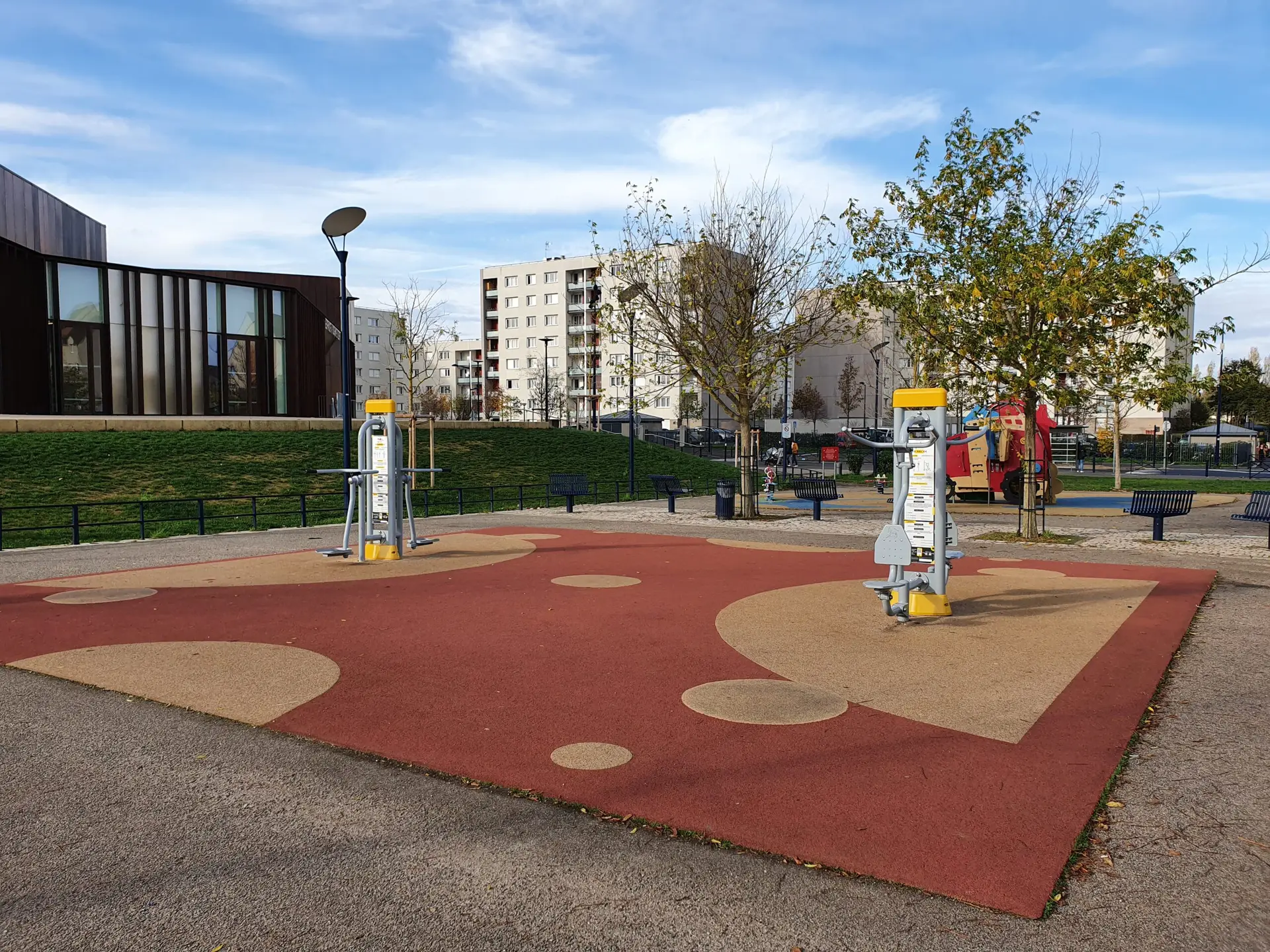
I. Priority districts: specific challenges in terms of health and social cohesion
1.1 What is a Priority Urban Neighborhood?
QPVs are defined by the 2014 Lamy Law as territories characterized by:
- A significant income gap with the rest of the conurbation
- A concentration of socio-economic difficulties (unemployment, job insecurity, dropping out of school)
- Inadequate infrastructure in terms of public services, shops and sports facilities
Today, France has 1,514 QPVs throughout the country, home to around 5.4 million people, or almost 8% of the French population.
1.2 Inequalities in access to sport are particularly marked
QPV residents face a number of obstacles when it comes to practising sport:
Financial obstacles :
- The cost of gym memberships (€30-50/month) is a major obstacle for low-income households.
- Sports equipment (shoes, outfits) is also a barrier to entry.
Geographical obstacles :
- Away from sports facilities (pools, gyms, stadiums)
- Long journey times to access equipment
- Sense of isolation in certain neighborhoods
Socio-cultural barriers :
- Lack of gender diversity in traditional sports structures
- Social codes can be intimidating for people far removed from sport
- Low representation of women in the public sports arena
Health consequences: These inequalities in access translate into significant health disparities. Studies show that QPV residents have :
- Overweight and obesity rates 20-30% higher than the national average
- Higher prevalence of type 2 diabetes and cardiovascular disease
- A worrying level of physical inactivity, particularly among young people and seniors
1.3 The crucial need for meeting places and cohesion
Over and above the health issue, QPVs often suffer from a lack of places to socialize:
- Under-used or degraded public spaces
- Lack of intergenerational meeting places
- Feeling of insecurity that limits appropriation of public space
- Low social mix between different neighborhood groups
It’s against this backdrop that outdoor fitness trails take on their full meaning: they simultaneously meet the challenges of public health, livening up public spaces and creating social links.
II. The outdoor fitness trail: a facility for social cohesion
2.1 Why the fitness trail works particularly well in QPVs
Total financial accessibility: Unlike gyms, the fitness trail is 100% free, 24 hours a day, 365 days a year. This eliminates the main barrier to entry and guarantees equal access for all residents, whatever their income.
Geographical proximity: Located in the heart of the neighborhood, the course is just a few minutes’ walk from housing. This proximity is decisive in anchoring regular practice, particularly for the elderly, mothers and people with reduced mobility.
Absence of intimidating social codes: The public outdoor sports area is less codified than a gym. No compulsory clothing, no membership, no collective changing rooms: everyone comes as they are, at their own pace, without judgment. This simplicity encourages the inclusion of those who are most distant from sport.
Visibility and the knock-on effect: A well-located fitness trail creates a showcase effect: by seeing other residents exercising, passers-by are encouraged to give it a try. This social imitation phenomenon is particularly powerful in densely populated neighborhoods.
2.2 A tool for social and generational diversity
The outdoor fitness trail has the unique feature of being suitable for all ages and levels:
Children and teenagers (6-17 years) :
- Playful discovery of muscle strengthening
- An alternative to screens and a sedentary lifestyle
- Development of motor skills and self-confidence
Young adults (18-35) :
- Functional training and outdoor weight training
- Group training (street workout, cross-training)
- Free addition to gyms
Active adults (35-60 years) :
- Keeping fit
- Preventing pathologies linked to a sedentary lifestyle
- Decompressing after work
Seniors (60+) :
- Preserving autonomy and balance
- Combating social isolation
- Prevent falls and maintain muscle mass
This generational cohabitation in the same space naturally creates interactions and exchanges of advice, and reinforces the feeling of belonging to the neighborhood.
2.3 A lever for reclaiming public space
Priority neighborhoods sometimes suffer from under-utilization of public space, or even problems of delinquency or incivility. The installation of a fitness trail contributes to :
Bringing public space back to life:
- Creating a new attraction in the neighborhood
- Increased throughput, even at off-peak times
- Positive appropriation of space by residents
Improving the sense of security :
- Regular human presence on site (deterrent effect)
- Increased lighting around installations
- Collective view of space (natural surveillance)
Enhancing the neighborhood’s image :
- A positive signal to residents: “we’re investing in you”.
- Local residents proud of their new equipment
- Changing perception of the neighborhood from the outside
Catalyze other dynamics: A well-designed fitness trail never stands alone. It often becomes the starting point for other initiatives: collective clean-up of the area, tree planting, organization of sporting events, creation of a local association…
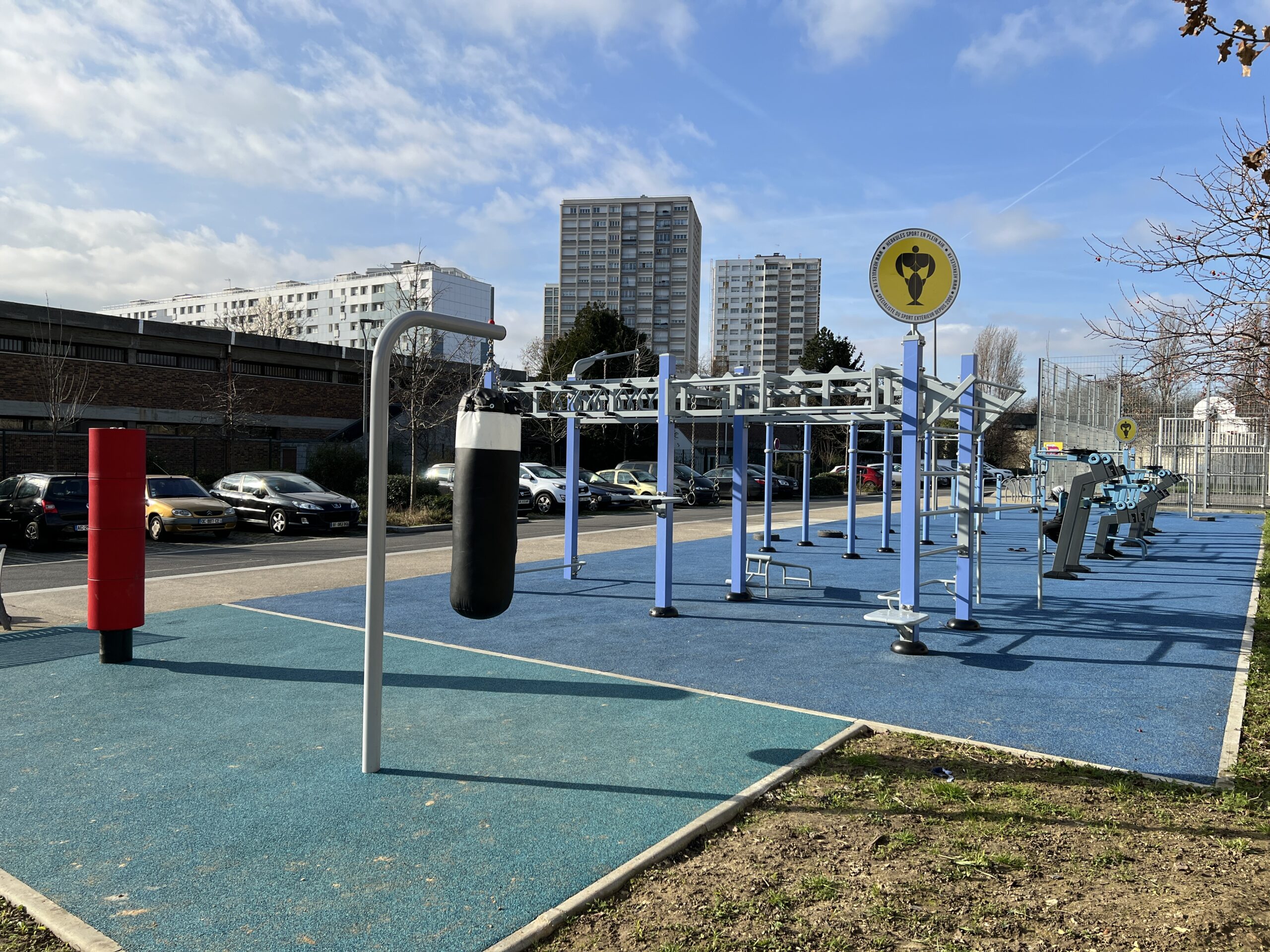
III. The keys to a successful fitness program in QPV
3.1 Layout: choosing the right location
The success of a fitness trail depends largely on its geographical positioning:
Ideal location criteria :
Centrality :
- In the heart of the district, within walking distance in less than 10 minutes for 80% of residents
- Close to pedestrian traffic (shops, schools, transport)
- Visible from main roads
Safety :
- Open, uncluttered space (avoid isolated corners)
- Functional street lighting
- Proximity to housing (natural surveillance)
Comfort of use :
- Flat, stable ground
- Natural or artificial shade (trees, pergola)
- Away from noise pollution
- Benches for accompanying persons
Integration into the urban fabric :
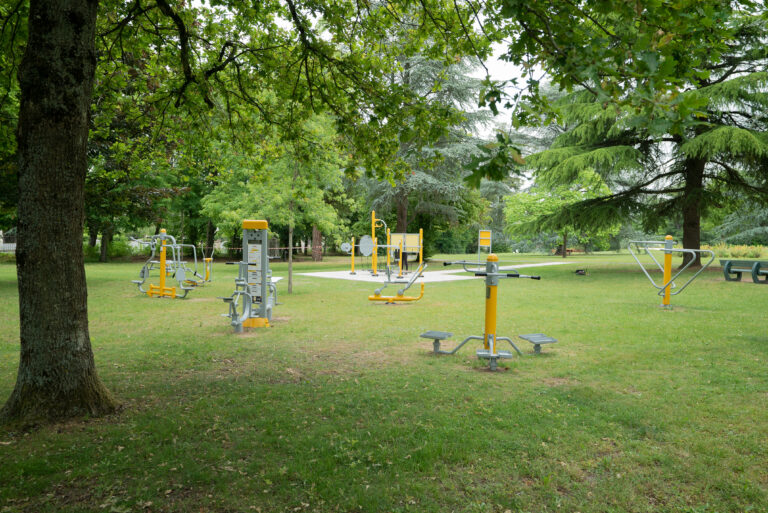
- Ideally in an existing park or green space
- Or as a complement to other facilities (city stadium, playground, skatepark)
- Never isolated in a disused parking lot
3.2 Co-construction with local residents: an essential step
The classic mistake is to impose a facility without prior consultation. However, QPV residents are in the best position to identify real needs and ensure ownership of the project.
3.3 The choice of equipment: diversity and progressiveness
A fitness trail in a disadvantaged neighborhood has to cater for a wide variety of audiences. Herkules Fitness recommends a diversified range of equipment with 3 levels of difficulty:
WARM-UP / INITIATION ZONE (3-4 stations)
Objective: Welcome beginners, seniors, overweight people
Standard equipment :
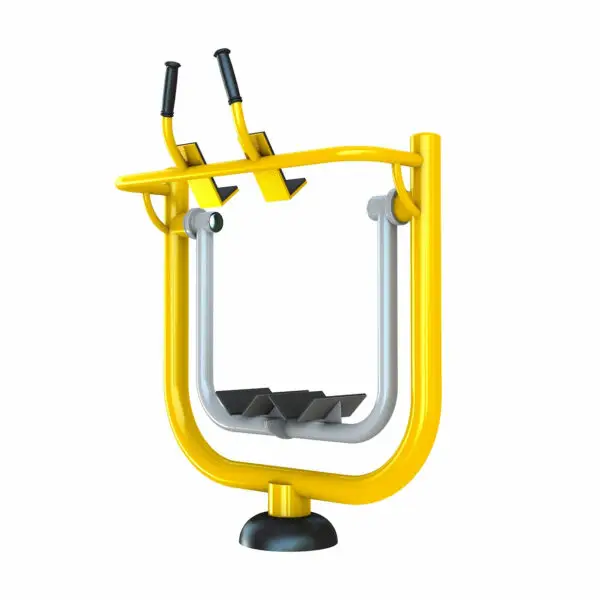
- Elliptical trainer : Gentle cardio, zero joint impact
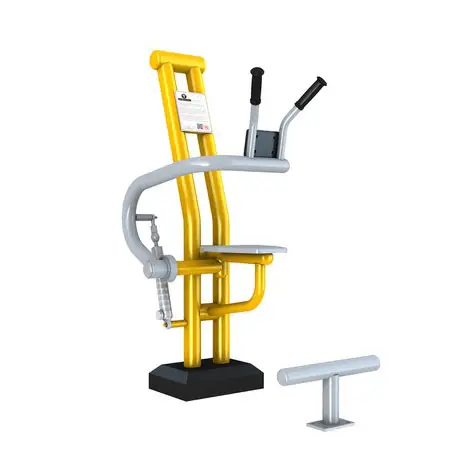
- Rowing machine : Gentle full-body workout
- Walker Joint mobility and coordination
These stations are accessible to all, require no prior physical condition, and offer a reassuring introduction to physical activity.
REINFORCEMENT / INTERMEDIATE ZONE (5-6 stations)
Objective: Develop strength, tone and balance
Standard equipment :
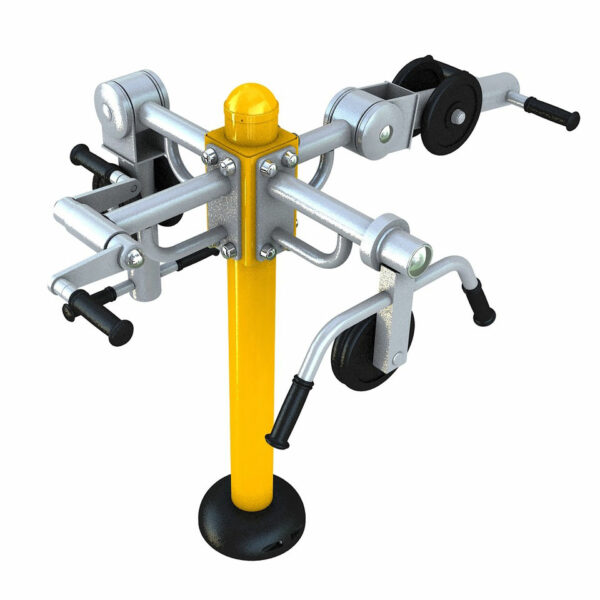
- Leg Press Quadriceps, glutes
- Chest Press Back, shoulders
- Bench Press Pectorals, arms
- Suspended beam Proprioception, sheathing
These stations form the heart of the route, and are used by the majority of regular riders.
PERFORMANCE / ADVANCED ZONE (3-4 stations)
Objective: Challenge experienced athletes and young street workouts
Standard equipment :
- Traction bar (multi-height)
- Parallel bars Dips, advanced strength training
- Horizontal scale Grip strength, explosiveness
- Multi-station street workout Pull-ups, muscle-ups, acrobatic figures
These resorts attract experienced riders, create emulation and offer a perpetual challenge.
Essential additional equipment:
- Illustrated teaching panels: detailed exercises, safety tips
- QR codes: access to demonstration videos (important for low-literacy audiences)
- Clear signage: station numbering, route signposted on the ground
- Benches: For companions, breaks, conviviality
- Garbage cans: Keeping the site clean
- Lighting (if available) : Autumn/winter evening practice
Ideal configuration: A complete course for QPV = 12 to 15 stations spread over 800 to 1200 m², providing 30 to 45 minutes of circuit training.
V. Financing a fitness program in a disadvantaged neighborhood: optimizing subsidies
4.1 Financing available in QPVs
🎯 ANRU (Agence Nationale pour la Rénovation Urbaine – National Agency for Urban Renewal)
Subsidy rate: 30% to 50% of total amount Approximate amount: €30,000 to €50,000
Conditions:
- Project included in the New National Urban Renewal Program (NPNRU)
- Local sports facilities” or “public space activities” section
- Co-construction with residents mandatory
- Timetable: 6-12 months appraisal, payment based on supporting documents
File to be compiled :
- Project presentation (context, objectives, target audience)
- Location and layout plan
- Detailed quotes (equipment, installation, signage)
- Overall provisional budget
- Financing plan (other subsidies mobilized)
- City council deliberation
- Production schedule
🎯 City contract
Grant rate: 20 to 40% Approximate amount: €20,000 to €40,000
Conditions:
- Project in line with local Contrat de Ville priorities
- Generally: “Living environment and urban renewal” or “Social cohesion”.
- Validation by the City Contract Steering Committee
- Schedule: more flexible than ANRU (3-6 months)
Advantage: The Contrat de Ville often provides funding for activities (sports educators, events) that the ANRU does not always cover.
🎯 Regional Council
Grant rate: 15 to 25% Approximate amount: €15,000 to €25,000
Regional systems :
- “Local sports facilities (Île-de-France, Auvergne-Rhône-Alpes, etc.)
- “City policy (regional envelope dedicated to QPVs)
- “Sport santé bien-être” (public health prevention)
Conditions:
- Annual call for projects (check regional calendar)
- Mandatory co-financing (other subsidies + own funds)
- Criteria: Innovation, social impact, inclusion of vulnerable groups
🎯 Departmental Council
Subsidy rate: 10 to 20% Approximate amount: €10,000 to €20,000
Departmental systems :
- “Fonds d’intervention pour l’équipement des collectivités” (Intervention fund for community equipment)
- “Departmental sports policy
- “Prevention and public health (some departments)
Subsidy rate: 20 to 40% (territorial portion) Approximate amount: €15,000 to €30,000
Conditions:
- Project promoting access to sport for disadvantaged groups (QPV = priority)
- The “sport santé” or “sport insertion” dimension
- Application via the regional committee (CDOS or CROS)
🎯 European Funds (ERDF – ESF)
Grant rate: 40% to 60% (depending on the focus) Approximate amount: €30,000 to €50,000
Conditions:
- Large-scale project in line with European priorities:
- ERDF: Sustainable urban development (axis 9-10 generally)
- ESF: Social inclusion and the fight against poverty
- Complex procedure (through the Region, 12-18 months lead time)
- Minimum amount often required (€50,000 total project)
Tip: Group several districts/cities together to reach the thresholds.
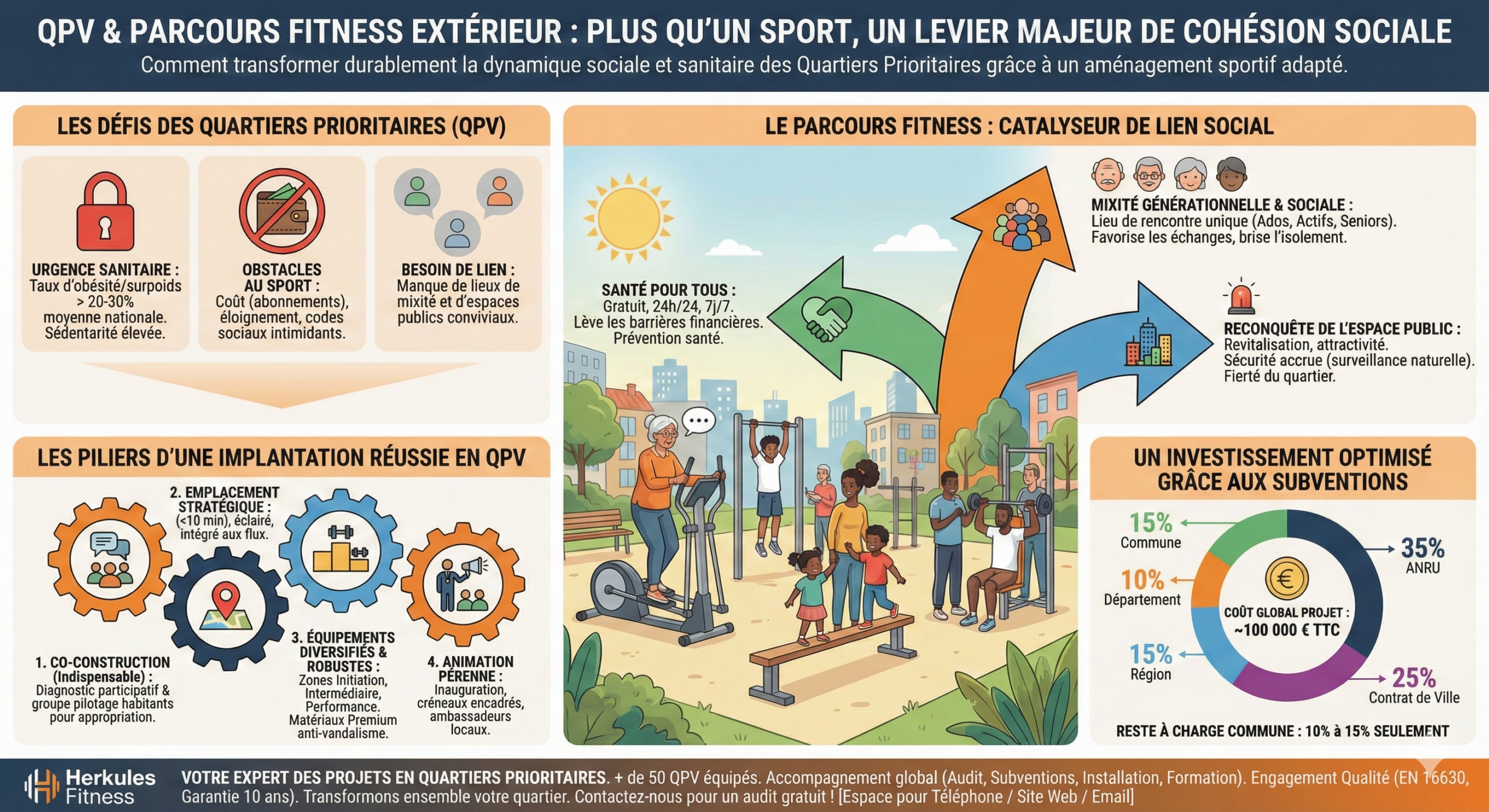
Conclusion: The fitness trail, a profitable social investment
In a disadvantaged neighborhood, an outdoor fitness trail is much more than just a sports facility. It’s a tool for social transformation that :
✅ Improves public health: Combats sedentary lifestyles, obesity, chronic diseases ✅ Creates social ties: Generational mix, encounters, neighborhood solidarity ✅ Revitalizes public space: Positive appropriation, enhanced sense of security ✅ Enhances neighborhood image: Pride of residents, increased attractiveness
The fitness pathway in QPV is not an expense, it’s an investment in the area’s human, social and health capital.
Do you have a fitness trail project in a QPV?
Herkules Fitness is with you every step of the way:
🔹 F ree audit of your site 🔹 Customized recommendations (equipment, layout, budget)🔹 1 0-year warranty + responsive after-sales service