
Present in most open-access fitness areas, the outdoor chest press is one of those pieces of equipment that intrigue as much as they reassure: its guided movement seems easy to grasp, but how do you use it correctly and what does it really do? Halfway between the gym machine and the floor pump, this equipment provides effective, safe upper-body work accessible to all levels.

In this article, we take a look at how the outdoor chest press works: which muscles it targets, the exact technique to follow, variations for progress, its advantages over other push-up exercises, and how to incorporate it intelligently into an outdoor training program.
Key takeaways:
- The external chest press is a pushing apparatus that mainly targets the pectorals, triceps and anterior deltoids (shoulders).
- The resistance comes from the body’s weight: by reclining more or less, you can adjust the intensity, making this equipment suitable for all levels.
- There are three key techniques: back pressed against the backrest, shoulder blades retracted, controlled movement without locking the elbows at the end of the push.
- This exercise fits perfectly into a street workout routine, complementing push-ups, dips and pull-ups for a balanced upper-body workout.
- To make lasting progress: start with 3 sets of 10 repetitions, gradually increasing the volume and then the inclination of the body to intensify the resistance.
What is an outdoor chest press?
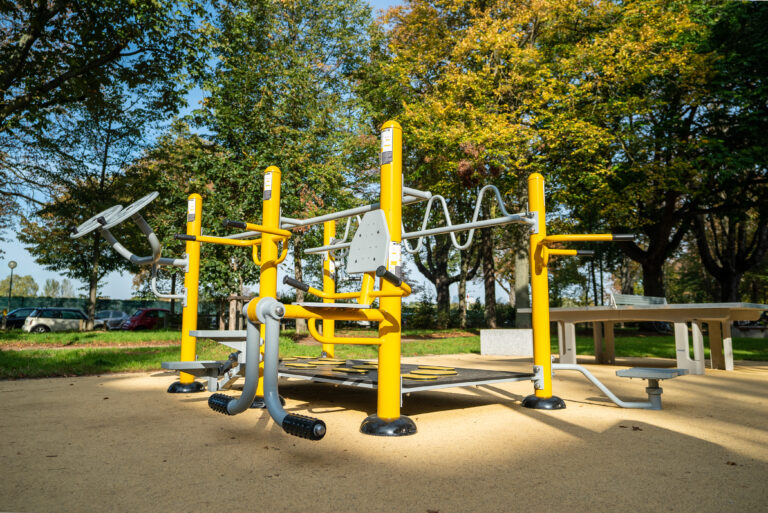
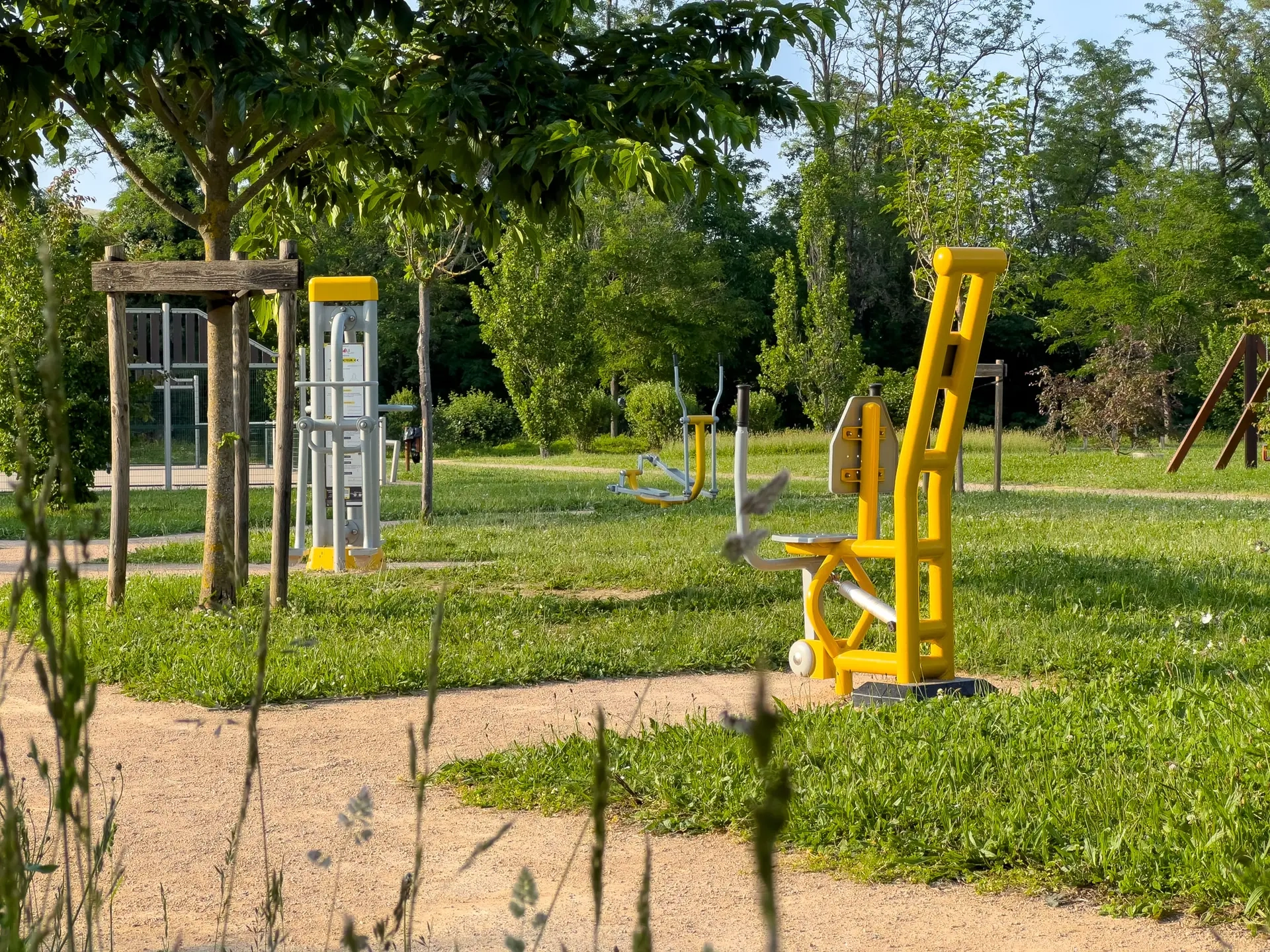
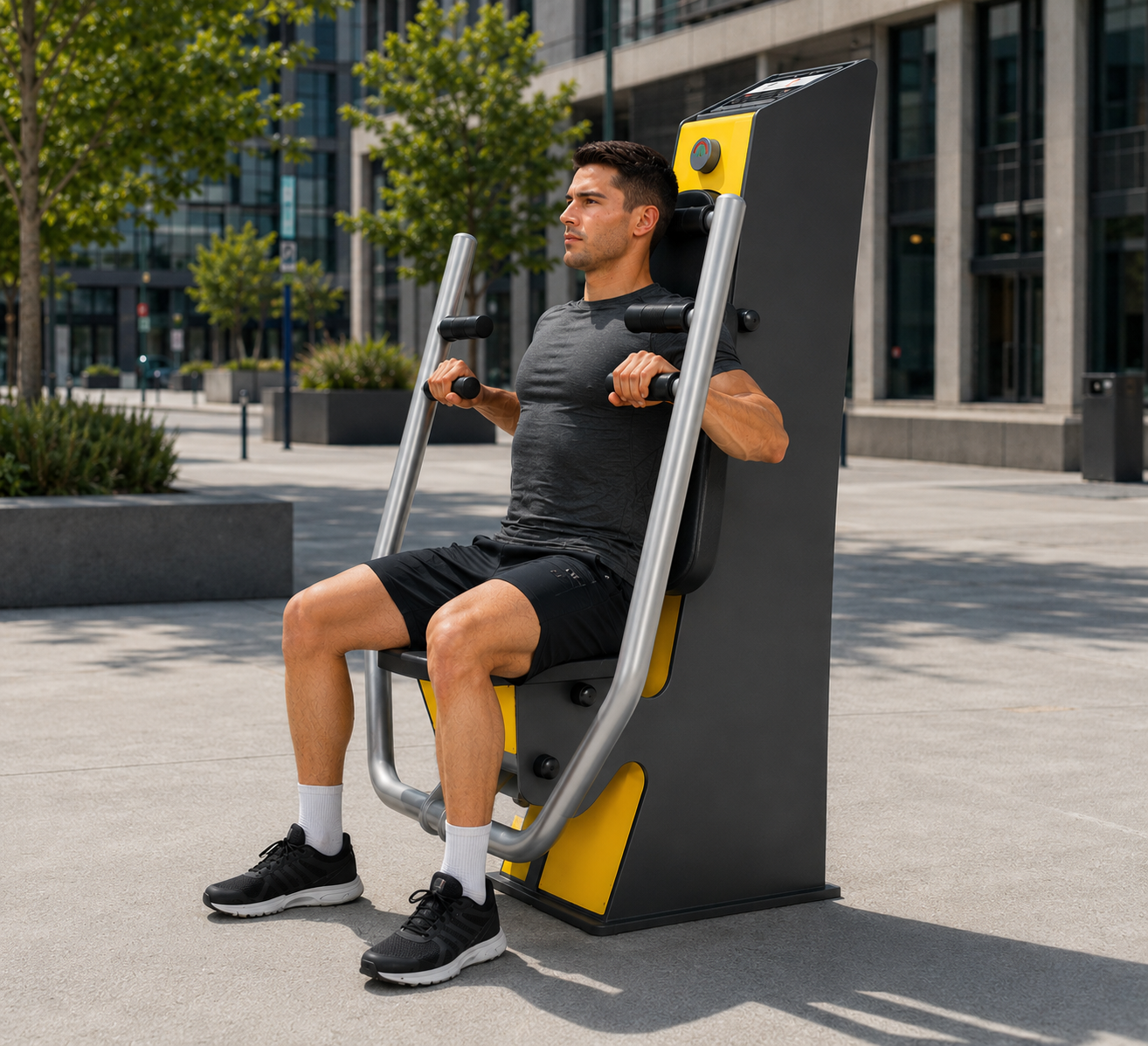
The outdoor chest press, sometimes referred to as an outdoor butterfly or pectoral press, is a guided-movement weight-training device installed in public fitness areas. It consists of a seat, a backrest and two articulated handles that the user pushes forward at chest height. Unlike gym machines that use weights or pulleys, resistance here comes from the user’s body weight, sometimes combined with a fixed lever or counterweight system.
In concrete terms, the more you lean forward while pushing the handles, the lower the resistance; the more you remain pressed against the backrest while pushing vertically or slightly backwards, the higher the resistance. This ergonomic design makes it an intuitive piece of equipment for beginners, while offering interesting scope for progression for experienced users. Designed to be robust and weather-resistant (galvanized steel, epoxy paint, composite seats), it is one of the most popular pieces of equipment in municipal fitness parks.
Which muscles are targeted by the external chest press?
The chest press is a horizontal push-up exercise (or slightly declined depending on the model), i.e. a movement in which you push a load in front of you. As such, it mainly involves the anterior muscular chain of the upper body, with intensity varying from muscle to muscle.
| Muscle | Role in the exercise | Profit |
| Great pectoral | Main muscle, agonist | Chest volume and power, posture |
| Triceps | Synergistic muscle, elbow extension | Thrust force, back of arm curvature |
| Anterior deltoid | Synergist, shoulder flexion | Stability and shoulder width |
| Anterior serrate | Scapula stabilizer | Posture, preventing shoulder pain |
| Abdominal gainage | Trunk stabilization | Power transmission, lumbar protection |
The pectoralis major muscle
It’s the agonist muscle of the exercise, i.e. the one that produces most of the movement. The pectoralis major occupies the front of the chest, and its main function is to bring the arm inwards (horizontal adduction). This is precisely the movement you reproduce by pushing the handles of the chest press towards each other. With regular training, you’ll not only gain in volume and muscle density in this area, but also in posture (a strong pectoral pulls the shoulders forward less).
The triceps: finishing the push
Located at the back of the arm, the triceps are responsible for elbow extension. They work in synergy with the pectoral muscles in the final phase of the push, when you extend your arms out in front of you. Regular chest press training helps to shape the back of the arm and improve push-off strength in all everyday activities (carrying, pushing a door, lifting an object).
Anterior deltoids: shoulder stability
The deltoids are the muscles that cover the shoulder. The anterior (front) portion is called upon with every shoulder flexion movement, i.e. every forward thrust. The chest press thus helps to broaden and stabilize the shoulder, which is invaluable for posture and the prevention of neck pain.
Stabilizing muscles
Although the movement is guided, several muscles work in stabilization: the serratus anterior (which presses the scapula against the ribcage), the abdominals (which stabilize the trunk) and the erector spinae muscles. This is particularly true if you maintain an active gainage throughout the series, which is highly recommended.
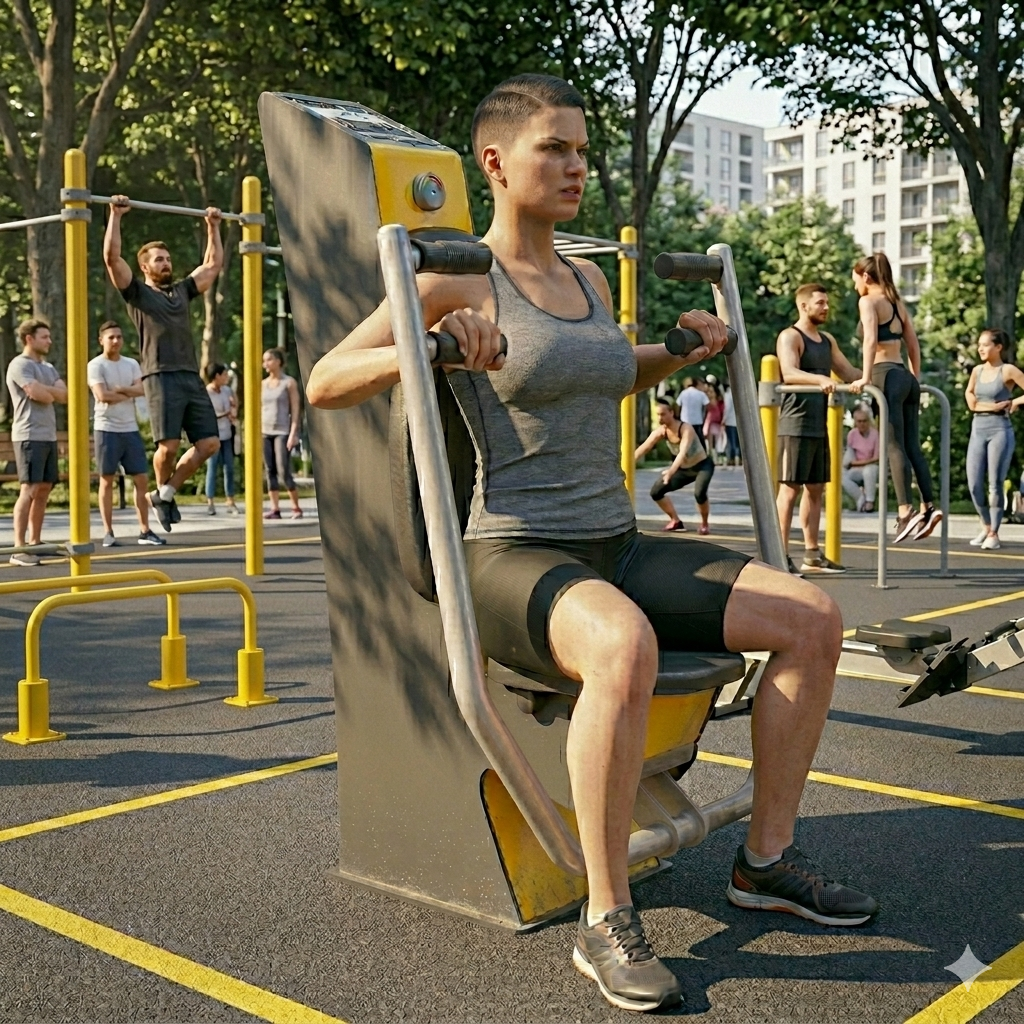
How to use an outdoor chest press correctly
Although the apparatus is guided and therefore more tolerant than a free movement, poor execution reduces its effectiveness and increases the risk of pain. Here’s the step-by-step procedure.
Before the series: installation
- Sit on the apparatus, with your back pressed against the backrest and your buttocks well back in the seat.
- Check that the handles are at chest height (mid-pectoral) when gripped. On some models, the seat is adjustable: adjust it if necessary.
- Place your feet flat on the floor, shoulder-width apart, to stabilize your pelvis.
- Grasp the handles with a full grip, thumbs wrapped around them, wrists in line with the forearms (not broken backwards).
- Slightly retract the shoulder blades (as if you wanted to bring them together in the back) and engage the abdominals.
During movement
- Push phase (concentric): exhale as you push the handles forward in a controlled manner, for 1 to 2 seconds. Elbows should remain slightly bent at the end of the movement, never fully locked.
- Return phase (eccentric): inhale as you bring the handles towards you, slowly, over 2 to 3 seconds. It’s this phase, often overlooked, which produces the bulk of the muscular benefits.
- Amplitude: bring the handles down until your elbows are level with your trunk, without going any further. Excessive amplitude puts the shoulder in a vulnerable position.
Recommended format
For beginners, aim for 3 sets of 10 repetitions, with 60 to 90 seconds recovery between each set. For intermediates, increase to 3 or 4 sets of 12 to 15 repetitions. For advanced users, increase the difficulty by slowing down the return phase (3 to 4 seconds) or by performing longer sets (20 reps or more).
Outdoor chest press vs. floor pumps: which to choose?
The floor press is the push-up exercise par excellence in callisthenics. The chest press, its guided cousin, has markedly different characteristics. Neither is superior in absolute terms: both have their place in a balanced routine.
| Criteria | Chest press exterior | Ground pumps |
| Accessibility | Very easy, guided movement | Easy, no equipment required |
| Stabilization | Low (guided movement) | Strong (sheathing required) |
| Joint risk | Limited, imposed trajectory | Moderate (wrists, shoulders) |
| Progression | Body tilt | Variants (declines, claps, etc.) |
| Ideal for | Beginners, recovery, seniors | All levels, overall sheathing |
For a complete beginner or a senior citizen returning to the sport, the chest press is an excellent entry point: it teaches the pushing movement without imposing a sheathing that’s difficult to maintain. For regular exercisers, push-ups remain essential, as they develop stabilizing strength. The best approach is to combine the two: for example, two sets of chest presses at the start of the session, followed by two sets of push-ups to finish. You get the best of both worlds.
Mistakes to avoid at the outdoor chest press
– Lock your elbows at the end of the push: tension is then transferred from the muscles to the joint. Always maintain a slight flexion.
– Lifting your back from the backrest: this often involuntary parasitic movement causes you to lose your stability and gives your pectoral muscles a poor workout. Stay flat throughout the series.
– Going too fast: exercise must be controlled. Executing too quickly uses momentum rather than muscle, which greatly reduces the benefits.
– Break wrists: wrists should remain in line with the forearms. If they tilt back under the push, you risk joint pain.
– Pushing beyond the lock: some models have a mechanical stop. Never push beyond this point: it’s useless and dangerous for your shoulders.
– Skip the warm-up: before the first heavy set, always do 1 or 2 light sets (with a very inclined chest) to prepare the shoulders.
How to integrate the chest press into a complete workout
The chest press can be used in a variety of ways, depending on your goal. Here are three typical ways to incorporate it into a street workout.
Option 1: main push exercise (beginner)
- Warm-up (5 min): walking, joint rotation, shoulder mobility.
- Chest press: 3 sets of 10 repetitions, 90 seconds recovery.
- Australian pull-ups (under a low bar): 3 sets of 8 repetitions.
- Bodyweight squats: 3 sets of 15 repetitions.
- Gainage: 3 sets of 30 seconds.
Option 2: pre-fatigue before pumps (intermediate)
- Warm-up (5 min).
- Chest press: 2 sets of 12 repetitions, 60 seconds recovery.
- Floor push-ups immediately after : 3 sets of 10 repetitions.
- Dips on parallel bars: 3 sets of 8 repetitions.
- Pectoral stretching: 1 minute per side as a finish.
Option 3: finishing (advanced)
- Warm-up (5 min).
- Weighted or inclined push-ups: 4 sets of 8 repetitions.
- Dips: 4 sets of 10 repetitions.
- Chest press finish: 3 sets maximum, with no recovery time between sets (drop set). The aim is to push the pectoral muscles to their limits after heavy exercises.
The external chest press is all too often underestimated by experienced exercisers, who prefer “pure” bodyweight exercises. This is a mistake: its guided movement, rapid learning curve and versatility make it an excellent tool for beginners, for resuming after an interruption, or for completing a more demanding routine. Properly executed, it develops the chest, triceps and shoulders with minimal joint risk.If you regularly frequent a public fitness area, make it part of your routine without hesitation: alone or in addition to push-ups and dips, it will help you build a strong, balanced and functional upper body. And like all outdoor equipment, it has one decisive advantage over its indoor cousins: it’s free, accessible at all hours, and invites you to enjoy the fresh air. All the more reason to tame it.