
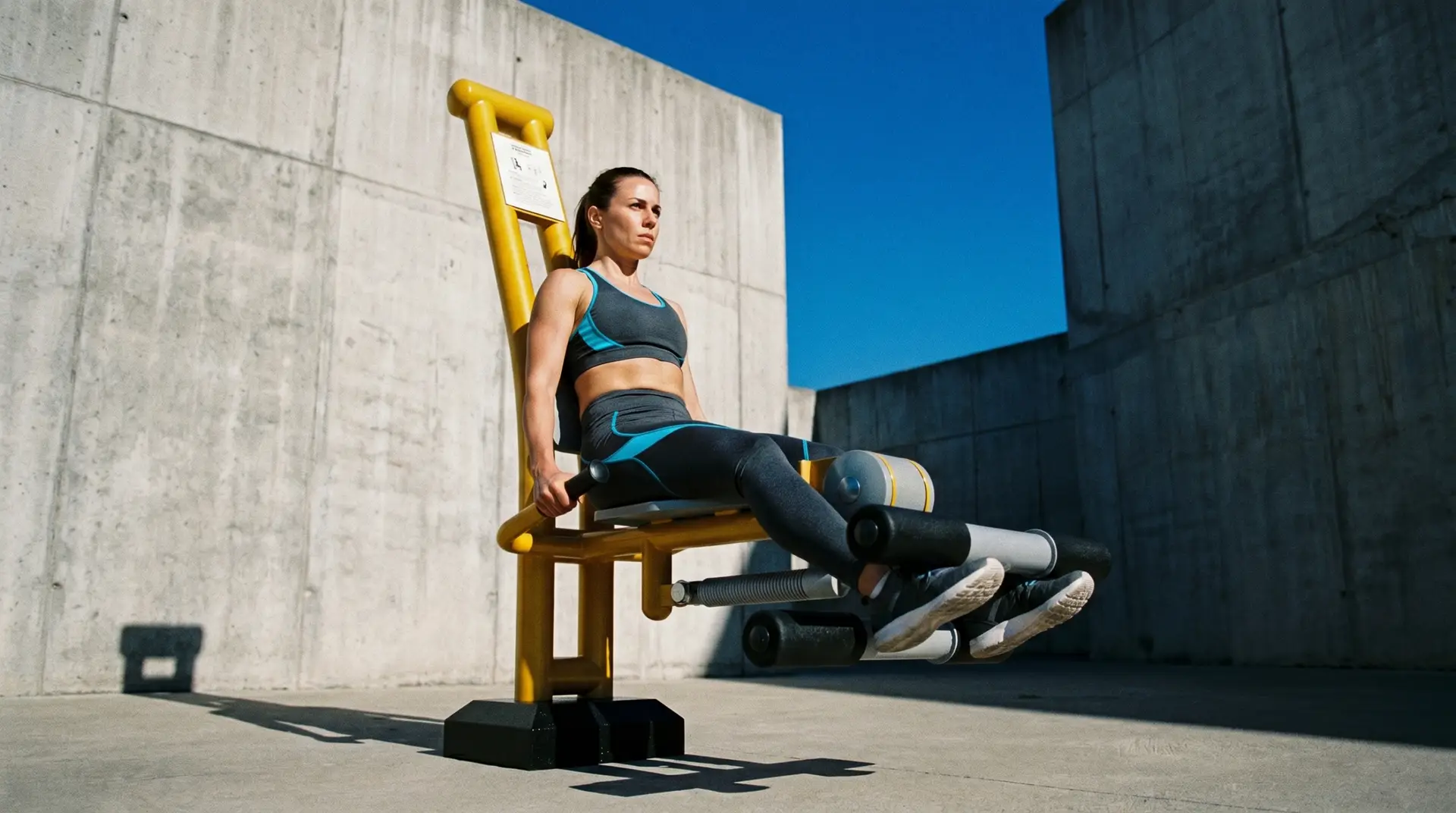
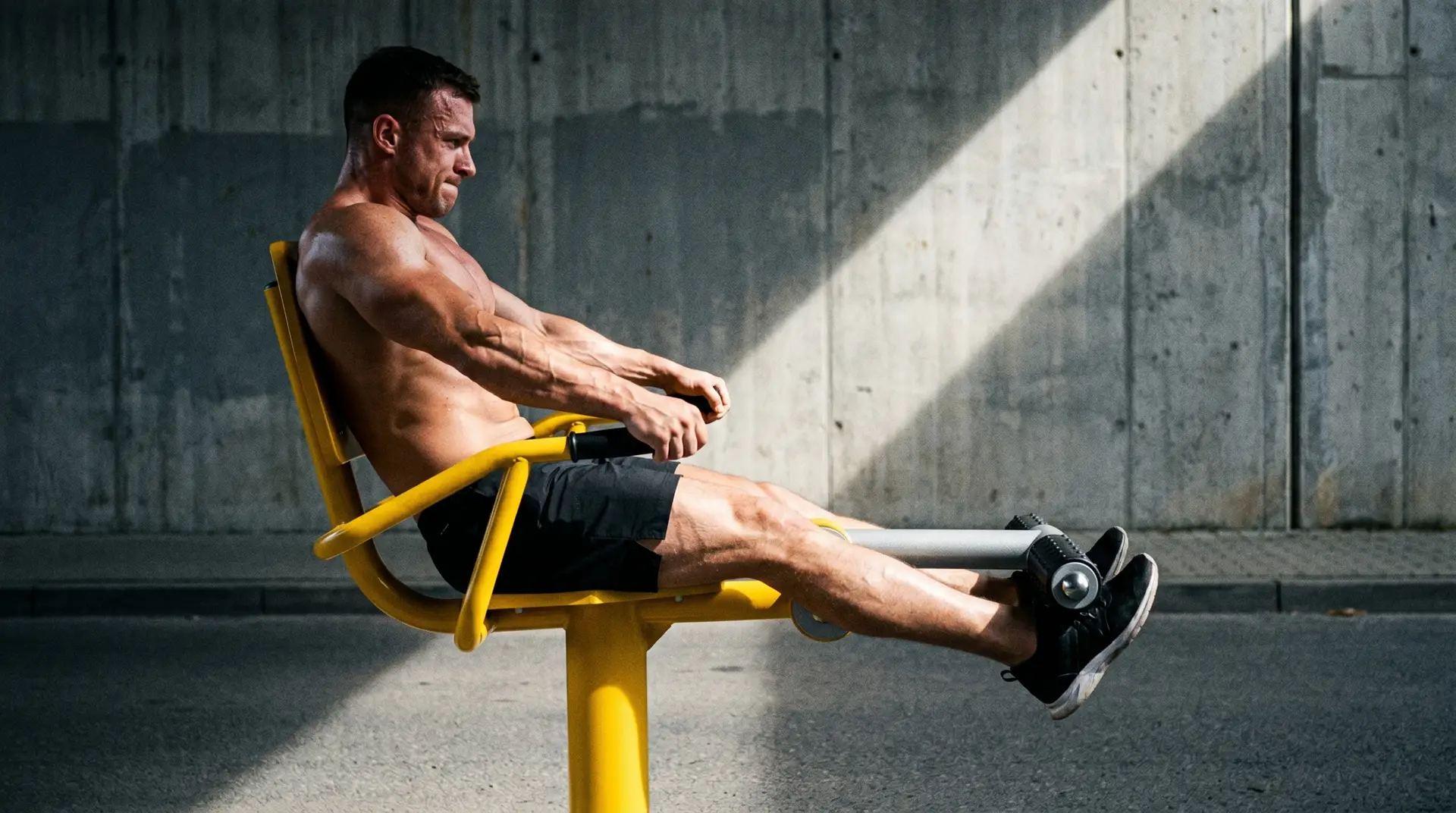
On outdoor fitness machines, the leg extension is often used mechanically — always seated the same way, always with both legs, always at the same tempo. That habit wastes most of the machine’s potential. Used properly, an outdoor leg extension actually offers around ten variations with distinct muscular effects, adaptable to every profile: beginners, experienced athletes, older adults, people in rehabilitation.
This guide details every exercise you can perform on a park leg extension, with the precise technique for each one, the muscles primarily targeted, the level required and the possible adaptations. It is designed as a technical reference to accompany the 6-week programme available on this site.
Key takeaways:
- The outdoor leg extension is not a single exercise: there are many variations (single-leg, isometric, partial ranges, eccentric tempo, foot rotations) that target the quadriceps differently depending on your goal.
- Each variation loads certain parts of the quadriceps more than others: external rotation favours the VMO (vastus medialis), internal rotation the vastus lateralis, while full range recruits the whole quadriceps.
- Single-leg extension is ideal for correcting muscular imbalances between the dominant and non-dominant leg, which are common in athletes.
- Isometric holds at 60° and low partial ranges are particularly suited to rehabilitation and knee pain prevention, subject to professional advice where needed.
- For an effective session, combine no more than 3 or 4 variations, starting with full-range work, then the specialisation variations, and finishing with the most intense methods (eccentric, chained sets).
Anatomy refresher: what the outdoor leg extension can train
Before going into the variations, remember that the leg extension is an isolation exercise: it loads the quadriceps almost exclusively. The four heads of the quadriceps are not, however, activated identically depending on the variation chosen, the orientation of the foot and the range of movement.
| Muscle head | Location | Zone of maximum activation | Variation that favours it |
| Rectus femoris | Front of the thigh, superficial | Whole range | Both legs, full range |
| Vastus lateralis | Outer side of the thigh | 0 to 90° of flexion | Foot in slight internal rotation |
| Vastus medialis (VMO) | Inner side, just above the knee | Final 30° of extension | High partial range, foot in external rotation |
| Vastus intermedius | Deep, under the rectus femoris | Whole range | Slow tempo, isometric hold |
This table has a direct practical implication: for balanced quadriceps training, repeating the same variation is not enough. Combining several exercises from this guide lets you load the four heads in different ways.
Exercise 1: two-leg extension, full range
Description
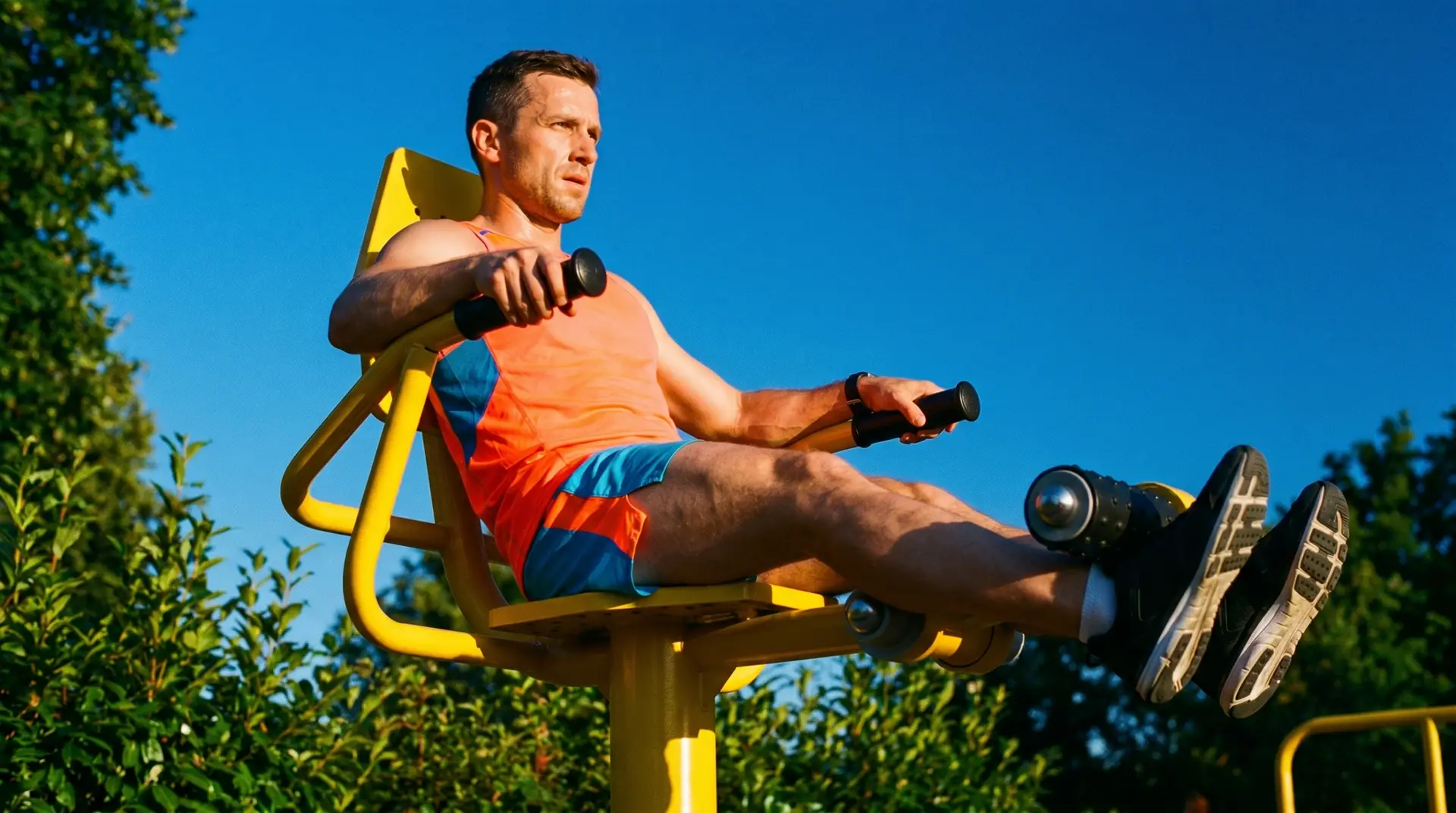
This is the base exercise, the starting point for all work on an outdoor leg extension. Both legs work at the same time, over the full range available on the machine.
How to perform it
1. Sit on the machine, back against the backrest, hips flexed at 90°
2. Ankles under the roller or footrest, feet in a neutral position
3. Breathe in, then breathe out as you push into full knee extension over 1 to 2 seconds
4. Hold for 1 second at the top, knees almost straight but not snapped into lock
5. Lower slowly over 2 to 3 seconds back to the starting position
Recommended training parameters
| Level | Sets × reps | Tempo (conc-pause-ecc) | Rest |
| Beginner | 3 × 12 to 15 | 1-1-2 | 90 sec |
| Intermediate | 4 × 10 to 12 | 2-1-3 | 75 sec |
| Advanced | 4 × 15 + dropset | 1-2-3 | 60 sec |
Main muscles worked
The whole quadriceps, with the rectus femoris and vastus intermedius taking priority.
Technical point
Do not lock the knee into hyperextension at the end of the movement: stop 5° short of full extension to protect the kneecap cartilage and the anterior cruciate ligament.
Exercise 2: single-leg extension (one leg at a time)
Description
The single-leg variation means working one leg at a time, with the other resting or hanging freely. It reveals and corrects muscular imbalances between the dominant and non-dominant side, which are common in athletes who play asymmetrical sports (tennis, football, cycling).
How to perform it
6. Same position as the two-leg variation
7. One ankle under the roller, the other leg free (foot on the ground or slightly lifted)
8. Perform the full movement, controlling the lowering phase over 3 seconds
9. Complete all the reps on one side before switching
10. Always start with the weaker side
Why start with the weaker side?
Starting with the weaker side avoids fatigue built up on the first side skewing the number of reps you can genuinely perform. The strong side should match the rep count of the weak side, never the other way round.
Main muscles worked
The whole quadriceps on one side. Increased recruitment of the vastus medialis (VMO) because more stabilisation is required.
Exercise 3: extension with a modified foot position
The position of the foot during the extension influences how much each head of the quadriceps is recruited. Two orientations can be used on an outdoor strength machine.
Foot in slight internal rotation (toes turned inwards)
This orientation increases recruitment of the vastus lateralis, the muscle on the outer side of the thigh. It is particularly useful for users looking to develop the outer sweep of the quadriceps or with a relative weakness in that head.
Caution: internal rotation should not exceed 10 to 15° and must never be combined with a maximum load. This variation is reserved for light to moderate sets.
Foot in slight external rotation (toes turned outwards)
This orientation favours recruitment of the VMO (vastus medialis oblique), the inner lower part of the quadriceps, directly involved in stabilising the kneecap. It is often prescribed when rehabilitating patellofemoral pain syndrome or mild patellar tendinopathy.
Recommended parameters for the rotation variations
| Foot variation | Target head | Recommended volume | When to use it |
| Internal rotation 10–15° | Vastus lateralis | 3 × 12, light to moderate | Outer development, balance |
| External rotation 10–15° | Vastus medialis (VMO) | 3 × 15, light | Knee rehab, patellar prevention |
| Neutral position | Whole quadriceps | Any prescription | Base, general strength |
Exercise 4: high partial range extension
Description
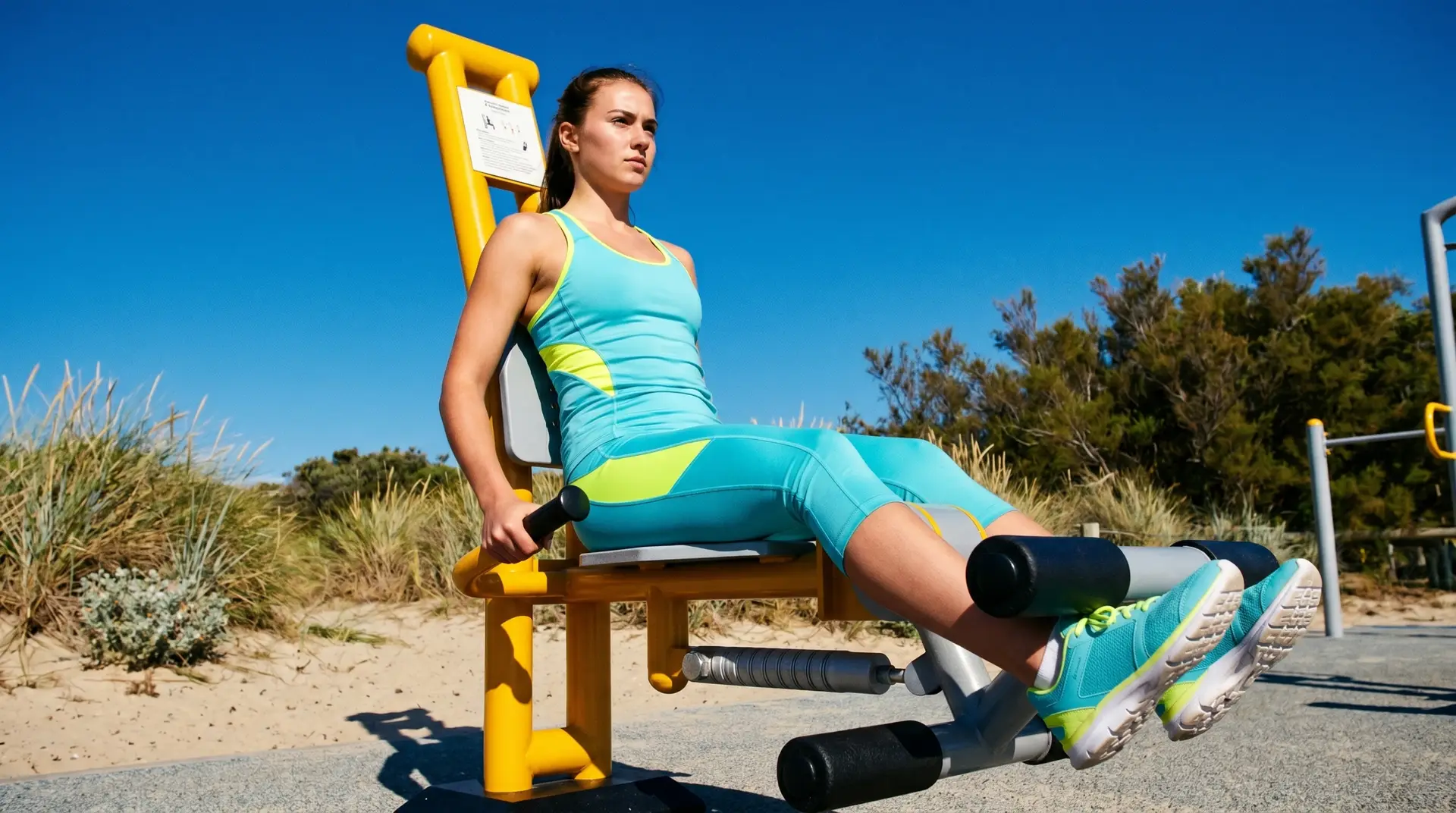
High partial range means working only through the last 30 degrees of extension, the final portion of the movement. This is the zone where the VMO is most active and where the machine’s resistance is generally highest.
How to perform it
11. Start halfway to full extension (around 30° of remaining flexion)
12. Push to almost full extension and hold for 2 seconds
13. Return to 30° of flexion, never going down into full flexion
14. The range of movement is deliberately limited to around 30°
Benefits and limits
This variation produces a very intense peak isometric contraction on the VMO and puts heavy demand on the patellar tendons. It is effective for breaking through plateaus and for users wanting to improve strength at the end of extension. It is not advised for anyone with active patellar tendinopathy or painful patellofemoral syndrome.
Main muscles worked
VMO (vastus medialis) and vastus intermedius first and foremost. High tendon load.
Exercise 5: low partial range extension
Description
The opposite of the previous variation, the low partial range works the initial portion of the movement (from 90° to 60° of flexion). This zone loads the rectus femoris more and puts less strain on the patellar tendon. It is a good substitute for people whose joints are sensitive at the end of extension.
How to perform it
15. Start from the position of maximum flexion available on the machine
16. Push to around 60° of remaining flexion, never further
17. Return slowly to the starting position
18. The range is deliberately limited to the lower half of the movement
Clinical use
This variation is often recommended by physiotherapists when returning to activity after a mild ligament or meniscus injury. It keeps the quadriceps working without excessive strain at the end of extension.
Outside a rehabilitation context, it is less useful than full range work for general muscle development.
Exercise 6: mid-range isometric hold
Description
An isometric hold means keeping a position without movement, generating a static muscular contraction. On an outdoor leg extension, the isometric hold is performed halfway through the extension (around 60° of flexion), the point of maximum activation for the quadriceps as a whole.
How to perform it
19. Bring the legs to around 60° of flexion from the starting position
20. Hold that position with controlled breathing (do not hold your breath) for 20 to 45 seconds
21. Return slowly to the starting position
22. Repeat 3 to 5 times with 60 seconds of rest
What makes it specific
The isometric hold at 60° of flexion is one of the few quadriceps training methods that is recommended without reservation for patellar tendinopathy (following the protocols of Rudavsky and Cook, 2014). It produces immediate tendon analgesia and supports collagen synthesis without creating excessive joint strain.
Recommended parameters
| Context | Hold duration | Repetitions | Rest between reps |
| Tendinopathy rehabilitation | 45 sec | 5 | 2 min |
| Preventive strengthening | 30 sec | 4 | 90 sec |
| Muscular fatigue (end of session) | 20 sec | 3 | 60 sec |
Exercise 7: extension with an accentuated eccentric tempo
Description
This variation changes neither the position nor the range but plays on the tempo, deliberately extending the eccentric phase (lowering) to 4 or 5 seconds. It is one of the most effective methods for stimulating muscle hypertrophy and strengthening tendons on a fixed-resistance machine.
How to perform it
23. Extend upwards over 1 to 2 seconds (fast concentric)
24. Pause for 1 second at the top
25. Lower under control over 4 to 5 seconds (slow eccentric)
26. Go straight back into the lift with no bounce
Why is eccentric work so effective?
The eccentric phase generates higher muscular tension than the concentric phase for the same perceived effort, because the muscle is lengthening under load. On a fixed-resistance outdoor machine, it is one of the main levers available for creating progressive overload without increasing the actual load.
Studies in muscle biomechanics show that eccentric work produces between 20 and 40% more muscular micro-damage than purely concentric work, which stimulates greater protein synthesis after training.
Main muscles worked
The whole quadriceps with emphasis on the tendon structures. Type II (fast twitch) fibre recruitment is more pronounced than with a standard tempo.
Exercise 8: two-leg to single-leg chain (descending method)
Description
This advanced technique chains a two-leg set to failure with, immediately afterwards and with no rest, a single-leg set on each leg. It extends the time under tension without changing the machine’s resistance.
Protocol
27. Two-leg set: 12 to 15 full-range reps to fatigue
28. No rest: straight into a single-leg set on the right leg, 8 to 10 reps
29. No rest: on to a single-leg set on the left leg, 8 to 10 reps
30. Rest for 2 minutes. Repeat 2 to 3 times.
Who is it for?
Intermediate to advanced users only. This technique produces high muscular and metabolic fatigue. It is not advised for beginners or for anyone with a sensitive knee joint.
It is a good alternative to dropsets on fixed-resistance machines where the load cannot be reduced.
Exercise summary: choosing by objective
| Exercise | Main target head | Level | Primary objective |
| Two-leg extension, full range | Whole quadriceps | All levels | Base, general strength |
| Single-leg extension | Single-side quadriceps + VMO | Intermediate | Correcting imbalances |
| Foot in internal rotation | Vastus lateralis | Intermediate | Outer development |
| Foot in external rotation | VMO | All levels | Patellar prevention |
| High partial range | VMO + vastus intermedius | Intermediate / Advanced | Strength at end of extension |
| Low partial range | Rectus femoris | All levels / Rehab | Return after injury |
| Isometric hold at 60° | Whole quadriceps, tendons | All levels | Tendinopathy, prevention |
| Eccentric tempo 4–5 sec | Quadriceps + tendons | Intermediate / Advanced | Hypertrophy, tendon strengthening |
| Two-leg / single-leg chain | Whole quadriceps | Advanced | Density, strength endurance |
How to combine these exercises in a park session
These variations should not be stacked at random. An effective outdoor leg extension session follows a progression of effort: full-range work first (neuromuscular base), then the specialisation variations (foot orientation, partial range) and finally the high-intensity techniques (accentuated eccentric, chained sets).
Sample session for an intermediate user (35 min)
| Order | Exercise | Volume | Rest |
| 1 | Warm-up: active knee and hip mobility | 5 min | — |
| 2 | Two-leg extension, full range | 3 × 12 (tempo 2-1-2) | 75 sec |
| 3 | Single-leg extension (each leg) | 2 × 10 per side | 60 sec |
| 4 | Extension with foot in external rotation (VMO) | 2 × 15 light | 45 sec |
| 5 | Isometric hold at 60° (optional if tendinopathy) | 3 × 30 sec | 90 sec |
| 6 | Static quadriceps stretches | 3 × 40 sec | — |
Note: if your park has other machines, add some hamstring work (leg curl or glute bridge on the ground) after the leg extension to balance the opposing muscle chains and prevent agonist/antagonist imbalances.
Leg extension machines built for all these variations
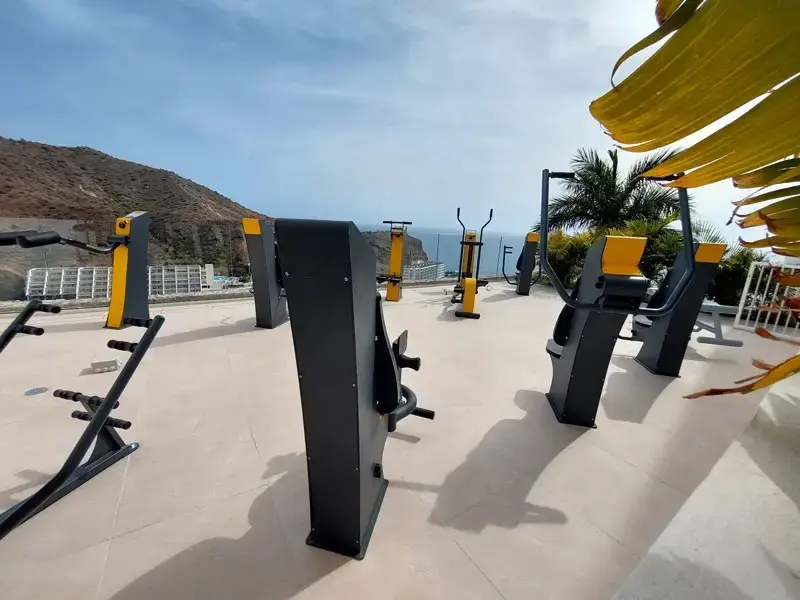
Every variation described in this guide assumes a machine whose axis of rotation lines up properly with the user’s knee joint. On poor quality or badly sized machines, some variations — particularly the foot rotations and partial ranges — create abnormal joint loading.
Herkules Fitness machines include an adjustment system for the pivot point and seat height so the kinematic axis can be matched to each user’s build — an essential condition for practising all the variations described here safely.
Frequently asked questions about outdoor leg extension exercises
Can you do all these exercises on any park machine?
No. Some variations, in particular the foot rotations and partial ranges, require a machine whose ankle attachment allows slight rotational movement and whose seat is adjustable. On fixed machines with no adjustment, stick to full-range two-leg extension, single-leg extension and eccentric tempo.
Is the outdoor leg extension effective for building thigh muscle?
The leg extension is effective for quadriceps hypertrophy as an isolation exercise, but it needs to be combined with compound exercises (squats, lunges, leg press) for complete thigh development. In a fitness park, bodyweight work (Bulgarian split squats, progressive pistol squats) is the ideal complement to leg extension sessions.
Are there exercises to avoid completely if you have knee pain?
With acute pain, all leg extension exercises should be stopped. For chronic pain such as patellofemoral syndrome, high partial ranges and isometric holds at 60° are generally well tolerated but should be validated by a physiotherapist. Foot rotation exercises are contraindicated where there is any ligament injury that has not healed.
How many variations can you fit into a single session?
For a 30 to 40 minute session centred on the leg extension, 3 to 4 variations is a sensible maximum. Beyond that, muscular and tendon fatigue is likely to compromise technique. Alternate variations from one session to the next rather than stacking them all together.
Is the outdoor leg extension suitable for older adults?
Yes, with a suitable selection of variations. Full-range two-leg extension, the isometric hold at 60° and low partial ranges are the exercises best tolerated by older users. They maintain quadriceps strength — a key factor in fall prevention — with minimal joint risk. The single-leg variation with eccentric control is also recommended for working on muscular balance.