
The installation of free-access fitness areas in municipal parks has become increasingly popular in recent years, as demand for outdoor sporting activities has grown. But behind the enthusiasm of local residents lies a sensitive question for elected representatives and technical departments: what happens in the event of an accident? Who is liable, on what grounds, and how can the legal risk to the community be limited?
This article reviews the legal framework applicable to accidents occurring in public fitness areas, from the foundations of municipal liability to best practices for its prevention. It is aimed at mayors, technical service managers, legal departments and local authority insurers.
Key takeaways:
- The municipality is legally responsible for public fitness areas, through its public works and general police powers (article L.2212-2 of the CGCT).
- The main cause of liability is the lack of normal maintenance: defective equipment, damaged shock-absorbing floor, missing signage.
- Compliance with standards NF EN 16630 (outdoor fitness equipment) and NF EN 1176/1177 (floors and play areas) is a key factor in demonstrating the municipality’s diligence.
- There are three types of liability: administrative (joint action before the administrative court), civil (liability for damage to property) and criminal (endangerment, unintentional injury).
- A written maintenance logbook, annual inspections by an approved body and appropriate property damage + liability insurance are the best legal protection.
| ⚖ Legal disclaimerThis article provides an educational summary of the applicable legal framework and does not constitute individual legal advice. For any specific case or dispute, it is advisable to contact the local authority’s lawyer, the relevant legal department or the commune’s insurer. Normative and jurisprudential references evolve: remember to check the texts in force. |
Why can a municipality be held liable?
When a municipality installs a fitness area on its public property, it becomes the owner and guardian of a public work. As such, it assumes a number of obligations: ensuring the safety of the facility, guaranteeing its proper operation, maintaining it, informing users and, more generally, protecting the people who use the site. These obligations derive both from specific legislation (Code général des collectivités territoriales, Code du sport, European technical standards) and from general principles established by case law.
Municipal liability does not necessarily require gross negligence. Where public works are concerned, and particularly for users (as opposed to third parties), administrative case law considers that a simple presumption of lack of normal maintenance may be sufficient to engage the commune. In practical terms, this means that in the event of an accident, it is often up to the local authority to prove that it has properly maintained the structure, and not up to the victim to prove fault.
The three possible levels of liability
In certain situations, the same accident may give rise to several liability regimes simultaneously. Distinguishing between them is essential to understanding the risk involved.
| Type of liability | Jurisdiction | Respondent | Main penalty |
| Administrative | Administrative tribunal | The municipality (legal entity) | Victim compensation |
| Civil | Judicial Tribunal | Municipality or agent (rare) | Damages and interest |
| Criminal | Criminal court | Mayor, agent, elected official (individual) | Fine, sometimes suspended prison sentence |
Administrative liability
This is the usual arena for disputes concerning public works. The victim brings the case before the administrative court, seeking compensation from the municipality for the damage suffered. There are two main types of liability: liability for failure to carry out normal maintenance (which requires the victim to demonstrate the defect in the work and its link with the damage) and, more rarely, no-fault liability for third parties to the work. In the vast majority of cases, it is the former that applies to fitness area users.
Civil liability
More rare in the case of public works, liability may be sought when damage is caused outside the strict framework of the work (for example, when a municipal employee causes personal damage to a user during maintenance). This is a matter for the courts, and may be based on liability for things (article 1242 of the French Civil Code) or on the personal fault of an employee.
Criminal liability
This is the most dreaded type of liability, as it involves individuals (mayor, elected representative in charge of sports, technical services manager) on an individual basis. Offences include unintentional injury (articles 222-19 et seq. of the French Penal Code), manslaughter in the event of death, and deliberate endangerment of others. Penalties can range from fines to suspended prison sentences. However, the Fauchon law of July 10, 2000 limits the criminal liability of public decision-makers to proven or deliberate misconduct in cases of indirect causation, which constitutes an important safeguard.
Concrete obligations of the municipality
To avoid incurring liability, the local authority must comply with a set of obligations covering the entire life cycle of the fitness area: from design to eventual dismantling.
Compliance with technical standards
Two standards structure the open-access outdoor fitness equipment sector. Standard NF EN 16630 sets out safety requirements and test methods for permanently installed outdoor fitness equipment. Standards NF EN 1176 (playground equipment) and NF EN 1177 (shock-absorbing floors) are frequently used by extension, notably for the qualification of fitness area floors. Compliance with these standards does not absolve the local authority of its responsibility, but it does constitute a major element of proof of the local authority’s diligence in the event of litigation.
In practical terms, this means buying only NF EN 16630-certified equipment, requesting certificates of conformity from the supplier, and keeping them in the technical file for the project. The same requirement applies to cushioning floors: the free-fall height of equipment must be compatible with the cushioning capacity of the installed floor.
Care and maintenance
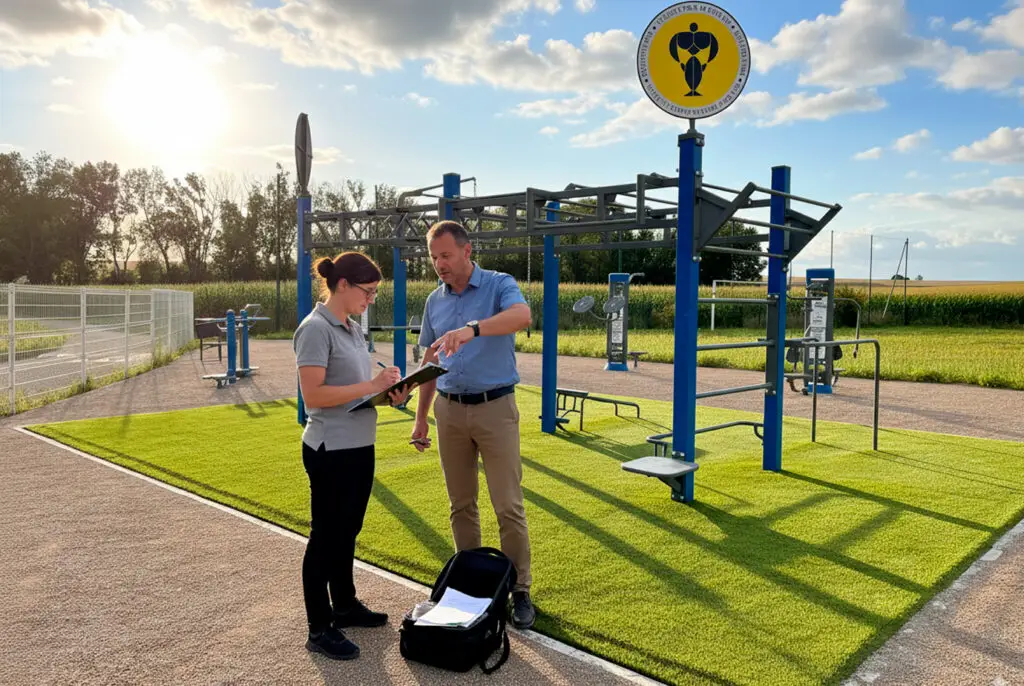
This is the most legally sensitive area, since failure to carry out normal maintenance is by far the most frequent reason for incurring liability. The commune must organize :
– Regular visual inspection (weekly to monthly, depending on use) by municipal staff to detect damage, loose parts and dangerous objects.
– A more thorough quarterly functional inspection : checking that fasteners are tight, floor condition, condition of welds.
– A thorough annual inspection by an independent accredited body or by the manufacturer: this is the cornerstone of legal traceability.
– A written, dated and signed maintenance log , kept for the entire life of the equipment, recording all checks, anomalies and interventions carried out.
Signage and user information
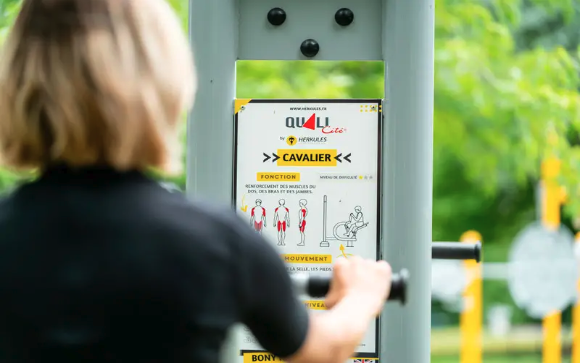
All fitness areas must feature a visible information panel, including at least :
– Identification of the operator (municipality) and a contact number for reporting any anomalies.
– Conditions of use: recommended minimum age, behaviors to avoid, warm-up recommendations.
– Emergency contact details (15, 18, 112).
– The date of the last inspection and the words “use at your own risk” are useful but never sufficient to exonerate the commune.
The absence of signage, or damage to signage that has not been replaced, may be considered a breach of contract by the commune in the event of litigation.
Access control and surveillance
A public fitness area is not a supervised sports arena: there is no obligation for an agent to be present at all times. Jurisprudence is consistent on this point: the municipality is not required to continuously supervise a facility that is open to the public. On the other hand, it must ensure that the conditions of use do not themselves become dangerous (presence of abandoned objects, untreated wilful damage, use outside normal use). In certain cases, opening hours can be set by municipal by-law to limit problematic night-time use.
The key concept: lack of normal maintenance
For a municipality to incur administrative liability, the victim must, in principle, demonstrate three cumulative elements: the existence of damage, the existence of a lack of normal maintenance of the structure, and a causal link between the two. In practice, however, when the victim is a user (and not a third party), the administrative judge often applies a presumption that reverses the burden of proof: it is then up to the municipality to demonstrate that it has properly maintained the structure.
This explains why maintenance logs and annual inspection reports are absolutely essential. Without written, dated documentation, the local authority finds itself in a very uncomfortable defensive position. With rigorous documentation, on the other hand, it can often demonstrate that it has taken all reasonable care, which considerably reduces the risk of condemnation.
Typical examples of normal maintenance faults in public sports facilities include: rusty welds on the pull-up bar, deterioration of the shock-absorbing floor under a fall area, broken and unreplaced moving parts on the apparatus, signs torn off and not replaced, and unsealed floor fixings.
The user’s share of responsibility: fault and acceptance of risk
The municipality’s liability is never automatic. Several factors, in particular the behavior of the victim, can mitigate or totally exclude it. Case law recognizes several grounds for exoneration.
– The victim’s fault: obvious misuse of the equipment (several people sitting on a bar, jumping off a piece of equipment without due care, using equipment outside the recommended age range).
– Acceptance of the risks inherent in sporting activities: fitness activities entail known risks (sprains, strains, falls), which any informed user accepts on principle. The commune cannot guarantee the total absence of risk.
– Force majeure: an act of vandalism that occurred shortly before the accident and that the commune could not reasonably have detected.
– Third-party damage: intervention by a third party who has knowingly damaged the equipment without the commune’s knowledge.
These grounds for exoneration frequently result in shared liability (e.g. 50/50 or 70/30) rather than total exoneration. The administrative judge is known for his pragmatic and nuanced approach in this area.
The central role of municipal insurance
No matter how diligent a company is, there is no such thing as zero risk. That’s why it’s essential to take out appropriate insurance coverage.
– The municipality’s civil liability insurance covers damage caused to third parties (in this case, users) as a result of public works. In the event of an administrative judgement, this insurance will pay compensation.
– Property damage insurance : this covers damage to the equipment itself (vandalism, bad weather, theft), enabling the site to be restored quickly.
– Legal protection insurance for elected representatives : useful for covering defense costs in the event of criminal prosecution of an elected representative or employee in a personal capacity.
When taking out or renewing an insurance policy, it is essential to declare precisely the existence of the fitness area and its characteristics (number of apparatus, surface area, specific equipment). Incomplete declarations may lead to a reduction in indemnity, or even forfeiture of cover. It’s also advisable to check coverage limits: for a heavily used area, standard limits may prove insufficient in the event of a serious accident.
8 best practices to limit legal risk
Beyond strict compliance with legal obligations, here are the practices that make the difference in the event of litigation.
1. Document each stage of the project in writing : preliminary studies, choice of supplier, certificates of conformity, acceptance reports. This technical file will be invaluable in the event of a dispute.
2. Set up a maintenance maintenance log rigorously updated: inspection dates, anomalies detected, work carried out, agent signatures.
3. Schedule a mandatory annual inspection by an approved independent body. Keep reports for the life of the equipment, and beyond.
4. React quickly to any report : defective equipment must be immediately consigned (put out of service by a visible device), pending repair. Consignment is legally protective.
5. Renew signage regularly : an illegible or damaged sign is legally equivalent to no sign at all.
6. Formalize internal responsibilities : designate by decree an agent responsible for monitoring sports areas, and ensure that he/she is replaced in case of absence.
7. Review insurance coverage whenever new equipment is added, and every 3 to 5 years as a matter of routine.
8. Consider issuing a municipal by-law specifying access times, prohibited behavior and user responsibilities. Posting this by-law near the site reinforces the municipality’s legal position.
The legal liability of a local authority in the event of an accident on a public fitness area is neither overwhelming nor systematic. It is based on a simple principle: the local authority must be able to prove that it has maintained its facility diligently and in accordance with current standards. What makes the difference in the event of a dispute is not so much the technical perfection of the installation as the written traceability of its management.
A municipality that has a complete technical file, an up-to-date maintenance log, annual inspection reports and appropriate insurance is in a very solid legal position, even in the event of a serious accident. Conversely, the absence of rigorous documentation exposes the local authority to avoidable penalties. Investing in a quality approach in this area is therefore not just an administrative requirement: it’s one of the best ways of ensuring legal protection for elected representatives and local authorities alike.