
Of all the machines installed on outdoor fitness areas, the adductor machine is often the least used — not because it lacks value, but because people do not know how it works or what it is for. Yet the adductor muscles play a central role in pelvic stability, in preventing groin injuries and in performance across many sports (running, football, skiing, dance).
This guide explains how the outdoor adductor machine works, which muscles it targets, the correct technique, a progressive training programme and the mistakes to avoid, so you can get the most out of this often-neglected machine.
Key takeaways:
- The outdoor adductor machine mainly targets the inner thigh muscles, essential for pelvic stability and groin injury prevention.
- For effective execution, keep your back straight, control the movement and bring the legs inwards without using momentum from the torso.
- Progression comes mainly from the number of sets, the reps, the tempo and the frequency, generally 2 to 3 sessions a week depending on your level.
- The adductor machine works best as part of a complete leg session, alongside quadriceps work, abductors and functional exercises such as lunges.
- If you feel groin pain, stop the exercise and avoid resuming too soon; after a diagnosed injury, return under the supervision of a health professional.
What is an outdoor adductor machine and how does it work?
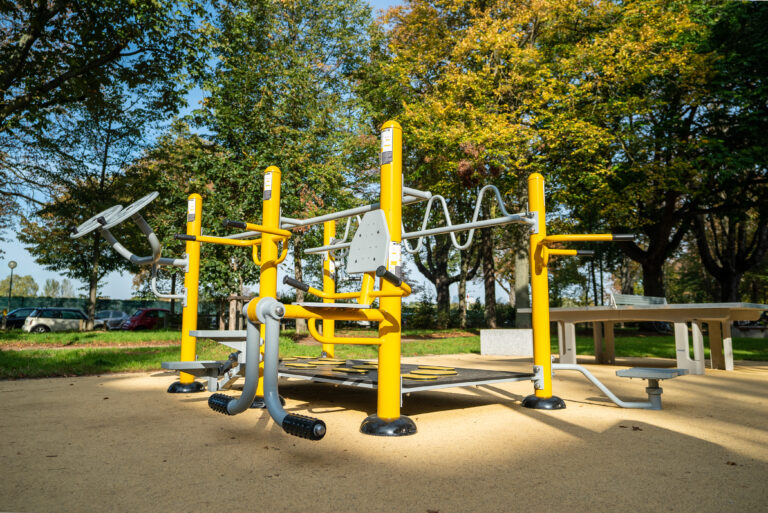
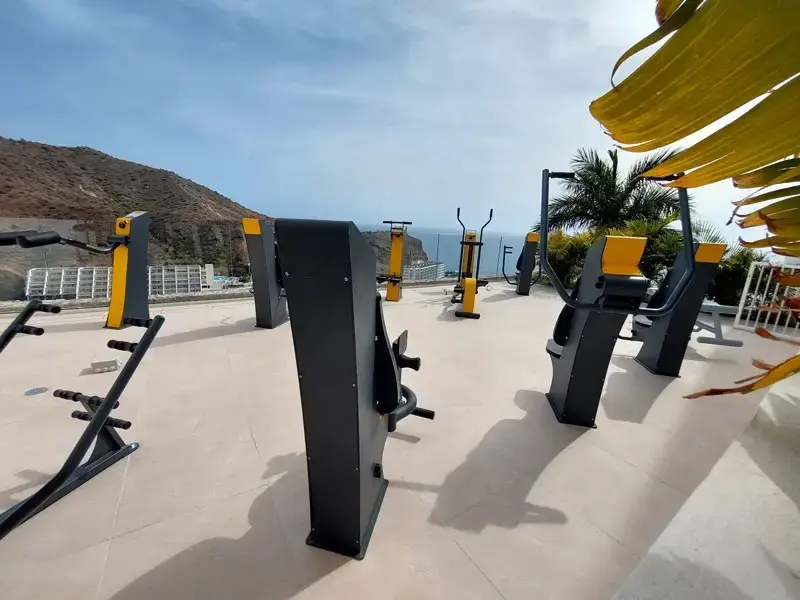
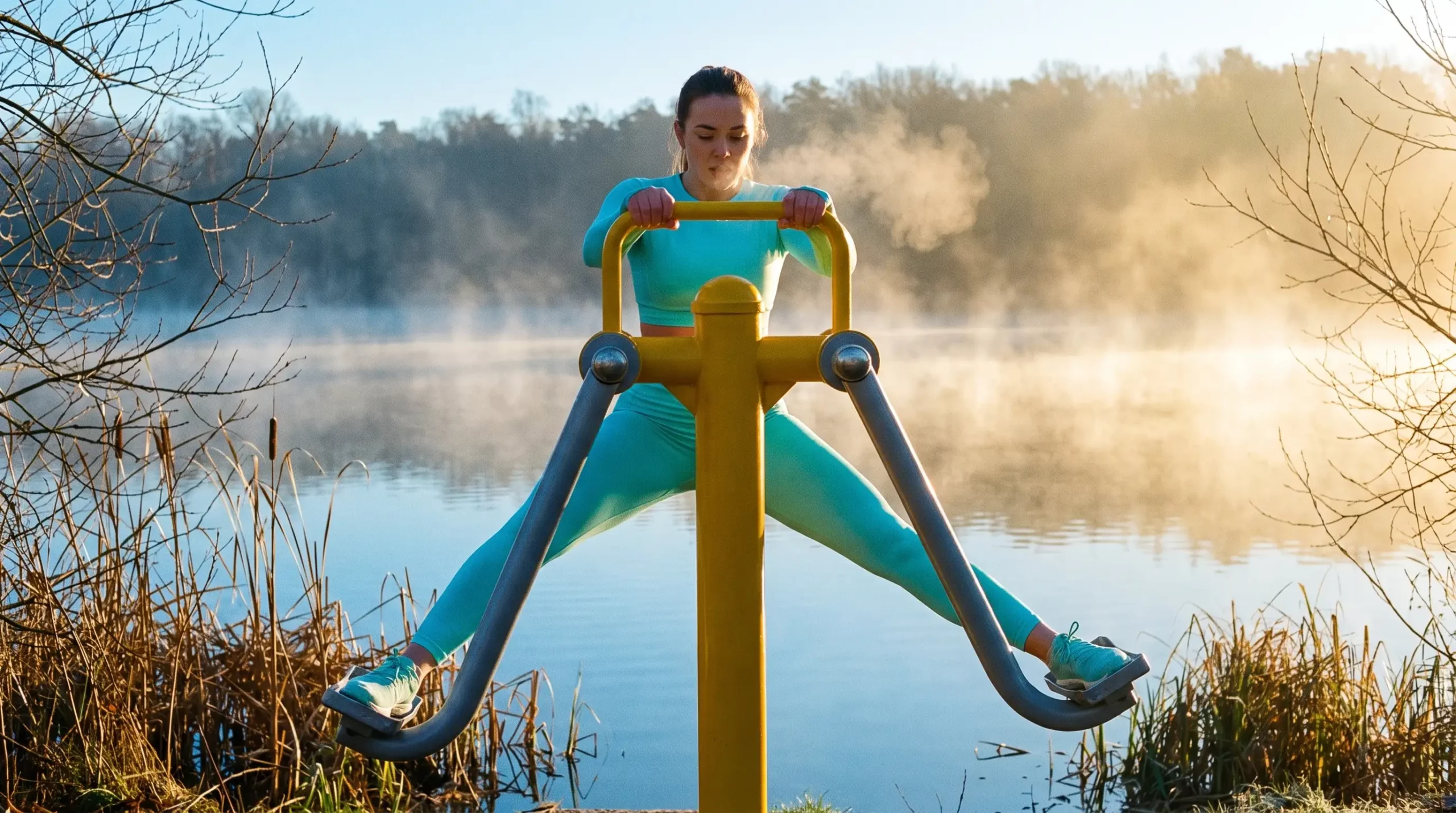
The adductor machine is a freely accessible outdoor fitness machine designed to isolate and strengthen the thigh adductors — the inner muscles that draw the leg towards the midline of the body. On park machines, the mechanism generally relies on a system of levers or pneumatic cylinders: the user, seated or standing depending on the model, presses the legs inwards against a resistance calibrated by the manufacturer.
The two most common configurations
- Seated version: the user sits with the legs apart on either side of moving pads and closes the legs against the machine’s resistance
- Standing lateral version: the user stands with one leg attached to a lever arm and brings the leg back towards the midline against resistance
Most park machines actually combine two movements on the same station: adduction (bringing the legs together) and abduction (spreading the legs apart), with the same machine usable in both directions depending on the starting position.
The muscles targeted by the outdoor adductor machine
The adductor group comprises five main muscles on the inner side of the thigh. Their shared function is to draw the leg towards the midline of the body, but each contributes differently depending on the angle of the hip and the degree of knee flexion.
| Muscle | Location | Main function | Worked by |
| Adductor longus | Inner side, superficial | Main hip adduction | Any adduction variation |
| Adductor brevis | Beneath the adductor longus | Adduction, pelvic stabilisation | Full range |
| Adductor magnus | The largest of the group | Powerful adduction, hip extension | High resistance, full range |
| Gracilis | The longest, running to the knee | Adduction, knee flexion | Straight-leg position |
| Pectineus | Deep, close to the groin | Adduction, hip flexion | Start of the movement, small range |
Why this muscle group is so often neglected: the adductors are not significantly loaded by any common everyday movement (walking, climbing stairs). The result is a frequently underdeveloped muscle group, even among people who regularly use other outdoor fitness machines.
Why strengthen the adductors: functional and sporting benefits
Preventing groin injuries
The adductors are one of the most frequently injured muscle groups in sports involving rapid changes of direction (football, rugby, tennis, skiing). A landmark sports medicine study (Tyler et al., 2001, American Journal of Sports Medicine) showed that a strength deficit in the adductors relative to the abductors is associated with a higher risk of groin injury in ice hockey players — a principle that carries across to many pivoting sports.
Pelvic stability and posture
The adductors actively help stabilise the pelvis during walking, running and single-leg support. Targeted strengthening improves postural control, which is particularly useful for runners and for anyone practising balance-based sports.
Complementing abductor and quadriceps work
Isolated adductor work, alongside quadriceps strengthening (via the leg extension for example) and abductor work, delivers complete muscular balance in the thigh. This trio reduces the risk of imbalances that can affect knee and hip stability over the long term.
Worth remembering
The adductors are not just an aesthetic matter. Strengthening them has documented preventive value for athletes in activities involving frequent changes of direction.
Correct technique on the outdoor adductor machine
Seated position (the most common configuration in parks)
- Sit on the machine, back straight against the backrest if it has one
- Place your legs on either side of the pads or levers, knees slightly bent
- Breathe out as you bring the legs inwards, until the pads touch or the machine reaches its maximum range
- Hold the contraction for 1 second in the closed position
- Breathe in as you return slowly to the starting position, over 2 to 3 seconds
Decisive technical points
- The back must stay straight throughout the movement: do not lean the torso forward to “help” the movement
- The movement must come from the hip, not from a rotation of the pelvis
- Control the return phase (abduction): letting it fly back under the machine’s resistance sharply reduces the effectiveness of the muscular work
- Breathe normally, without holding your breath at the end of the contraction
Common mistake
Using momentum from the torso or arms to “help” close the legs. This compensation reduces the actual load on the adductors and can create unwanted tension in the lower back.
A progressive training programme on the outdoor adductor machine
As with most fixed-resistance outdoor fitness machines, progression is built through volume, tempo and frequency, not by adding load.
| Level | Sets × reps | Tempo | Weekly frequency | Rest between sets |
| Beginner | 3 × 15 | 1-1-2 | 2 times/week | 45 sec |
| Intermediate | 4 × 12 | 2-1-2 | 2 to 3 times/week | 40 sec |
| Advanced | 4 × 15 + isometric finish | 1-2-3 | 3 times/week | 30 sec |
Isometric finish to the last set
For advanced users, finishing the last set with a 15 to 20 second isometric hold in the closed position (legs together) intensifies the muscular work without adding joint load. This variation is also recommended when returning after groin discomfort, provided there is no pain.
Fitting the adductor machine into a full park session
The outdoor adductor machine should not be worked in isolation with no regard for the whole muscular chain of the thigh. A balanced session includes it alongside the other machines available on the fitness area.
Example of a full leg session (30 min)
| Order | Exercise / machine | Volume | Objective |
| 1 | Warm-up: hip mobility and brisk walking | 5 min | Joint preparation |
| 2 | Leg extension (quadriceps) | 3 × 12 | Strengthening the front of the thigh |
| 3 | Outdoor adductor machine | 3 × 15 | Strengthening the inner thigh |
| 4 | Outdoor abductor machine (if available) | 3 × 15 | Agonist/antagonist balance |
| 5 | Bodyweight lunges | 2 × 10 per leg | Functional multi-joint work |
| 6 | Adductor and quadriceps stretches | 5 min | Recovery, flexibility |
Recommended order: always work the adductors after a compound exercise (lunges, squats) if your session includes one, or right at the start of the isolation block if the session only uses machines. Pre-fatigued adductors compromise stability during any balance exercises that follow.
The adductor machine and rehabilitation: what to know
The adductor machine is sometimes recommended by physiotherapists when rehabilitating after groin pain syndrome or a mild adductor muscle strain, during the gradual return phase. Its fixed, guided resistance makes it a useful tool for controlled work, provided certain principles are respected.
Principles for a safe return
- Never resume adductor work while there is acute groin pain
- Start with a reduced range and resistance that feels light — even if the machine does not allow you to reduce the mechanical resistance, limit the range of movement rather than the load
- Favour isometric work at the start of the return: less tissue strain than dynamic work
- Progress over several weeks before returning to a normal training volume
- Consult a physiotherapist or sports doctor before resuming after a diagnosed injury
Point to watch
Pain that appears or intensifies during or after using the outdoor adductor machine should lead you to stop the exercise and, if it persists, to seek medical advice. Never keep training “to push through the pain” with this type of injury, which is known for becoming chronic when the return is too early or too intense.
Adductor machines built for intensive outdoor use
The mechanical quality of an outdoor adductor machine directly determines the quality of the muscular work you can do: smoothness of the resistance, no play in the mechanical joints, ergonomic adjustment for different body sizes. A poorly designed machine can produce jerks in the resistance that undermine control of the movement and increase the risk of postural compensation.
Herkules Fitness adductor machines are EN 16630 certified and sized to accommodate a wide range of user body types, with a resistance system calibrated for progressive, safe work — both for regular training and in a supervised rehabilitation context.
Frequently asked questions about the outdoor adductor machine
How long does it take to see results on the outdoor adductor machine?
The first neuromuscular adaptations (better control and functional strength) are noticeable after 3 to 4 weeks of regular training (2 sessions a week). A visible change in muscle tone generally takes 8 to 12 weeks of consistent practice, combined with suitable nutrition if your goal includes an aesthetic dimension.
Does the outdoor adductor machine burn inner thigh fat?
No. Like any localised strength exercise, the adductor machine strengthens the underlying muscle but does not specifically target fat loss in that area (the idea of “spot reduction” is not supported by the scientific literature in exercise physiology). Reducing body fat comes from an overall calorie deficit, achieved through diet and overall physical activity, not from an exercise targeting one specific zone.
Can you use the outdoor adductor machine every day?
It is not recommended. Like any muscle group trained against resistance, the adductors need 48 hours of recovery between sessions to allow muscle rebuilding. Daily use at significant intensity increases the risk of adductor tendinopathy without adding any benefit over a frequency of 2 to 3 sessions a week.
Is the outdoor adductor machine suitable during pregnancy?
Adductor work during pregnancy should be approached with caution, particularly from the second trimester onwards, because of the physiological ligament laxity (relaxin secretion) that increases pelvic mobility and can contribute to pelvic pain if the exercise is poorly controlled. Advice from the midwife or obstetrician following the pregnancy is recommended before adding this machine to a physical activity routine during pregnancy.
Should you stretch the adductors after every session?
Light adductor stretching after training helps maintain hip range of motion, but its effect on preventing soreness or injury remains debated in recent scientific literature. A gentle static stretch of 20 to 30 seconds at the end of a session is a reasonable practice, as long as you do not expect miracles from it in terms of muscle recovery.