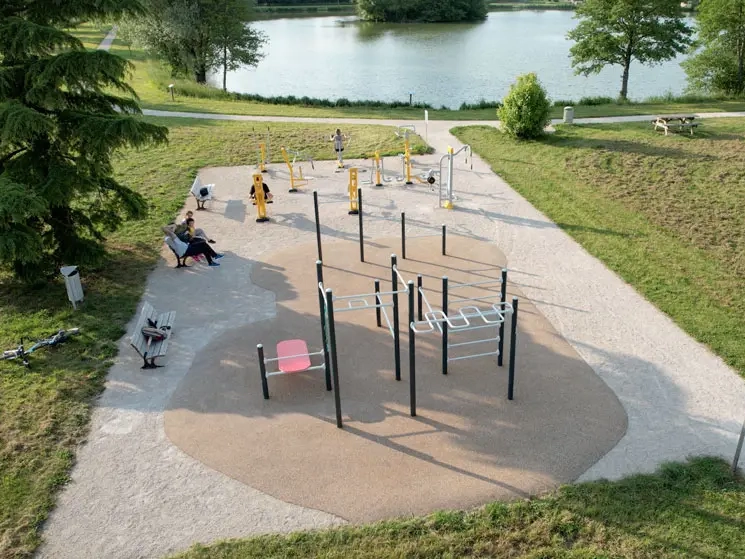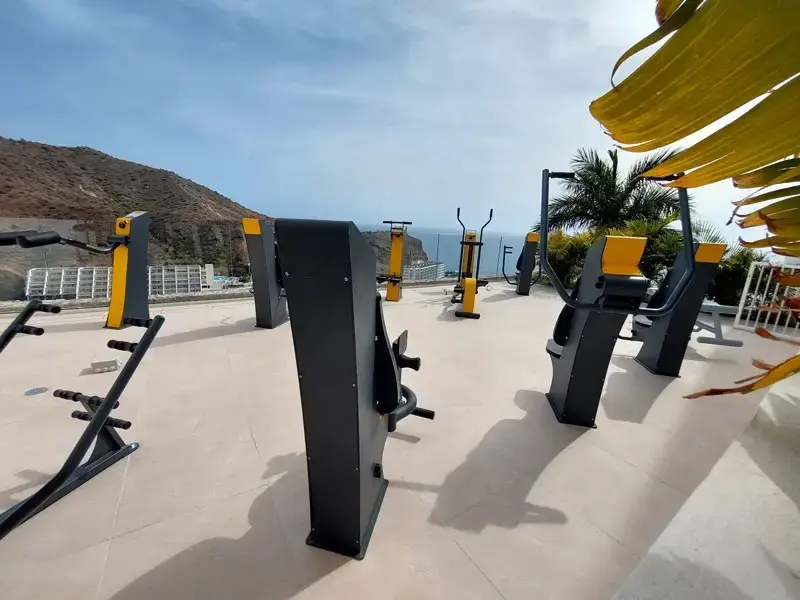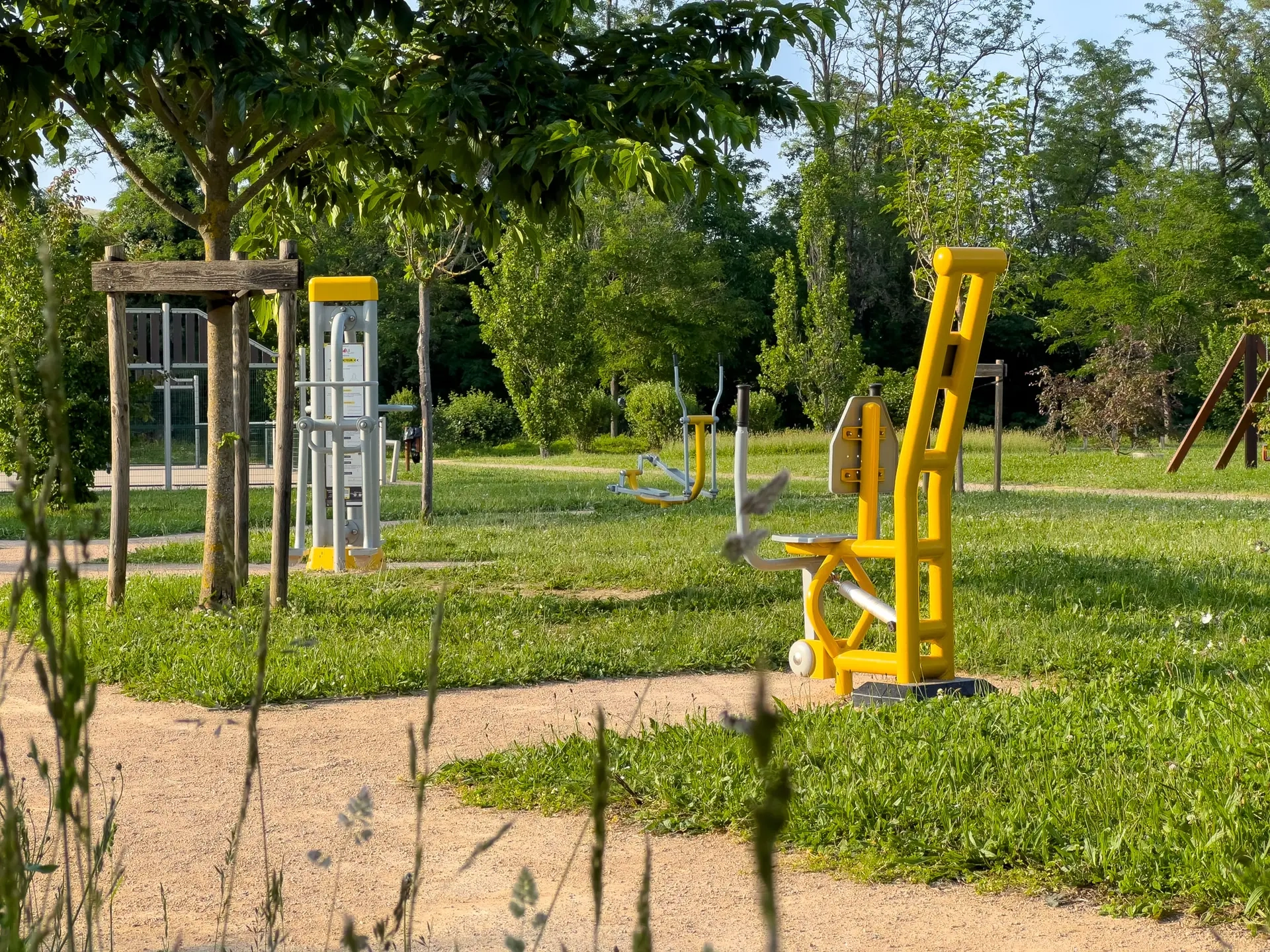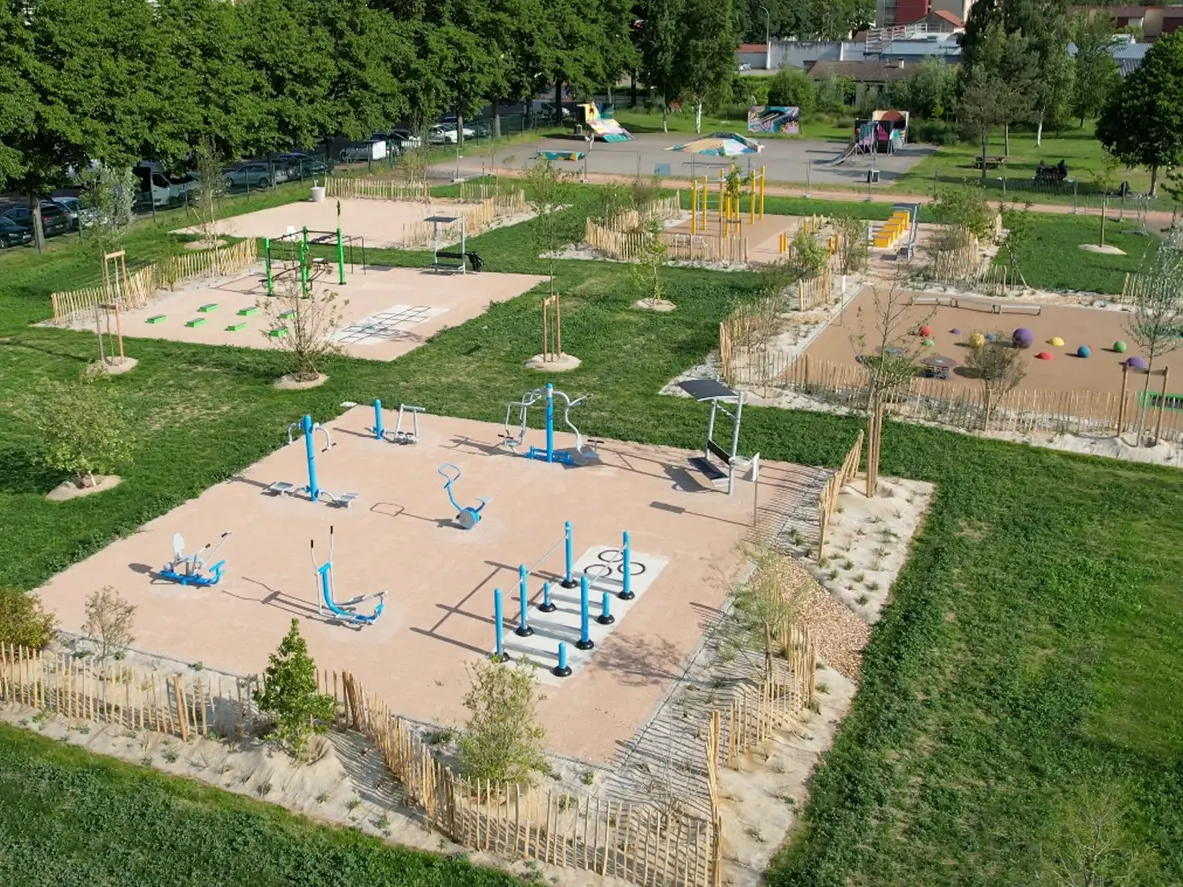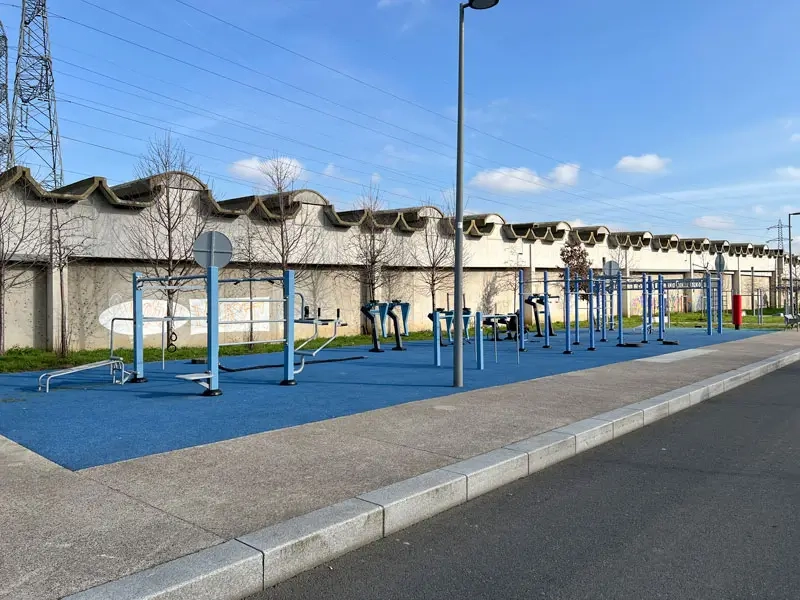

Making outdoor fitness equipment available to the public — whether urban fitness machines, street workout structures or trim trails — engages the legal liability of the local authority or the organisation managing the site. Yet one obligation that directly conditions that liability is still too often overlooked: the annual inspection report. Who is qualified to write it? What regulatory weight does it carry? And what budget should a manager of an outdoor sports area reasonably allow for it?
Key takeaways:
- The annual inspection is essential: a report compliant with EN 16630 is a key piece of evidence of sound management of outdoor fitness equipment and protects the operator in the event of an accident.
- Several parties can carry it out: accredited inspection bodies, trained manufacturers/installers or certified in-house technicians, provided they can evidence the required competence.
- The report must be complete and documented: condition of structures, anchorages, wear parts, safety zones, criticality level of each defect and recommended actions.
- Costs stay predictable and can be optimised: typically between €150 and €700 per site, with savings available through bundled or multi-year contracts.
- The annual inspection is not enough on its own: it must be backed by routine visual inspections and operational inspections to deliver effective preventive maintenance.
Why is the annual inspection report mandatory?
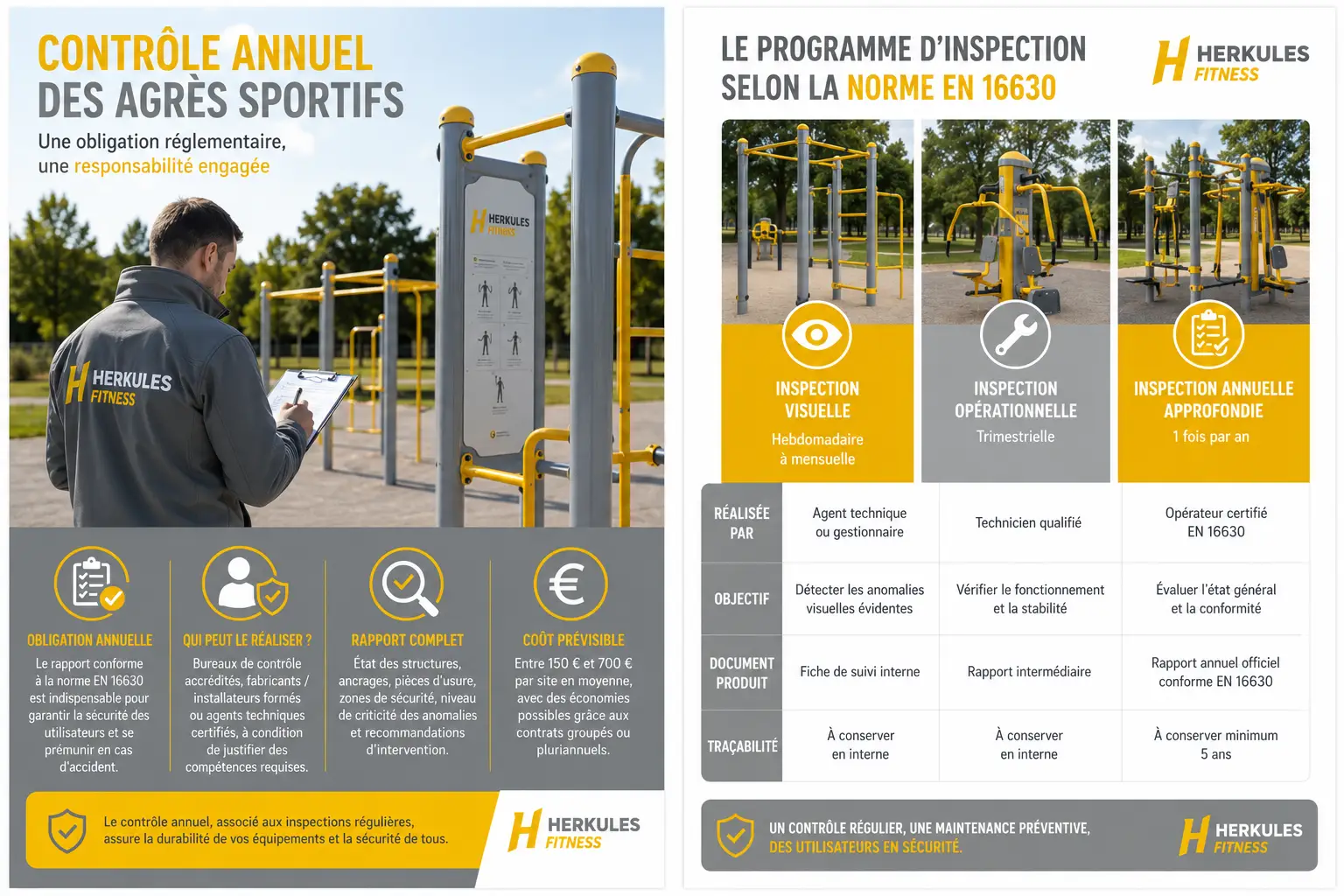
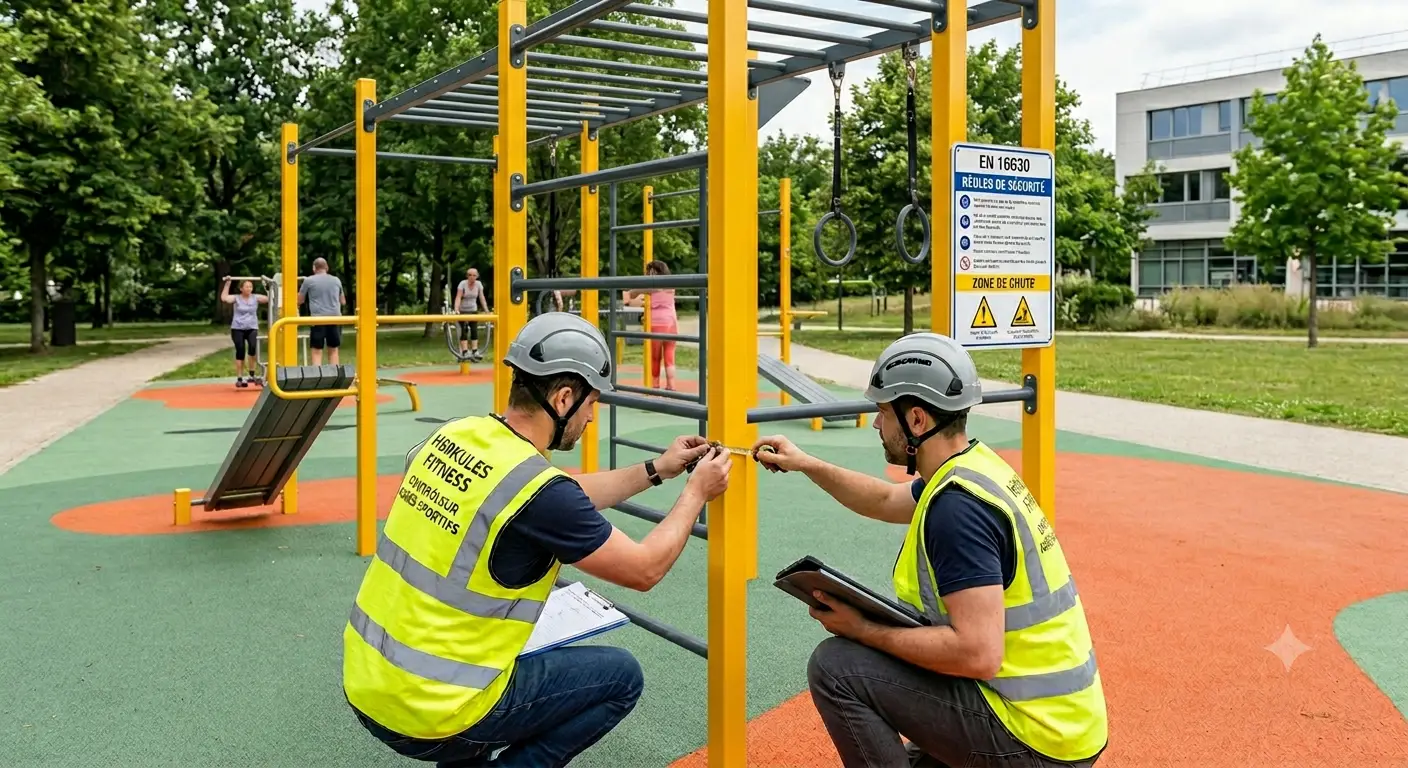
The European standard EN 16630 is the reference framework for fitness equipment installed in public spaces. It requires a three-tier inspection programme — routine visual inspection, operational inspection and in-depth annual inspection — the outcome of which must be recorded in a written document.
The annual inspection is the only one that produces a legally usable report. It assesses the general condition of the structures, the strength of the anchorages, wear on moving parts, compliance of spacings and surfaces, and any potential injury risk linked to equipment deterioration.
If an accident occurs on equipment that has not been inspected, or has been inspected by an unqualified operator, the local authority is exposed to claims for failure to maintain or lack of due diligence. The annual inspection report is therefore a cornerstone of the risk management file.
Worth remembering
EN 16630 applies to all freely accessible fitness equipment installed in public spaces or on private land open to the public.
The absence of an annual report can trigger the civil and criminal liability of the operator in the event of an accident.
Who can carry out the annual inspection report?
This is where confusion is most common: EN 16630 does not reserve the annual inspection for a single type of provider. It does, however, require the inspector to hold recognised technical competence and a thorough knowledge of the applicable standards.
Accredited inspection bodies
Technical inspection bodies (TÜV, Bureau Veritas, SGS, Dekra, Apave and their regional equivalents) are the providers most frequently used by local authorities, particularly under multi-site public contracts. Their involvement offers maximum traceability and each body carries its own professional indemnity cover. Their reports are standardised, dated, signed and easy to archive in line with the requirements of municipal technical departments.
Approved manufacturers and installers
Most manufacturers of outdoor sports equipment offer an annual inspection service delivered by technicians trained specifically on their product ranges. This option brings detailed mastery of wear parts, manufacturer tolerances and replacement recommendations. It is particularly well suited when the entire estate comes from a single supplier.
Important: a manufacturer’s technician trained on EN 16630 can legitimately sign an annual inspection report. That report carries the same regulatory weight as one issued by an accredited body, provided the competence is documented.
In-house technicians: conditions and limits
Some municipalities or sports organisations consider entrusting the annual inspection to their own technical staff. This is technically possible if the officer has completed certified training on EN 16630 and can evidence their level of competence. In practice, this option is not advisable for large or heterogeneous equipment estates, as it does not offer the same guarantees of impartiality and traceability as an external inspection.
| Type of operator | EN 16630 competence | Weight of the report | Recommended for |
| Accredited inspection body | Certified | High / legally usable | Large estates, public contracts |
| Approved manufacturer / installer | Range-specific | High if trained | Single-supplier estates |
| Trained in-house technician | Variable | Moderate | Top-up checks, isolated sites |
What must a compliant annual inspection report contain?
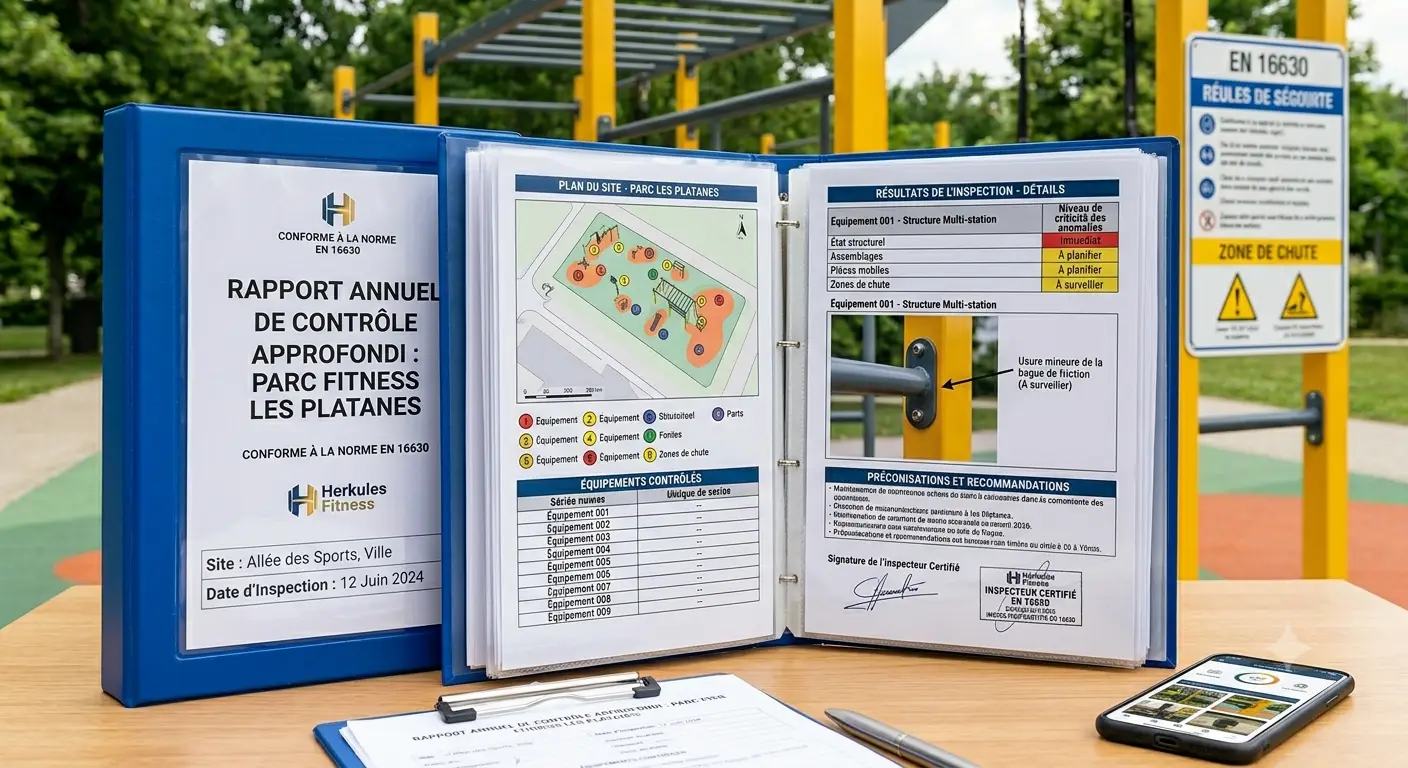
An annual inspection report compliant with EN 16630 must include the following elements, without exception:
• Precise identification of each item of equipment inspected (reference, serial number, installation date)
• The date and conditions of the inspection (weather, accessibility, load on the equipment at the time of the check)
• Assessment of structural condition: anchorage, welds, corrosion, deformation
• Assessment of moving parts and contact surfaces (wear, excessive play, sharp edges)
• Verification of spacings and fall zones (compliance with manufacturer specifications)
• Classification of every defect by criticality level (immediate / to be scheduled / to be monitored)
• Recommendations for making safe or replacing, with an indicative deadline
• The inspector’s signature and qualifications
Any report that does not cover all of these points is incomplete and will not allow the operator to be released from liability in the event of a claim.
How much does an annual inspection report cost?
The cost of an annual inspection varies with several factors: the number of items inspected, the complexity of the site (accessibility, multiple locations), the type of provider chosen, and the geographical area. Here is an indicative price guide:
| Context | Indicative cost per visit | Cost per item |
| 1 to 5 items, single site | €150 – €350 | €60 – €80 |
| 6 to 20 items, single site | €300 – €700 | €35 – €55 |
| Multi-site, 20+ items | On quotation | €20 – €40 |
| Annual maintenance contract included | From €500/year | Variable |
These prices are indicative (excluding VAT, for Western Europe). Bundled contracts covering the annual inspection, quarterly operational inspections and corrective maintenance work generally deliver savings of 30 to 40% compared with services ordered separately.
Optimising your inspection budget: the levers to pull
• Group several sites into a single tender to benefit from economies of scale
• Include the inspection service in the tender specifications from the equipment purchase stage
• Opt for a multi-year contract (2 to 3 years) that smooths the cost and guarantees continuous traceability
• Check whether the manufacturer offers a maintenance/inspection package with extended warranty
How often should intermediate inspections take place?
The annual report does not replace the intermediate inspections required by EN 16630. The full inspection programme breaks down as follows:
| Type of inspection | Frequency | Carried out by | Document produced |
| Visual inspection | Weekly to monthly | Technical officer or site manager | Internal monitoring sheet |
| Operational inspection | Quarterly | Qualified technician | Interim report |
| In-depth annual inspection | Once a year | EN 16630 certified operator | Official annual report |
A lack of regular visual inspection often leads to undetected deterioration that surfaces at the annual inspection with a high criticality level, and therefore a higher repair cost. A preventive approach is economically more rational than curative management.
Points to watch for municipalities, care homes and schools
Municipalities and local authorities
Equipment installed on public land or in municipal parks falls directly under the responsibility of the local authority’s executive. The annual inspection report should be kept for at least 5 years and produced in the event of a claim or an audit. For accessible areas designed for people with reduced mobility, additional accessibility checks may be required under local planning rules and universal accessibility standards.
Care homes and medico-social facilities
Equipment adapted to elderly residents (gentle mobility machines, light rehabilitation trails) deserves particular attention during the annual inspection: wear tolerances are stricter given the fragility of the users. Some specialist insurers covering care homes require the annual report to be produced in order to maintain the facility’s public liability cover.
Schools
In playgrounds and school sports areas, intensive use justifies a weekly visual inspection and an operational inspection at the start of each school year. The annual report must be sent to the public body that owns the premises, which is responsible for keeping it on file.
How Herkules Fitness supports its clients with inspections
Herkules Fitness offers its institutional clients end-to-end support that goes beyond supplying and installing EN 16630 certified equipment. Our technical teams can take charge of the annual inspection of your outdoor fitness equipment, produce a report that meets regulatory requirements, and send you a preventive maintenance plan tailored to how your installations are actually used.
Whether you manage a multi-sports court, a trim trail or a senior fitness area, we help you structure your inspection policy, anticipate renewal costs and document your due diligence against your legal obligations.
Frequently asked questions about the annual inspection of outdoor fitness equipment
Is EN 16630 legally mandatory?
EN 16630 is a harmonised European standard. In most European countries it is not directly written into statute, but it is the technical benchmark recognised by insurers, courts and public authorities to demonstrate that the operator has met its safety obligations. In practice, applying it is unavoidable for any operator wishing to be released from liability.
What happens if a piece of equipment is deemed dangerous during the annual inspection?
The inspection report ranks defects by urgency. A critical failure requires the equipment concerned to be taken out of service immediately. A moderate-risk defect generally comes with an intervention deadline of 30 days. The equipment must be locked out (access blocked) until it is repaired or replaced, and a lock-out removal report must be produced.
Does the annual inspection report cover equipment renewal?
No. The annual inspection report assesses the condition of existing equipment and recommends actions. It does not replace a planned renewal policy. That said, successive reports build a valuable dataset for anticipating replacement cycles and making the case for budget allocations.
Is a separate report needed for each item or for each site?
Common practice is to produce one overall report per site, with an individual record sheet for each item. For multi-site estates, each site has its own dated and archived report. Some managers opt for a centralised dashboard covering the whole estate, but every site must still hold its own documentation, whether physical or digital.