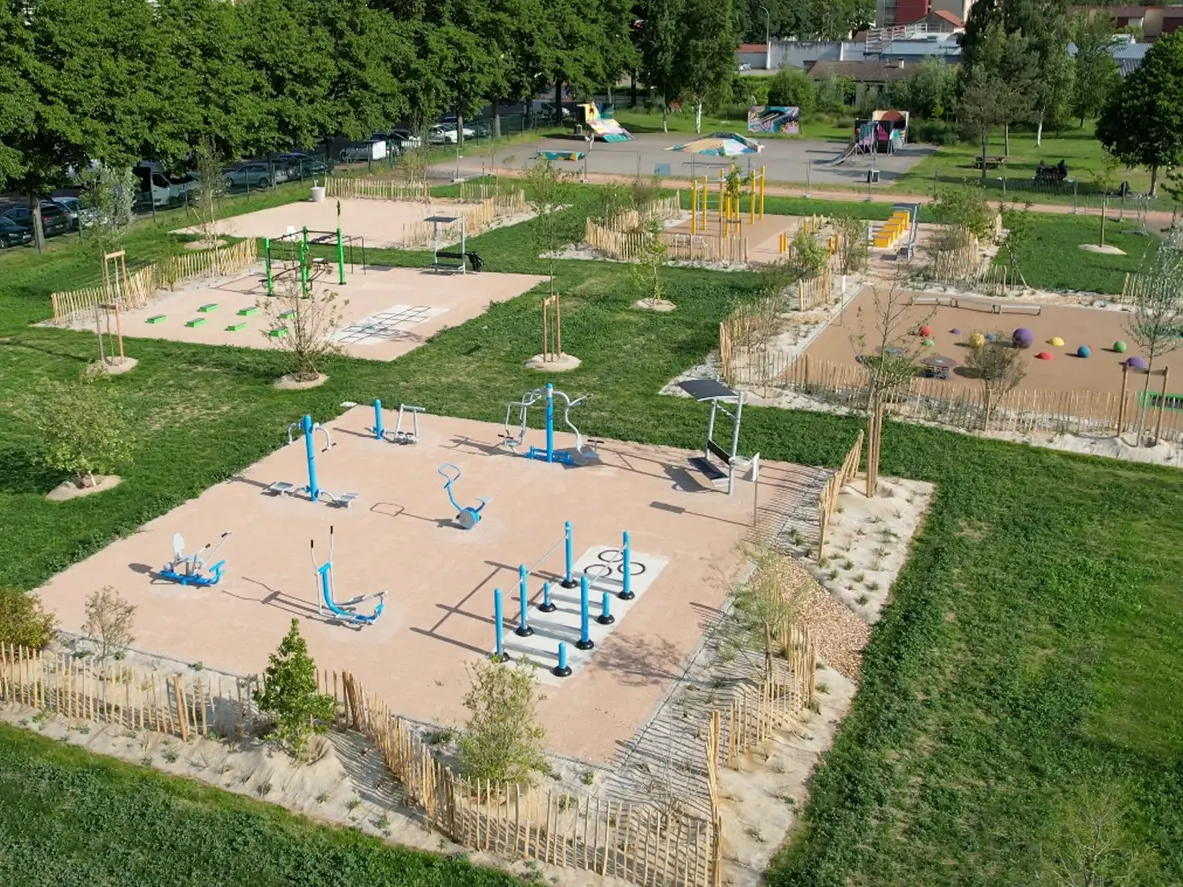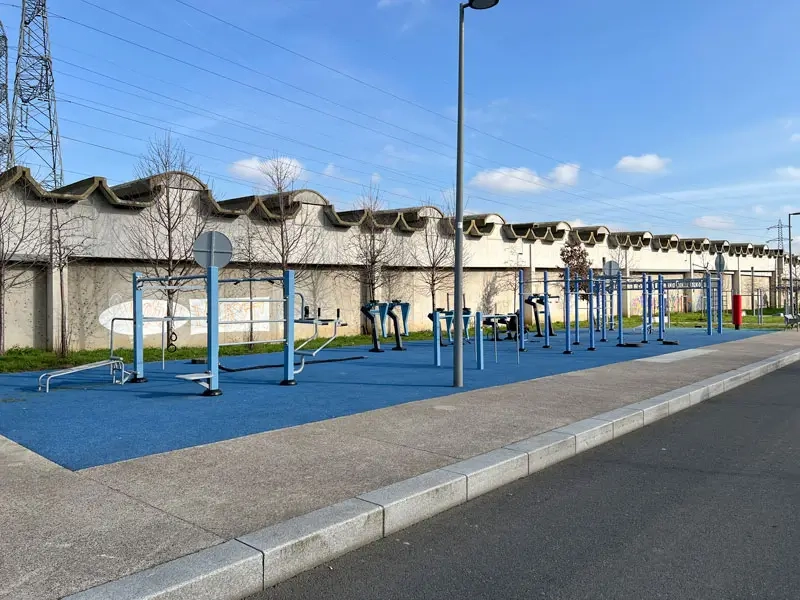

Installing an outdoor fitness area is not just about choosing certified equipment and anchoring it correctly. The signage that goes with it is a regulatory obligation in its own right, and one that project owners and managers of public sports facilities frequently underestimate. Missing or inadequate signage can directly engage the civil and criminal liability of the operator in the event of an accident.
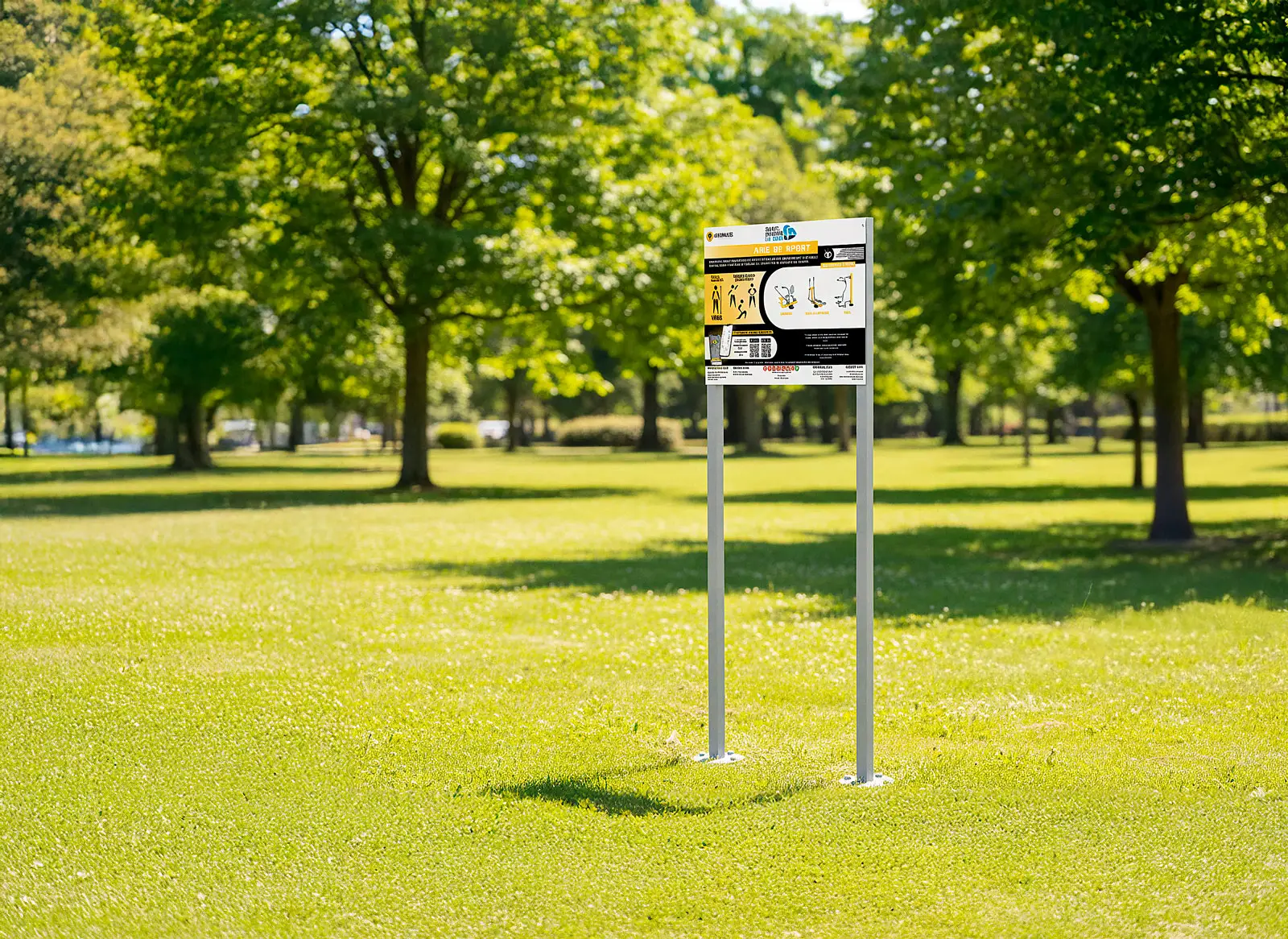
This article reviews the mandatory signs and information, the rules that frame them, and best practice for signage that stays compliant and durable — whether you are a municipality, a care home, a school or a private operator of a sports facility.
Key takeaways:
- Signage is a regulatory obligation: compliance rests in particular on the EN 16630 standard, on local authority safety duties and on accessibility rules for people with reduced mobility.
- Every item of equipment must carry its own information: how to use it, safety instructions, contraindications and the operator’s contact details must be clearly displayed.
- A general sign at the entrance is essential: it covers the rules of use, safety instructions, emergency numbers and useful contacts.
- Inadequate signage can engage the operator’s liability: in the event of an accident, its absence, illegibility or poor upkeep can be held against the operator as a fault.
- Signs must be maintained and matched to the audience: children, older adults, people with disabilities and foreign visitors all call for specific information, regularly updated.
The regulatory framework for signage in a fitness area
In most European countries there is no single text codifying every signage obligation for an outdoor fitness area. These obligations come from the intersection of several normative and regulatory sources that you need to know.
The EN 16630 standard
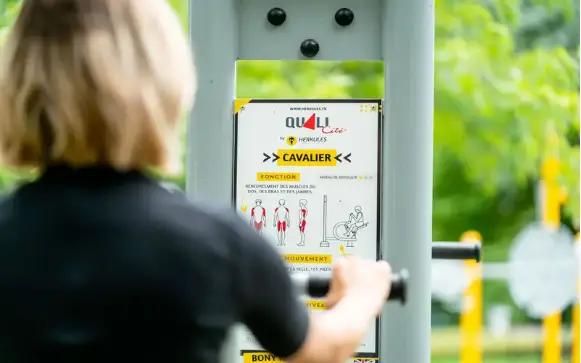
The essential technical reference for freely accessible fitness equipment, EN 16630 states that the installer and the operator must provide, immediately next to the equipment, information allowing the user to identify the outdoor fitness machine, understand how to use it correctly and be warned of potential risks. The standard does not prescribe a fixed format, but it defines a minimum content that signage must cover.
Local authority safety duties
Across Europe, local government law places on the authority a duty to ensure the safety and usability of facilities open to the public. In practice this general safety obligation translates into a duty to inform users, and on outdoor sports equipment signage is the main way of discharging it.
Accessibility rules
For areas accessible to people with reduced mobility, signage must also comply with national accessibility legislation and the European Accessibility Act: standardised pictograms, suitable mounting height, and visual contrast sufficient for users with impaired vision.
Worth remembering
No single text brings all the obligations together: compliance is assessed by combining EN 16630, local government safety duties and accessibility rules.
In a dispute, courts consistently refer to the EN 16630 standard as the benchmark for safety, even where no explicit statutory text exists.
Mandatory information on each machine
EN 16630 requires an information panel to be fixed to each item of equipment or in its immediate surroundings. That panel must include at least the following:
| Mandatory information | Detail required | Recommended format |
| Identification of the machine | Name or reference of the equipment, manufacturer | Plate fixed to the machine or an adjacent post |
| Correct use | Description of the movement and starting position | Pictogram + short text |
| Contraindications | Minimum age, medical conditions to avoid, pregnancy | Prohibition pictogram + text |
| Safety warning | Risk of falling, footwear recommended | Pictogram + short text |
| Operator contact | Number or email for reporting a fault | Text legible from 1 metre |
Note: a general sign at the entrance to the area does not remove the need for individual signage on each machine. The two levels are complementary, not interchangeable.
The main site entrance sign: content and location
Alongside individual signage on the machines, a general sign must be placed at the entrance to the area or at a visible main access point. This sign provides overall information and makes users aware of their own responsibility.
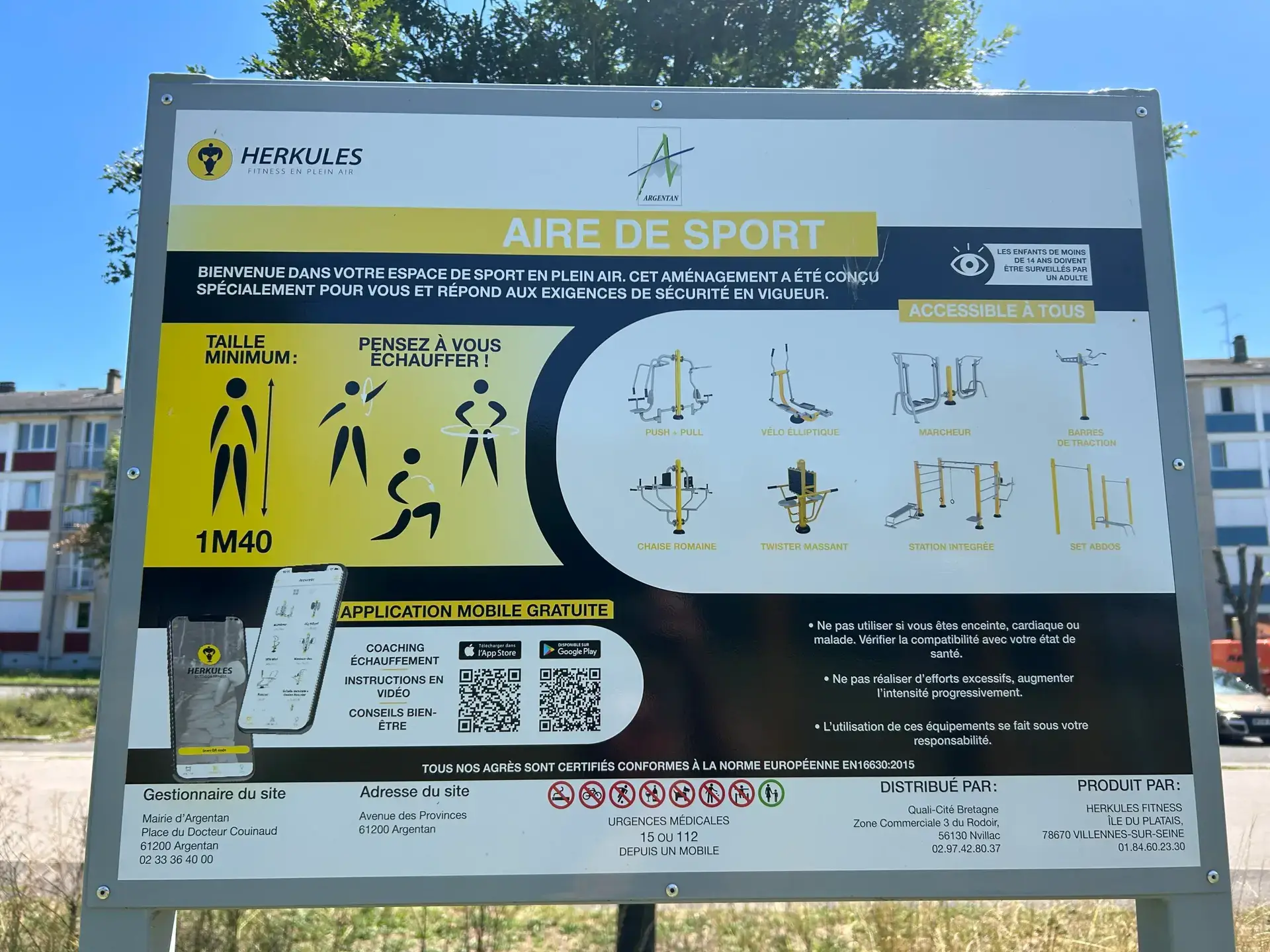
Recommended content for the entrance sign
• Name and identification of the site (municipality, operator, land registry reference where applicable)
• Rules of use: permitted age groups, opening hours if access is controlled, prohibited behaviour
• General safety warnings: use at your own risk, medical advice recommended, no unaccompanied children under 14 on certain machines
• Emergency number (112) and the precise address of the site so that emergency services can be directed quickly
• Operator contact for reporting damage or a fault
• Date of the last compliance inspection (optional but strongly recommended, as it evidences the operator’s diligence)
Location and dimensions
The entrance sign must be visible as soon as you reach the area, with no planting or structure blocking it. The recommended mounting height is between 1.40 m and 1.60 m (centre of the sign), which suits reading while standing and meets accessibility requirements. Practical minimum dimensions are 40 × 60 cm to guarantee legibility from a distance.
Practical tip
Leave a dedicated space on the sign for the date of the last inspection and the date of the next one. This reassures users and demonstrates a proactive approach should a dispute arise.
Signage and liability: what the courts say
Administrative and civil case law is consistent on this point: the absence of adequate signage is a fault in the organisation of a public service or in the duty of supervision, and it can engage the operator’s liability even where the accident results from careless use by the user.
Common grounds for claims
• No age contraindication on a machine unsuitable for children
• A damaged or illegible sign not replaced within a reasonable time after being reported
• No signage on a piece of equipment that is out of service and has not been cordoned off
• Safety information written in the local language only on a site used by an international public (tourist parks, seaside areas)
One key principle from case law: signage must be matched to the real users of the area, not just its theoretical users. A fitness area installed next to a nursery school calls for reinforced signage on the risks to young children, even if the equipment is not formally intended for them.
The duty to maintain signage
Signage is not a static item installed once and forgotten. It is an integral part of the maintenance plan for the area. As such, it must be included in routine visual inspections (checking legibility, integrity of the supports, absence of graffiti or damage) and replaced systematically whenever it is damaged.
Specific signage by type of audience
Signage obligations vary with the profile of the people using the area. Three contexts deserve particular attention.
Mixed adult/child areas
Where the outdoor fitness area sits in a multi-use space used by children (municipal park, neighbourhood green space), the signage must state explicitly the recommended minimum age for each machine. Most EN 16630 compliant manufacturers recommend a minimum age of 14 for active fitness equipment. This information must be visible and unambiguous.
Care homes and medico-social facilities
On areas intended for or accessible to older or dependent people, signage must include adapted pictograms (larger type size, stronger contrast) and state explicitly the recommendation to exercise with a companion present for residents with reduced mobility. Some specialist care home insurers make cover conditional on this specific signage being in place.
Accessible sites
For areas designed or certified for users with disabilities, signage must comply with national standards for street furniture and accessibility, as well as public guidance on the accessibility of outdoor sports spaces. Standardised “accessibility” pictograms must appear on the machines suitable for users with reduced mobility.
| Type of site | Specific signage required | Reference standard / rule |
| Mixed public park | Minimum age per machine, behaviour rules | EN 16630, local authority safety duty |
| Care home / senior residence | Larger type, companion recommended, emergency numbers | EN 16630, insurer recommendations |
| Accessible area | Accessibility pictograms, adapted mounting height | National accessibility law, street furniture standards |
| Multilingual tourist site | Risk and emergency information in 2+ languages | Local safety duty + case law |
Sign materials and durability: what to plan for
Compliant signage is not measured by its content alone. The durability of the materials is a decisive criterion, particularly outdoors where signs are exposed to UV, weather, vandalism and thermal shock.
Recommended materials
• Anodised or powder-coated aluminium: corrosion resistant, service life of more than 10 years outdoors, can be re-screenprinted
• Stainless steel (316L): recommended in coastal areas or where exposure to salt is high (outdoor pools, seafronts)
• High-density polyethylene (HDPE): an economical option for replaceable panels, UV resistant but less rigid
• Screenprinted toughened glass: premium look, high mechanical strength, suited to sites where urban design matters
Criteria to require in the tender specification
• UV resistance: ISO 4892-2 (accelerated UV ageing)
• Corrosion resistance: ISO 9227 (salt spray, minimum 500 h)
• Guaranteed legibility: minimum 70% contrast between background and text (WCAG 2.1 level AA)
• Anti-vandalism fixings: tamper-proof screws or structural bonding depending on the support
Purchasing tip
Require in your tender specification that signage be delivered with the equipment and covered by the manufacturer’s warranty. This avoids grey areas over liability if the supports fail prematurely.
Order a spare stock of at least 10% of the panels with the initial purchase so that damaged signs can be replaced quickly.
How Herkules Fitness handles signage
At Herkules Fitness, signage is not an optional extra but a component supplied as standard with every outdoor fitness area. Our individual machine panels and site entrance signs are designed and manufactured to meet the requirements of EN 16630, on powder-coated aluminium supports with UV treatment and pictograms that follow European standards.
Our teams support project owners from drafting the tender specification through to handover, building signage into the preventive maintenance plan and into the as-built documentation handed over to the authority.
Frequently asked questions about signage
Is signage mandatory even on a private area not open to the public?
On a private area with strictly restricted access (used only by a company’s employees, for example), the regulatory obligations are lighter, but the employer’s health and safety duty of care still requires clear information about the risks of using the equipment. EN 16630 compliant signage remains the best protection in a dispute.
Does signage need to be redone when a machine is replaced?
Yes. Signage is specific to each machine (reference, instructions for use, contraindications). Replacing equipment means replacing the associated panels. Keeping old signage on a new machine with a different reference is a documented non-conformity at inspection.
What is the regulatory service life of a sign?
No fixed service life is set by the rules. The applicable criterion is actual legibility: as soon as a sign is no longer readable, or shows damage likely to mislead the user, it must be replaced. In practice, a well-maintained powder-coated aluminium sign lasts 10 to 15 years outdoors.
Do pictograms have to be in a specific language?
Standardised pictograms are universal and need no translation. The additional text (warnings, emergency contact, rules of use), however, must be readable by the site’s usual public. On tourist sites or in municipalities with a significant proportion of foreign residents, a translation into English at minimum is strongly advised to cover the operator’s liability.
Can the operator be penalised if signage is damaged by vandalism?
Damage through vandalism does not release the operator from its obligation if the signage remains illegible. What the courts assess is how quickly it was put right: rapid replacement after a report demonstrates diligence. A vandalised sign left illegible for several weeks can amount to a clear fault.