
After the age of 60, regular physical activity is no longer simply a question of aesthetics or performance: it becomes a genuine act of preventive health care. Maintaining muscle mass, preventing falls, cardiovascular health, quality of sleep, combating depression and preserving autonomy: the benefits of adapted exercise are now widely documented.
Good news: you don’t have to go to a gym to get results. An intelligent bodyweight program, performed four times a week outdoors in a health park, is enough to maintain and even improve fitness. The open air, daylight and contact with nature add valuable psychological benefits. Here’s a complete, progressive and safe program designed specifically for seniors.
Key takeaways:
- Four 30- to 45-minute sessions a week are all it takes to maintain strength, balance and endurance after 60, without equipment and entirely outdoors.
- The program alternates between four pillars: upper body, balance/mobility, lower body and gentle endurance, for a complete and progressive workout.
- Prior medical advice is essential, especially in cases of cardiovascular or joint disease, or if you are taking medication.
- Balance and falls prevention should occupy one full session a week: it’s the most protective factor for independence after the age of 65.
- Progression takes place in 2-week stages: first you increase the duration, then the number of repetitions, then the difficulty of the exercise.
| ⚠ Medical warningBefore starting this program, talk to your GP, especially if you have cardiovascular pathology, diabetes, severe osteoarthritis, osteoporosis, or are taking anticoagulant treatments. This article offers general advice and in no way replaces individualized medical advice. |

Why body weight and the outdoors are ideal for seniors
Bodyweight training offers a number of specific benefits for seniors. Firstly, it limits joint stress: no heavy loads, no sudden movements, no senior sports equipment that could slip or fall. Secondly, it naturally stimulates overall muscle chains, which are precisely those that become unconditioned with age: postural muscles, glutes, quadriceps, sheathing.
Practiced outdoors, it offers additional benefits: exposure to daylight (vitamin D synthesis, sleep regulation), support work on varied surfaces (beneficial for balance), and cognitive stimulation linked to the outdoor environment. It’s also a free activity, accessible at all hours, with no membership constraints, which encourages regularity, the first factor in long-term success.
Precautions to take before you start
While physical activity is generally beneficial at any age, there are certain situations that require particular vigilance on the part of senior citizens. Here are a few points to check before getting started.
– Get a medical check-up: over 60, and especially if you’re returning to exercise after a long break, medical advice is recommended. An exercise test may be suggested, depending on the cardiovascular context.
– Identify relative contraindications: unbalanced hypertension, rhythm disorders, recent joint prostheses, significant bone fragility. These situations are not prohibitive, but do require adaptation.
– Assess your initial level: starting slowly isn’t a weakness, it’s a strategy. It’s better to last 6 months than to injure yourself after 3 sessions.
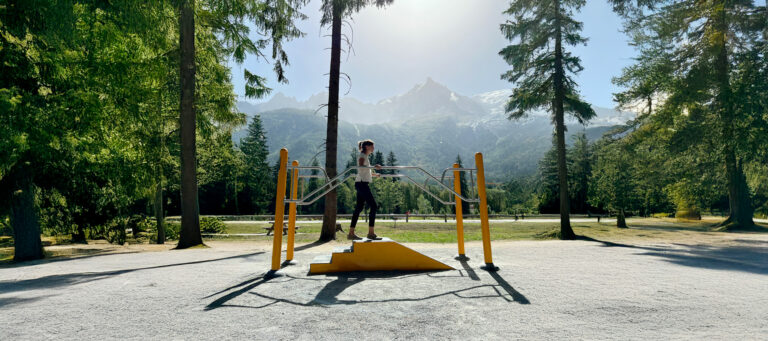
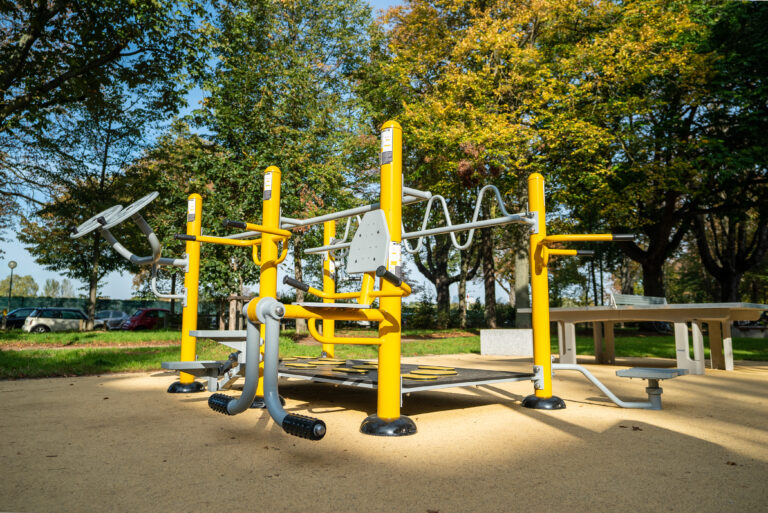
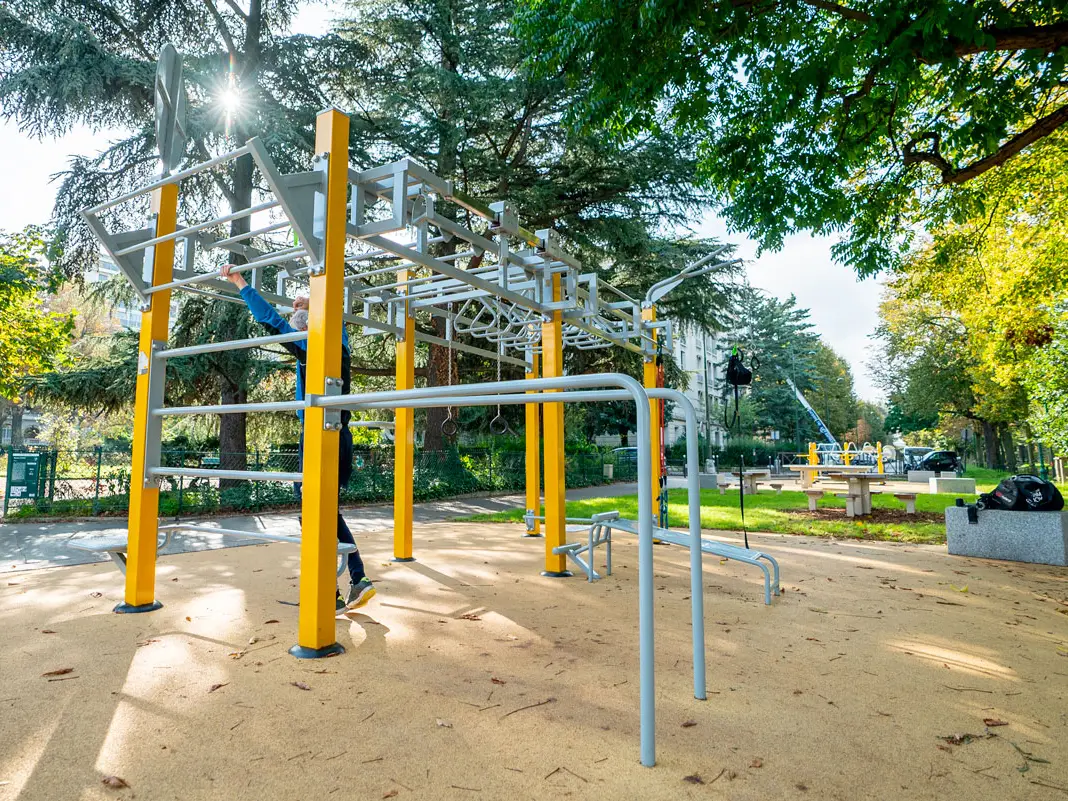
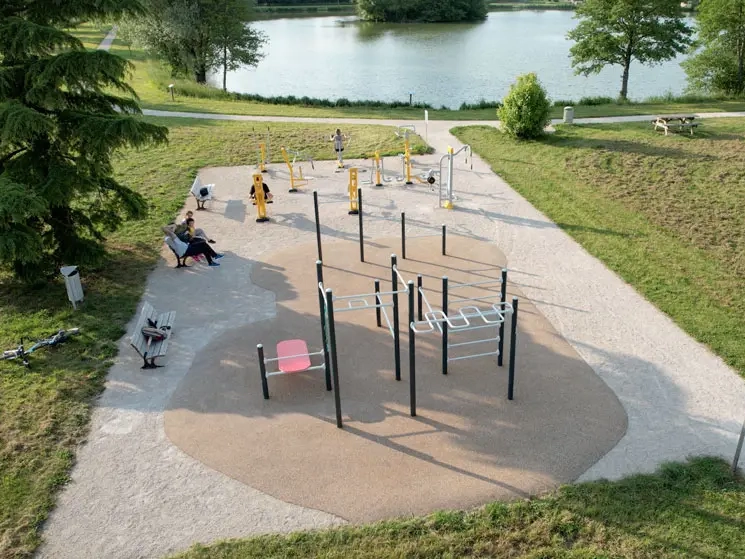
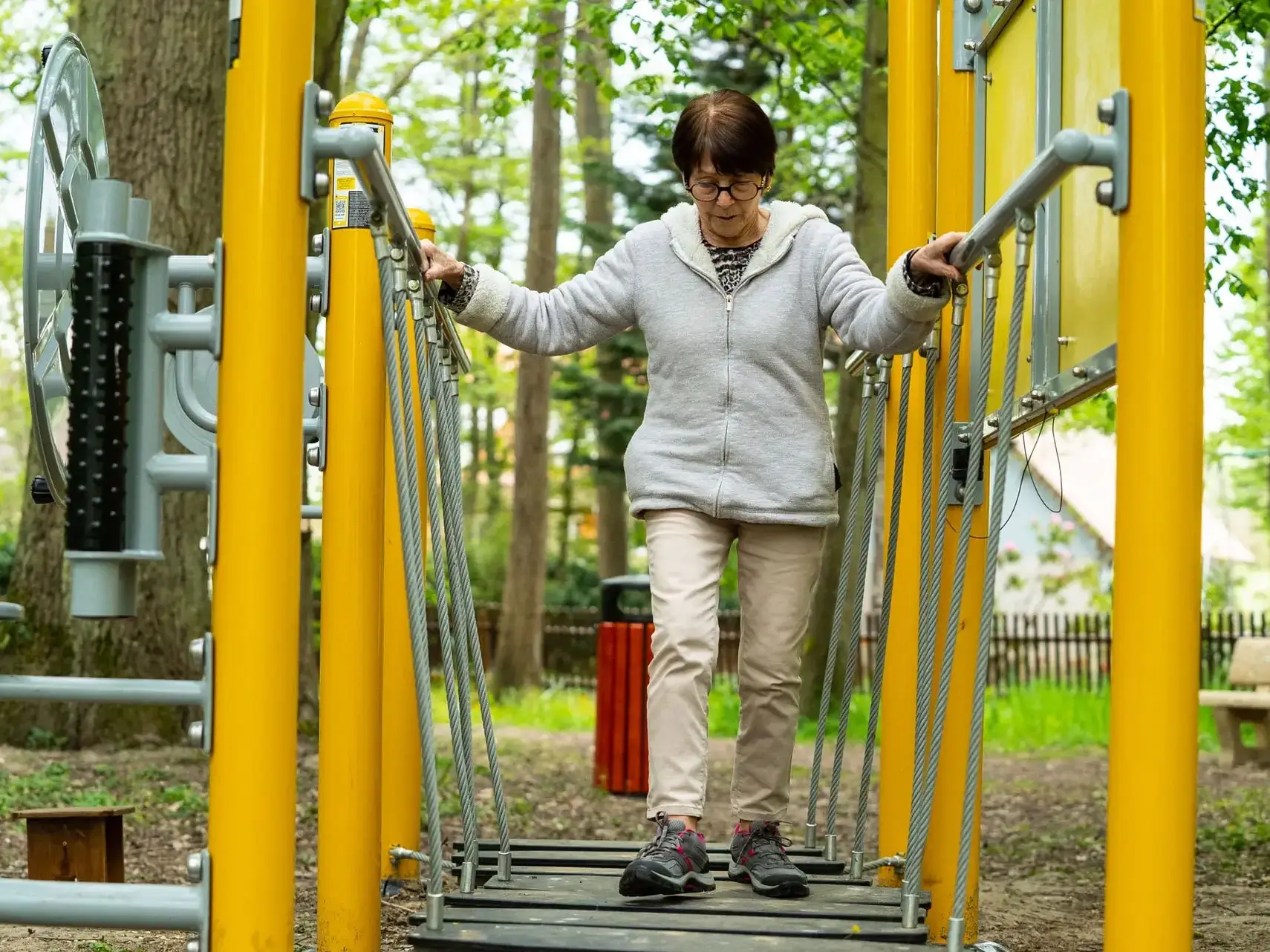
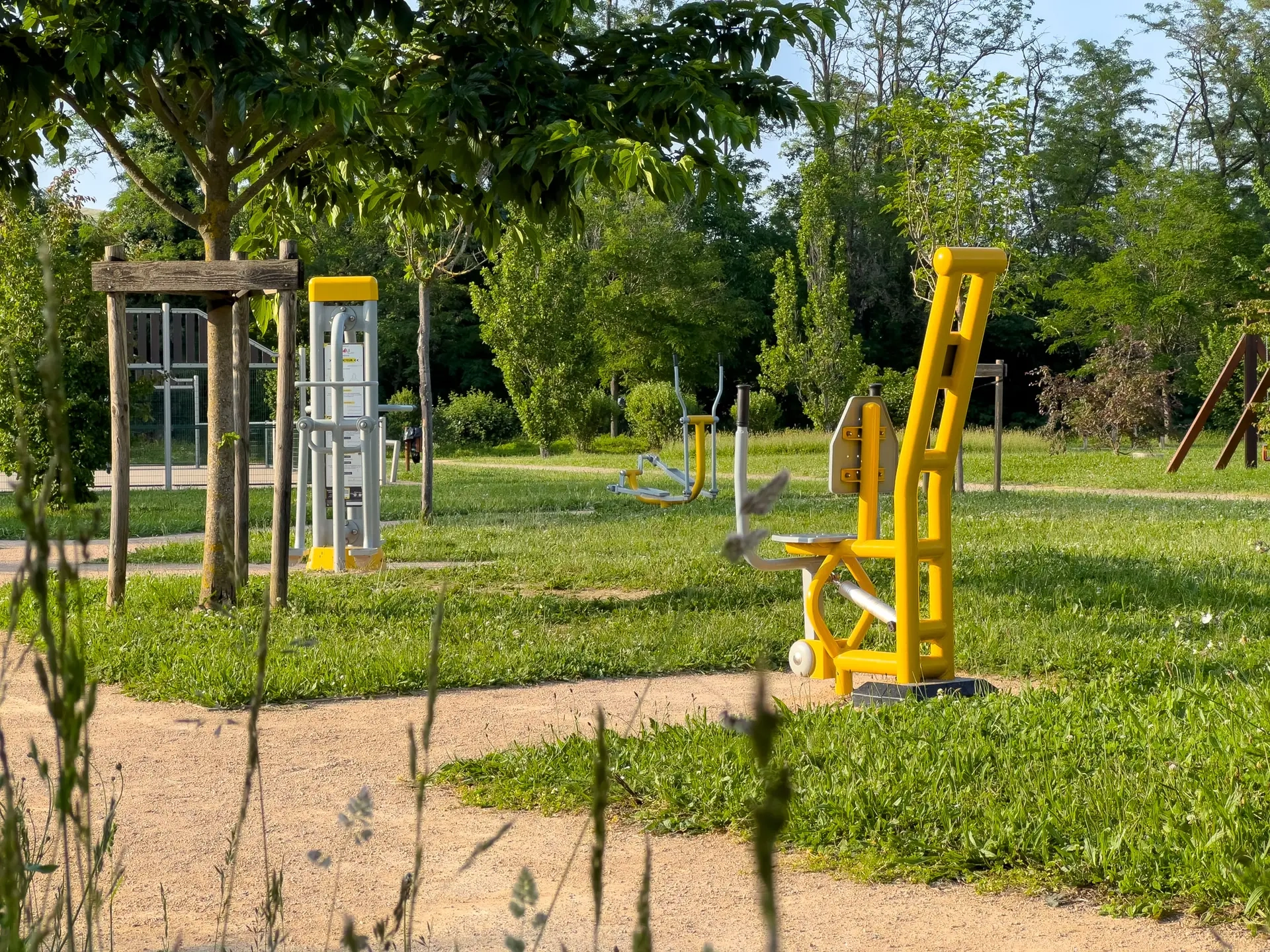
– Choose your location carefully: a flat, shady park with sturdy benches, near a fountain or watering hole, and ideally with a few simple apparatus (low bars, espaliers).
– Drink plenty of fluids: the sensation of thirst diminishes with age, so drink before, during and after each session, even if you don’t feel thirsty.
– Stop immediately in the event of warning signs: chest pain, abnormal shortness of breath, dizziness, palpitations, sharp joint pain. These signs should prompt prompt medical attention.
Warm-up: 8 essential minutes before each session
Warming up is even more important after 60 than at 30. It prepares the cardiovascular system for exertion, increases joint lubrication and activates the nervous system. Here’s a simple routine to follow before each session.
1. Active walking around the park for 3 to 4 minutes, gradually increasing the pace.
2. Gentle joint rotations: shoulders (10 in each direction), wrists, hips, ankles, knees.
3. Upper body mobilization: 10 arm movements (circles, unloaded lateral raises).
4. Trunk mobilization: 10 gentle rotations on each side, hands on hips.
5. Cardio activation: 30 seconds of chassé steps or knee lifts at a moderate pace.
In all, allow 7 to 8 minutes. At the end of the warm-up, you should feel your heart rate accelerate slightly, your breathing deepen a little, and your joints “unlocked”.
Weekly program overview
Here’s the structure of the 4 sessions spread over the week, with two days of complete rest and one day of active rest. This distribution guarantees sufficient recovery between muscular demands.
| Day | Session type | Objectives | Duration |
| Monday | Upper body | Strength, posture, autonomy | 30 – 40 min |
| Tuesday | Active rest | Walking, gentle stretching | 20 – 30 min |
| Wednesday | Balance & mobility | Falls prevention | 30 min. |
| Thursday | Rest | Full recovery | / |
| Friday | Lower body | Leg strength, sheathing | 30 – 40 min |
| Saturday | Gentle endurance | Cardio, respiratory capacity | 40 – 45 min |
| Sunday | Rest | Full recovery | / |
You can, of course, adapt the days to suit your schedule. The important thing is to respect at least one day of rest between two bodybuilding sessions (Monday and Friday in the example), and not to link more than two days of effort without recovery.
Session 1 – Monday: upper body and posture

This session is designed to maintain arm, shoulder and back strength, as well as correct the kyphosis (hunched back) that sets in with age. All exercises are performed against a wall, a bench or a low bar, without any load.
| # | Exercise | Format | Technique & advice |
| 1 | Pumps against a wall | 3 × 10 repetitions | Hands at shoulder height on a wall, body straight. Bend your elbows to bring your chest closer to the wall, then push. |
| 2 | Australian pull-ups on low bar | 3 × 6-8 repetitions | Lying on your back under a half-height bar, grasp the bar and pull your chest towards it, body sheathed. |
| 3 | Lateral raises without weights | 3 × 12 repetitions | Arms outstretched at your sides, raise them horizontally, slowly. No rocking. |
| 4 | Scapula retraction | 3 × 15 repetitions | Arms straight out in front of you. Bring your shoulder blades together behind your back. Excellent against kyphosis. |
| 5 | Finishing stretches | 30 s × 3 movements | Open the ribcage to the wall, stretch the biceps and trapezius. |
Recovery between each set: 60 to 90 seconds. The complete session, including warm-up, lasts 35 to 40 minutes.
Session 2 – Wednesday: balance and mobility
This is undoubtedly the most important session of the program. Loss of balance is one of the main factors in falls over the age of 65, and falls remain the leading cause of hospitalization among the elderly. Working on balance 1 or 2 times a week significantly reduces this risk.
| # | Exercise | Format | Technique & advice |
| 1 | Heel-and-toe walking | 10 m × 4 round trips | One foot in front of the other, heel to toe. Arms outstretched at sides to stabilize. |
| 2 | Unipodal balance | 3 × 20 s per leg | Near a bench to catch up. When it’s easy, close your eyes for 5 seconds. |
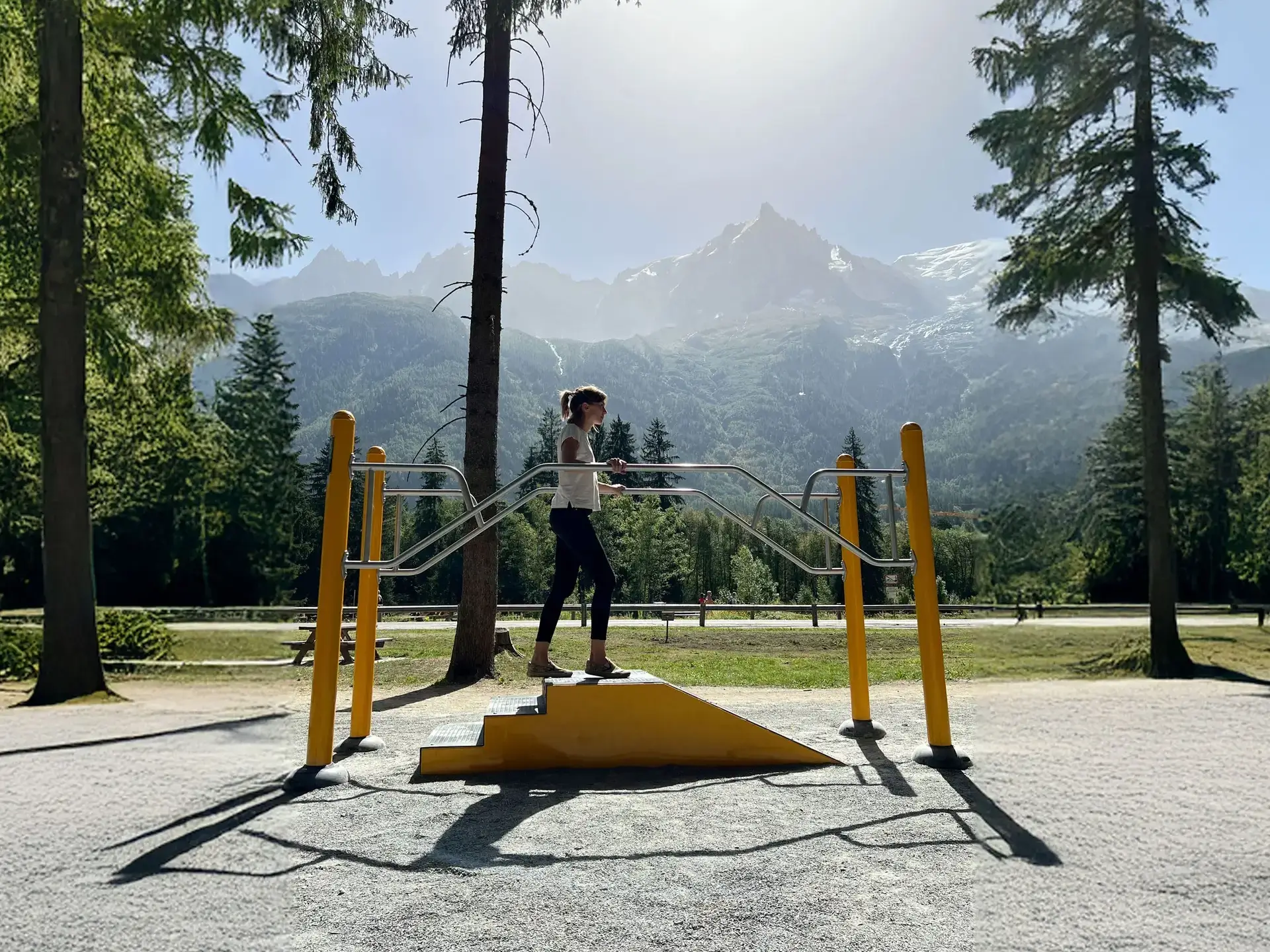
| 3 | Ascent-descent on low bench | 3 × 10 repetitions / leg | Bench 20 to 30 cm high. Slow ascent, controlled descent. Hold on as needed. |
| 4 | Partial squats with support | 3 × 12 repetitions | Hold onto the back of a bench. Lower to half-height (as if sitting down), raise again. |
| 5 | Trunk rotations while walking | 5 minutes | Slow walk with gentle rotation of the torso with each step. Hands on hips. |
| 6 | Mobility stretches | 30 s per group | Ankles, hips, back. Slow, controlled movements. |
The session lasts about 30 minutes. Concentrate on slow movements and quality of support, not quantity.
Session 3 – Friday: lower body and sheathing
Legs and trunk are the foundations of independence. Strong thighs enable you to get up from a chair, climb stairs and carry groceries, while a good sheathing protects your back in everyday life. This session is the most demanding: adapt the intensity to your sensations.
| # | Exercise | Format | Technique & advice | ||||
| 1 | Bodyweight squats with light support | 3 × 12-15 repetitions | Hold onto the back of a bench if necessary. Controlled descent, straight back. | ||||
| 2 | Bench climbs | 3 × 10 repetitions / leg | On a bench 30 to 40 cm high. Place the whole foot firmly on the bench, with a powerful ascent. | ||||
| 3 | Static lunges with support | 3 × 8 repetitions / leg | One leg forward, lower by bending both knees. Front knee in line with ankle. | ||||
| 4 | Calf raises | 3 × 15 repetitions | Stand up on tiptoe, slowly lower back down. Variation: on one leg only. | ||||
| 5 | Modified knee support | 3 × 20 seconds | Pump position, but resting on knees and forearms. Body aligned. | ||||
| 6 | Leg stretching | 30 s per group | Hamstrings, quadriceps, calves. Progressive, smooth stretching. | ||||
The session lasts 35 to 40 minutes. If you feel joint pain (knees, hips), reduce the range of motion and don’t force yourself.
Session 4 – Saturday: gentle endurance and respiratory capacity

This session is designed to maintain cardiovascular health, respiratory capacity and endurance. The aim is not to run a marathon, but to sustain a moderate effort over time, which is one of the best predictors of healthy longevity.
| # | Phase | Duration | Intensity & target |
| 1 | Warming up with gentle walking | 5 minutes | Comfortable pace, conversation possible without breathlessness. |
| 2 | Sustained walking | 2 minutes | You can talk but not sing. Moderate to high effort. |
| 3 | Slow recovery walk | 1 minute | Return to calm, deep breathing. |
| 4 | Repeat steps 2 and 3 | 8 to 10 times | Split format, for a total of 24 to 30 minutes. |
| 5 | Return to calm with a leisurely walk | 5 minutes | Gradually reduce intensity, breathe deeply. |
| 6 | Complete stretching | 5 minutes | Calves, quadriceps, hamstrings, back (30s per group). |
The complete session lasts 40 to 45 minutes. This split-walking formula is highly effective: it improves endurance and cardiac capacity without putting undue strain on the joints. If sustained walking is too easy, you can replace it with light uphill walking or outdoor cycling, if your park is so equipped.
How to progress over 8 weeks
Progression is essential if you are to continue reaping the benefits of the program. Here’s a simple framework to follow.
– Weeks 1 and 2: adaptation phase. Perform the series indicated, reducing the number of repetitions by 30% if necessary. The aim is to learn the movements and listen to your body.
– Weeks 3 and 4: strengthening phase. Perform sets in full format. You should feel good after each session.
– Weeks 5 and 6: Gentle progression phase. Add an extra set to one or two exercises per session, or increase the endurance duration.
– Weeks 7 and 8: integration phase. Vary the exercises (e.g. handstands on the bench instead of the wall), lengthen the sheathing time, increase the amplitude of squats.
At the end of these 8 weeks, you can continue to progress by regularly varying the exercises, adding a fifth workout or joining a group class (gentle gym, yoga, Nordic walking) instead of one of the sessions.
Mistakes to avoid
– Skipping the warm-up: this is the leading cause of muscle and joint injuries in senior citizens.
– Going too fast: progress should be measured in months, not days. The body needs time to adapt.
– Block your breathing during the effort: exhale on the difficult phase (the push), inhale on the easy phase (the return). Never hold your breath.
– Ignore aches and pains: mild aches and pains are normal, but sharp or persistent joint pain should prompt you to stop and seek medical advice.
– Isolate yourself: if possible, practice with a close friend, neighbor or group. Regularity and safety benefit enormously.
– Neglecting diet and hydration: after 60, protein requirements increase. A balanced diet with a portion of protein at each meal (eggs, fish, white meat, legumes) is essential to maintain muscle mass.
The secret to successful fitness after 60 lies in one word: regularity. Four 30-45 minute sessions a week, outdoors all year round, will produce infinitely more benefits than an intense program followed for a month and then abandoned. This program is designed to be sustainable over time, adapting to your sensations and availability.
Beyond the physical dimension, regular involvement in outdoor sports acts as a genuine natural medicine: it improves morale, structures the weeks, creates social links and preserves autonomy. As long as you respect the medical precautions and the principles of progression presented here, you’ll have all the keys you need to age better, longer and with more pleasure. The best time to start? Today.