
“CrossFit”, “cross training”, “cross fit”, “functional training”: these terms have been circulating for some years now in gyms, on social networks, and even in city parks, where we sometimes see very intense group sessions. For many practitioners, the confusion is total: is it the same sport? Why do some gyms call it CrossFit and others cross training, when the exercises seem identical? Is there really a difference, or is it just a question of marketing?

The answer is more nuanced than it seems. CrossFit is a registered trademark and a codified method; cross training is a generic cross-training concept that has existed since long before CrossFit. In practice, the two can be very similar, or radically different depending on the gym. This article explains exactly what sets them apart, what they have in common, and above all how to choose the one that best suits your profile and goals.
Key takeaways:
- CrossFit® is a registered trademark and proprietary method created in 2000 by Greg Glassman. Only affiliated gyms (“boxes”) may use the name.
- Cross training is a generic cross-training concept combining strength, cardio and gymnastics. It has been around since the 1970s and belongs to no one.
- In practice, many French gyms offer cross-training that closely resembles CrossFit, without paying the affiliation license: it’s the same training logic, without the label.
- Typical exercises are similar: weightlifting (clean, snatch), gymnastics (pull-ups, dips, handstand), metabolic conditioning (burpees, rowing machine, running).
- The choice between the two depends less on the practice itself than on the quality of the coaching, the community of the gym and your objective (competition or well-being).
CrossFit: a brand, a method, a community
CrossFit® is first and foremost a registered trademark and proprietary method. Created in California in 2000 by Greg Glassman, it is now owned by CrossFit Inc. an American company which controls the use of its name, methods and certifications worldwide. This trademark-protected dimension is the first difference with cross-training, and it has very concrete consequences for the practitioner.
A strictly codified method
The CrossFit method is based on three training pillars: metabolic fitness (running, cycling, rowing), weightlifting (Olympic movements such as the snatch or clean and jerk), and gymnastics (pull-ups, dips, balances). The core of each session is the WOD (Workout Of the Day), an officially published program of the day, which can be identical anywhere in the world on the same day. Some WODs have famous names (“Fran”, “Murph”, “Cindy”) and serve as benchmarks against which to measure progress.
The method also features a scaling system that allows each practitioner, from beginner to competitor, to perform the same WOD with loads and movements adapted to his or her level. This is one of the strengths of the system: everyone trains together, but each at their own intensity.
Certified coaches
To become an official CrossFit coach, you need to take a series of certifications issued by CrossFit Inc: Level 1 (CF-L1), then L2, L3 and L4 depending on the level of specialization. This training is not free (around €1,000 for L1) and must be renewed regularly. This guarantees a common base of pedagogical and technical skills for all CrossFit coaches worldwide.
Affiliated boxes
Official CrossFit gyms are called “boxes” and are affiliated to CrossFit Inc. via a licensing agreement (approximately $3,000 per year for a box). This affiliation imposes standards (equipment, coach qualifications, graphic charter) and gives access to CrossFit Inc.’s international network, guaranteeing that a CrossFit box in Paris, Lyon or New York applies the same principles.
The competition: the CrossFit Games
CrossFit has a strong competitive culture. Every year, the CrossFit Open (a worldwide competition open to all) attracts hundreds of thousands of participants. The best go on to the quarter-finals and semi-finals, and the world’s top twenty athletes take part in the CrossFit Games, where the title of “fittest on Earth” is defined. This structured, international dimension is one of the hallmarks of CrossFit.
Cross training: a generic concept
Cross training, on the other hand, is a much broader concept that refers to the practice of cross-training, i.e. combining several disciplines to develop varied physical qualities. The term has been used since the 1970s, long before CrossFit, by top-level athletes who combined running, swimming, weight training and stretching to avoid injury and break progression plateaus.
An ancient concept, free to use
No company owns the term “cross training”, no one can forbid a gym to use it, and every trainer is free to program as he or she sees fit. This freedom is both a strength (pedagogical innovation, adaptation to the local public) and a weakness (highly variable quality from one gym to another). In concrete terms, two gyms advertising themselves as “cross training” can offer totally different sessions in terms of intensity, technical complexity and equipment.
Universal training logic
The idea behind cross-training is simple: alternate or combine different training modalities to obtain a more complete athlete. Strength, endurance, mobility, coordination, power, recovery: no quality is neglected, unlike single-sport disciplines which can create imbalances (a cyclist with a weak back, a runner with atrophied shoulders). This logic is perfectly suited to practitioners who are not aiming for performance in a single discipline, but for an overall state of fitness.
A wide range of applications
Cross training can take radically different forms depending on the coach and the gym: HIIT (High Intensity Interval Training) circuits, functional training inspired by CrossFit without bearing the name, hybrid methods (CrossFit + crossfit-yoga, military fitness, kettlebell flow). This is also why it’s essential to visit a gym before signing up: one cross-training class may be the opposite of another.
CrossFit vs cross training: a point-by-point comparison
To clarify matters, here are the main differences between the two approaches, presented in table form.
| Criteria | CrossFit® | Cross training |
| Status | Registered trademark (CrossFit Inc.) | Unprotected generic concept |
| Origin | Created in 2000 by Greg Glassman | Available since the 1970s |
| Location | Box affiliated with CrossFit Inc. | Any room, park, garage, land |
| Method | Codified, official WODs, defined scaling | Free, programming at the coach’s discretion |
| Coaching | CF-L1 to L4 certifications required | Various diplomas (BPJEPS, BEMF, others) |
| Competition | CrossFit Games (Annual World Open) | Various non-standardized competitions |
| Registration fee | 60 to 150 € / month (affiliated box) | 40 to 100 € / month depending on room |
| Community | Strong, international, networked | Local, varies by venue |
Why are so many gyms now talking about “cross-training”?
If you get the impression that the term “cross training” has exploded in France over the last five years, you’re not wrong. There are several reasons for this phenomenon.
– The cost of affiliation: the CrossFit Inc. license represents around $3,000 per year, plus the obligation to train coaches to official certifications. Many small gyms prefer to circumvent this burden by offering similar training under a different name.
– Legal protection: CrossFit Inc. actively monitors the use of its trademark and does not hesitate to take legal action in the event of unauthorized use. To avoid any risk, many gyms use alternative terms (“cross training”, “functional training”).
– A desire for pedagogical autonomy: some coaches feel too constrained by the CrossFit framework (imposed WODs, standardized scaling) and prefer to invent their own sessions while retaining the same training logic.
– Broadening the target audience: the word “CrossFit” still has the image of a demanding, even intimidating, practice. “Cross training” sounds more accessible and attracts audiences who wouldn’t dare push open the door of a box.
As a result, in most French towns and cities, you’ll find both official CrossFit boxes and unaffiliated cross-training gyms. The exercises are often very similar, but the context (community, coaching, atmosphere) can be very different.
Which format best suits your profile?
There is no universal right or wrong answer. Here’s a checklist to guide you according to your expectations.
| Your profile | More CrossFit | More cross-training |
| You’re aiming for the competition | ✓ Structured qualification system | Possible but less marked |
| You’re looking for fun and teamwork | ✓ Very strong community | ✓ According to the room |
| Tight budget | More expensive on average | ✓ Often cheaper |
| If you’re just starting out and have doubts | Can be intimidating at first | ✓ More psychologically accessible |
| You want highly trained coaches | ✓ Mandatory certifications | Varies by venue |
| You live in a rural area | Boxes sometimes far apart | ✓ More widely available |
The best approach is to visit several gyms before committing yourself. Most offer a free or discounted trial session. Beyond the CrossFit or cross training label, look at the quality of the coaching, the atmosphere of the gym, the condition of the equipment, the profile of the other participants, and the flexibility of the hours in relation to your schedule. These criteria generally have a far greater impact on long-term satisfaction than the brand name.
Typical exercises: a common base with a few nuances
Whether you’re into CrossFit or cross-training, you’ll often find the same families of exercises. The difference lies in the programming and degree of coding.
Weightlifting movements
– Snatch: lift a barbell from the ground to overhead in a single movement.
– Clean and jerk: bring the bar to the shoulders and then over the head in two steps.
– Squat: front squat or back squat, with barbell.
– Deadlift: lift the barbell from the ground to the hips.
Gymnastics movements
– Pull-ups, strict pull-ups or kipping (with momentum).
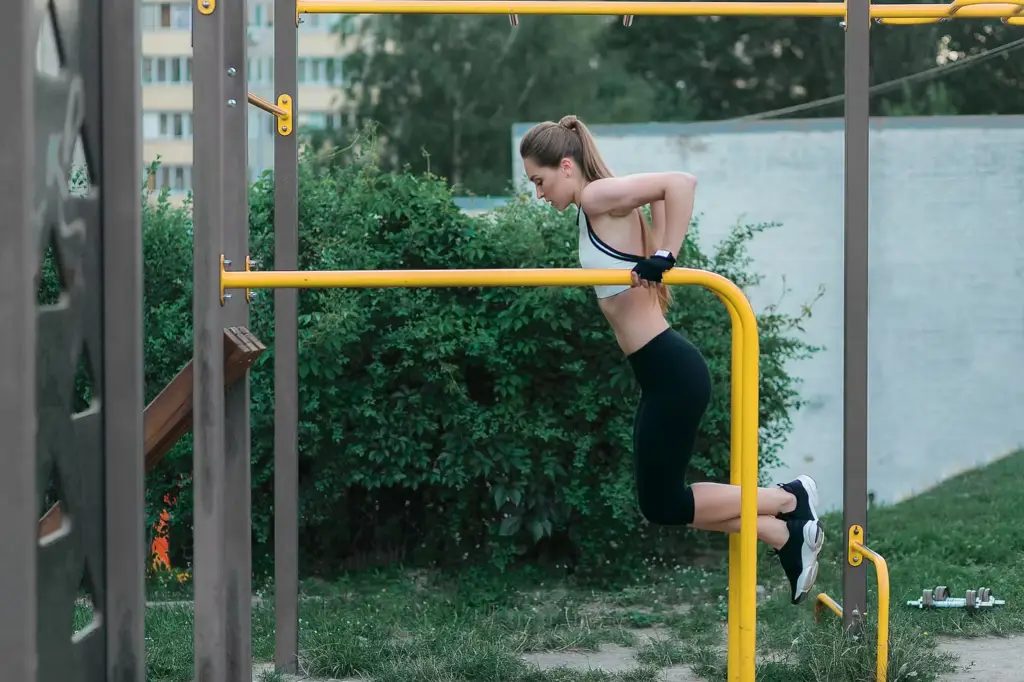
– Dips on parallel bars.
– Push-ups, classic or handstand.
– Toes-to-bar: hanging from a bar, bring your feet towards your hands.
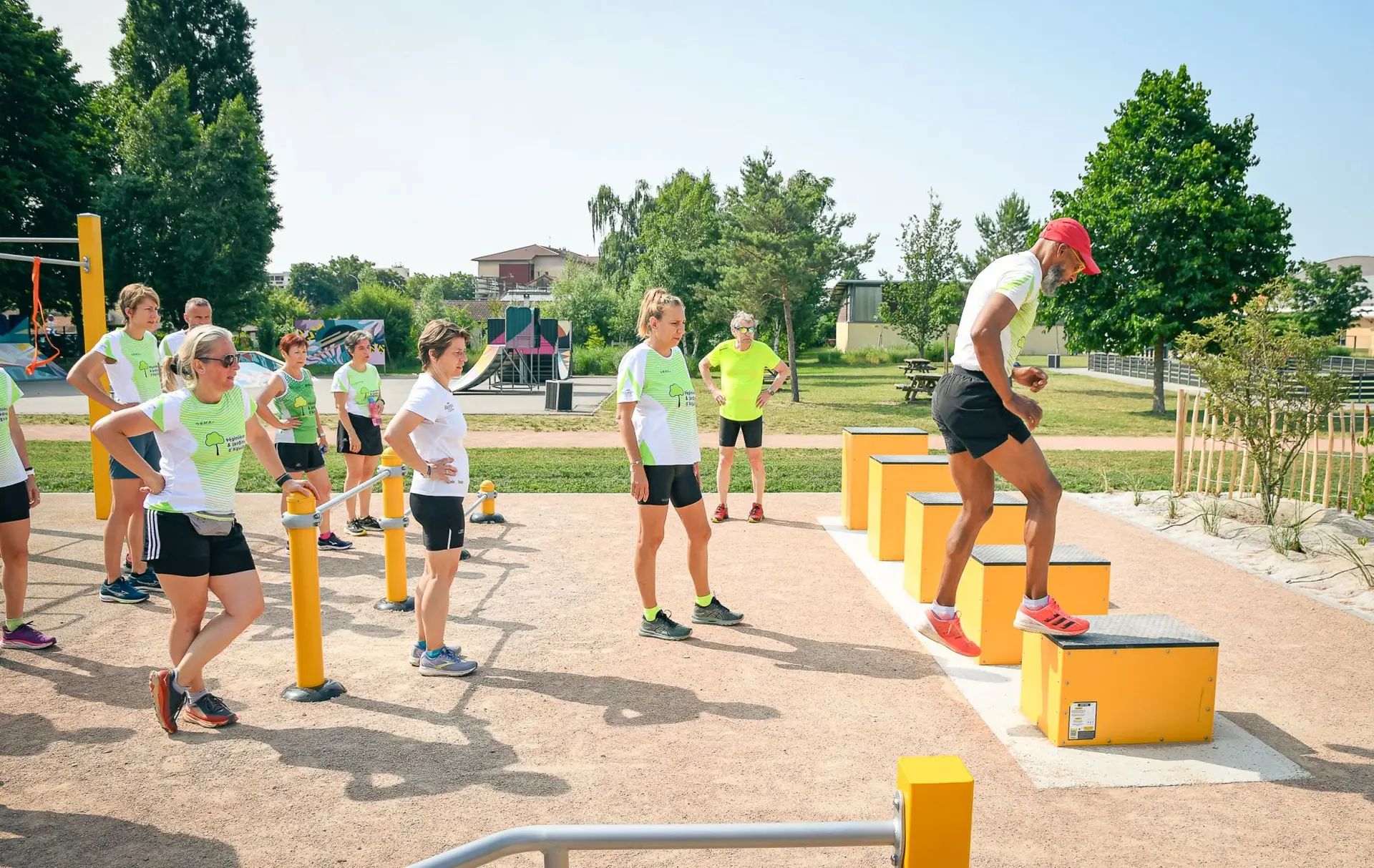
– Box jumps: jump on a box 50 to 76 cm high.
Metabolic conditioning
– Running (sprints, intervals).
– Rowing machine (typically concept2).
– Cardio bikes (Assault Bike, Echo Bike).
– Burpees: descent to floor, pump, jump.
– Wall balls: squat with medicine ball thrown against a wall.
In a CrossFit box, these movements are linked together according to a precise WOD with a timed objective (for example: “21-15-9 thrusters and pull-ups, as fast as possible”). In a cross-training gym, the sequence will be defined by the coach of the day, without necessarily referring to an official WOD.
And outdoors? Cross-training in the park
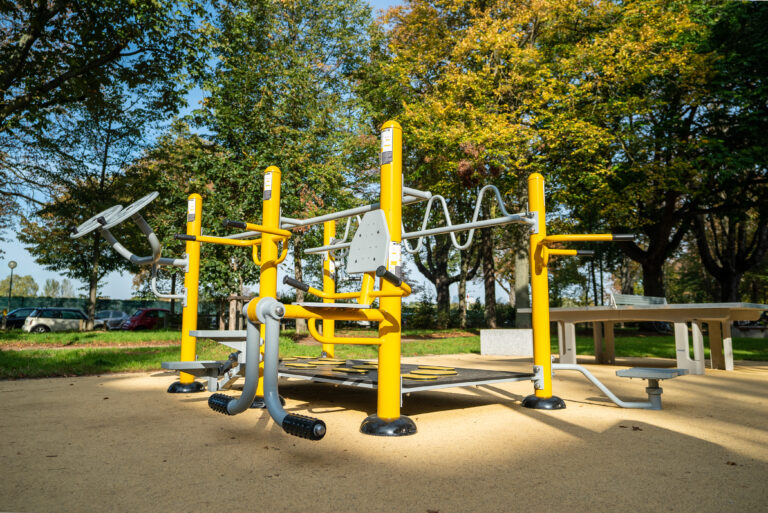
The good news is that most of the principles of cross-training can be practised free of charge, in the open air, on a public fitness area. If you’re on the fence about investing in an €80-a-month membership, or simply want to complement your gym routine, the park is an excellent training ground.
– Pull-ups, dips, push-ups: the basic callisthenic triptych, perfectly feasible in the park.
– Running and sprints: most parks offer enough space for intervals of 50 to 200 meters.
– Burpees, mountain climbers, jumping jacks: floor exercises require nothing more than a towel or a patch of grass.
– Box jumps: a stable public bench can do the trick.
– Light loads: to add resistance without equipment, a backpack filled with 1.5-liter water bottles serves as an improvised dumbbell.
The main limitation remains pure weightlifting (snatch, clean and jerk), which requires an Olympic bar and weights that are difficult to transport. But apart from this nuance, you can build up a real cross-training program outdoors, two or three times a week, without any expensive personal equipment.
Mistakes to avoid when choosing
– Choose on name alone: the CrossFit label doesn’t guarantee a good gym, and the absence of a label doesn’t mean a bad gym either. Always visit before signing up.
– Starting out too hard: CrossFit and cross-training can be very intense. In the first few weeks, don’t hesitate to ask for a scaling to protect your joints.
– Ignore the quality of coaching: it’s the #1 factor in progress and injury prevention. Find out about the training and experience of coaches, ask questions and observe corrections in progress.
– Underestimating the community dimension: long-term motivation largely depends on the atmosphere. A friendly room with average coaching is often better than a cold, technical room.
– Believing that you need to already be an athlete to start out is not true. Good coaches know how to adapt to all levels, from complete beginner to advanced. The real prerequisite is motivation.
The difference between CrossFit and cross training is real from a legal and pedagogical point of view, but it generally weighs less heavily in the practitioner’s day-to-day experience than the quality of the gym itself. CrossFit® provides a highly structured methodological framework, an international community and a standardized level of coaching. Cross training offers greater flexibility, often lower prices, and wider geographical accessibility.
Ultimately, the right question is not “CrossFit or cross training?” but “Which gym is right for me? There’s only one way to find out: visit, try and compare. And if you’d like to try out this style of training before committing yourself, you should know that a large part of the practice can take place in any park in your community, free of charge, at any time of day. The equipment doesn’t make the athlete: it’s the regularity and quality of execution that transforms a body for good.