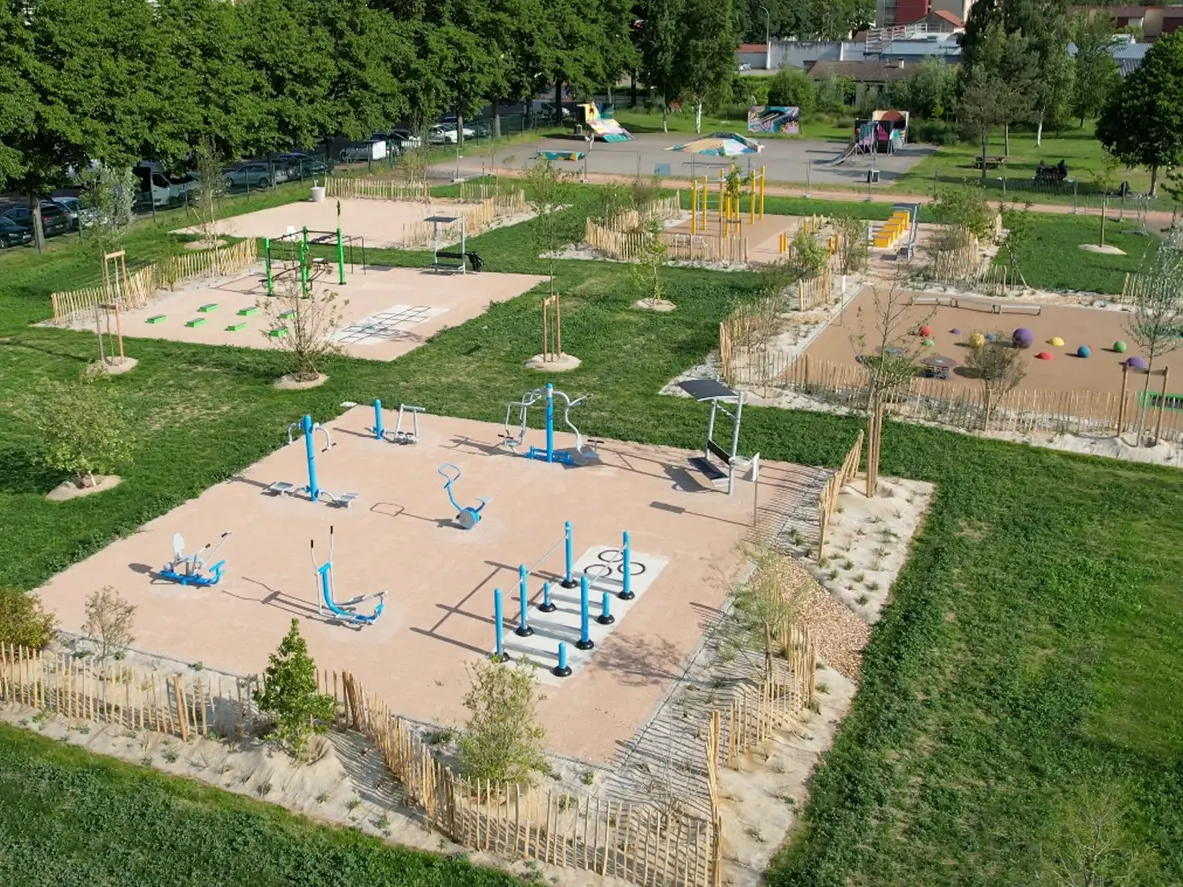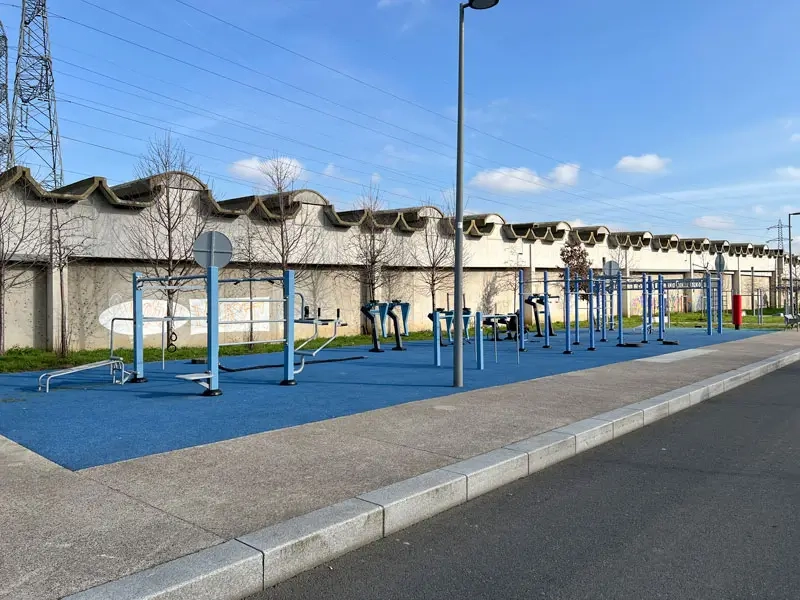

An outdoor fitness area project can look simple to run: pick the equipment, put it down on an available space, call it done. In reality, project owners — municipalities, social landlords, care home managers, developers — regularly make mistakes that carry a real price: costly rework, regulatory non-compliance, accidents that engage the operator’s liability, or simply equipment that goes unused because it was badly sited.
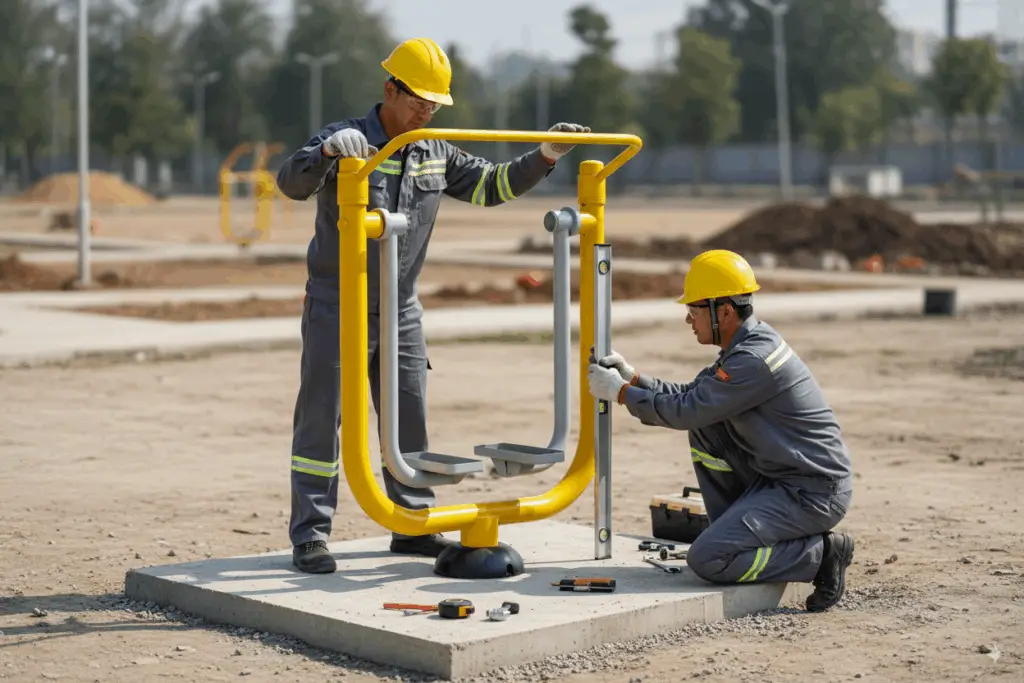
This guide lists the most frequent and most expensive mistakes at every stage of the project, from design to handover, so you can anticipate them rather than correct them after the fact.
Key takeaways:
- Plan before you install: carry out a full site survey (ground conditions, buried utilities, local planning rules, accessibility) to avoid costly rework and regulatory blockages.
- Insist on EN 16630 certified equipment: this standard guarantees the safety, compliance and durability of the installation. Always ask for test reports from independent bodies.
- Respect safety zones and ground preparation: poor sizing or an unsuitable surface can make the area non-compliant and expose the operator to liability in the event of an accident.
- Use qualified professionals: installation, anchoring, handover inspection and delivery of the as-built file must be handled by experienced contractors to protect warranties and compliance.
- Plan for the long term: consult the future users, write a precise tender specification and build in an annual maintenance budget of 5 to 8% of the installation cost from the outset.
Mistake 1: skipping the site survey
The first mistake happens before anyone even opens an equipment catalogue: skipping the site feasibility study. A space that looks available is not necessarily usable without technical or regulatory constraints.
Common blind spots
• Ground type and bearing capacity: clay or made-up ground needs specific foundation preparation for the anchors; ignoring this leads to equipment working loose within two years
• Buried utilities: gas, water, electricity, fibre. Utility searches and statutory notification of works are mandatory before any anchoring. Skipping this step exposes the project owner to criminal liability if damage occurs
• Local planning rules: some zones impose constraints on appearance, height or distance from boundaries. A prior notification of works may be required
• Sun exposure and prevailing winds: an area facing due west in a Mediterranean region will be deserted in summer between 2 pm and 6 pm, the most active hours. Orientation directly drives the usage rate
• Accessibility: as soon as public space is involved, the route from the pavement to the area must meet universal accessibility standards
Worth remembering
A serious site survey takes 2 to 4 weeks and costs between €500 and €2,000 depending on complexity. It prevents rework that invariably runs into tens of thousands of euros.
Mistake 2: choosing equipment that does not meet EN 16630
The EN 16630 standard is the European technical reference for all freely accessible fitness equipment. Buying uncertified equipment, or equipment certified against irrelevant standards (children’s playground standard EN 1176, for example), is a mistake with potentially serious consequences.
What EN 16630 certification guarantees
• Mechanical strength under static and dynamic loads representative of intensive use
• No sharp edges, entrapment gaps or dangerous fall zones
• Material durability suited to outdoor exposure (UV, corrosion, freeze/thaw)
• Technical documentation (installation and maintenance instructions, signage) supplied by the manufacturer
Critical point: EN 16630 certification must be verifiable. Always ask for the test report from a notified body (TÜV, Bureau Veritas, SGS and similar), not just a self-declaration from the manufacturer.
The trap of budget equipment
Low-cost imported equipment, often supplied with no serious standards documentation, has flooded the market for several years. A purchase price 30 to 50% lower hides considerable hidden costs: spare parts unavailable, accelerated coating degradation, undersized anchors and, above all, no cover in the event of a claim. Equipment that is not EN 16630 certified can be treated by insurers as defective from the outset, cancelling all public liability cover.
| Criterion | EN 16630 certified equipment | Uncertified equipment |
| Technical documentation | Complete, in the local language | Missing or partial |
| Notified body test report | Provided on request | Non-existent or irrelevant |
| Spare parts | Available for at least 10 years | No guarantee |
| Public liability cover | Full | Potentially void |
| Total cost over 10 years | Under control | Unpredictable |
Mistake 3: undersizing or badly designing the safety zone
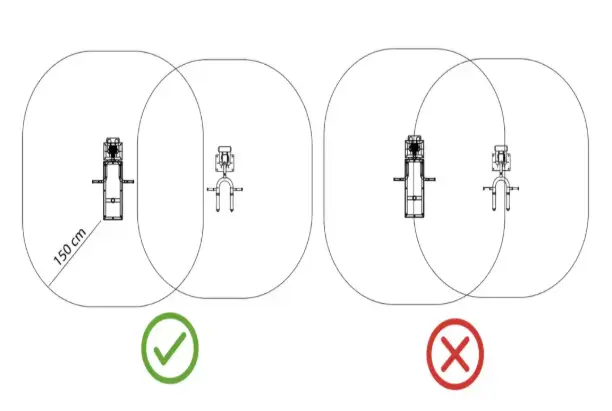
EN 16630 defines safety zones around each item of equipment: clear spaces, free of any obstacle, in which a user can fall or move without risk. Project owners frequently shrink these zones to fit more machines into a given area. That is a structural mistake which invalidates the compliance of the installation from day one.
The rules to follow
• Minimum distance between two machines: generally 1 metre between safety zones, varying with the equipment
• Minimum distance from fences, walls and street furniture: defined machine by machine in the manufacturer’s technical documentation
• Minimum area of the free fall zone: calculated from the height and the dynamics of the machine
• No obstacle (post, bench, tree, light column) may encroach on these zones
A common real-world case: a municipality installs 8 machines on 120 m² to “make the most of” the space. The result: the safety zones overlap, the installation is non-compliant at handover, and the first annual inspection triggers a formal notice to bring it into compliance, with removal and repositioning of the equipment at the operator’s expense.
The calculation rule to apply
At design stage, estimate the minimum usable area as follows: for each machine, add the footprint of the equipment to the surrounding safety zones required. Then add 20% extra area for circulation and access between machines. This calculation must appear in the tender specification and be verified by the manufacturer before the layout plan is approved.
Mistake 4: entrusting installation to an unqualified contractor
Anchoring outdoor fitness equipment is a technical operation on which user safety directly depends. Handing it to the lowest bidder without checking qualifications is a mistake that can only be corrected by removing and reinstalling the equipment.
What the installer must guarantee
• Knowledge of the anchoring specifications specific to each manufacturer (embedment depth, concrete grade, fixing tolerances)
• Command of ground constraints (bearing capacity, water, frost) and the ability to adapt if the ground is not as expected
• A formal handover inspection: a signed installation report meeting EN 16630 requirements
• Delivery of a complete as-built file: final layout drawings, technical data sheets, maintenance protocols
What to check in the tender specification
• Demonstrable experience on similar projects (references, photos, handover reports)
• Explicit knowledge of EN 16630 and its installation requirements
• Valid liability insurance covering this type of work
• A commitment on rectification timescales if non-compliance is found at handover
Advice
Always require the manufacturer or an approved technical representative to carry out or supervise the handover inspection. That is the only way to confirm the anchoring matches the manufacturer’s instructions and to keep the manufacturer’s warranty valid.
Mistake 5: ignoring the ground and its preparation
The ground is the most underestimated element of an outdoor fitness area project. Yet it determines how long the anchors last, how safe falls are, and how comfortable the area is to use.
Two ground layers to deal with
The foundation ground (below the play surface) determines how well the anchors hold. Unstable, clay or regularly waterlogged natural ground needs reinforced preparation: compaction, added aggregate, a suitable concrete footing. This preparatory work is often left out of initial budgets.
The surface finish (the visible, walkable layer) determines safety in a fall and comfort in use. Common options are exposed aggregate concrete, asphalt, compacted gravel, shock-absorbing artificial grass and rubber tiles. Each has advantages and limits to weigh up in context.
| Surface | Fall absorption | Upkeep | Cost / m² | Recommended for |
| Exposed aggregate concrete | Low | Very low | €35 – €55 | Circulation areas, not under machines |
| Compacted gravel | Low | Medium | €15 – €30 | Natural sites, trim trails |
| Shock-absorbing artificial grass | Medium | Low | €40 – €80 | Multi-purpose spaces |
| Rubber tiles (EPDM) | High | Low | €60 – €120 | Under active machines, accessible areas |
| Poured flexible surfacing | Medium to high | Very low | €50 – €90 | Large areas, maximum durability |
A classic mistake: installing equipment straight onto ordinary non-absorbing concrete. In a fall, the operator’s liability will be engaged directly if the surface has no shock absorption capacity at all, particularly on areas accessible to minors.
Mistake 6: designing the area without consulting future users
An outdoor fitness area designed at a desk, with no consultation of the people who actually use the site, is an area at high risk of going unused. This is not a marginal issue: several local authorities have invested between €30,000 and €80,000 in installations that see only a few dozen users a month.
Questions to ask before ordering
• What is the dominant user profile? (active older adults, sporty adults, teenagers, people in rehabilitation)
• What sports are already practised on the site? (running, cycling, Nordic walking)
• Is there existing equipment to complement or replace?
• What are the expectations around accessibility (reduced mobility, pushchairs)?
• At what times of day is the site busiest?
A single consultation meeting with local sports clubs, neighbourhood residents or, for a care home, the residents and care staff, can completely change the choice of equipment. Time invested up front avoids regrets — and premature replacement budgets.
Mistake 7: not budgeting for maintenance at the design stage
The installation budget is visible and controlled. The maintenance budget is invisible until the first incident, and that is where the risk lies. A properly maintained outdoor fitness area lasts 15 to 20 years. Without structured maintenance, equipment deteriorates, annual inspections turn up more and more defects, and the cost of putting things right often exceeds the cost of a new installation.
Cost items to anticipate
• EN 16630 annual inspection: €300 to €700 per visit depending on the number of machines (see our dedicated article)
• Weekly or monthly visual inspections: staff time or an outsourced service
• Replacement of wear parts (bearings, handle coverings, fixings): allow 3 to 5% of the installation cost per year
• Replacement of damaged signage: €50 to €150 per panel depending on materials
• Cleaning and weeding of the surface: varies with the material
Good budgeting practice
Build an annual maintenance line worth 5 to 8% of the installation cost excluding VAT into the initial budget. For a €40,000 area, that is €2,000 to €3,200 a year — a predictable, absorbable amount, unlike emergency repairs.
Negotiate a multi-year maintenance contract with the manufacturer or installer at the time of order: the rates are always better than one-off call-outs.
Mistake 8: writing a weak or copy-pasted tender specification
The technical specification is the contractual document binding the project owner and the contractor. A vague, generic specification, or one copied from a previous project without adaptation, is an almost guaranteed source of disputes.
Common gaps in fitness area specifications
• No explicit reference to EN 16630 as the minimum certification requirement
• No requirements on safety zones and distances between machines
• No requirement to hand over a complete as-built file at completion
• No clause on spare parts availability and the length of the manufacturer’s warranty
• No requirements on signage: content, materials, warranty period
• Bid evaluation criteria unweighted or insufficiently discriminating
A well-written specification does not just describe what you want: it sets requirements that can be verified at handover. Every technical specification should come with a corresponding check at handover (strength test, documentary verification, measurement of safety zones).
How Herkules Fitness helps you avoid these mistakes
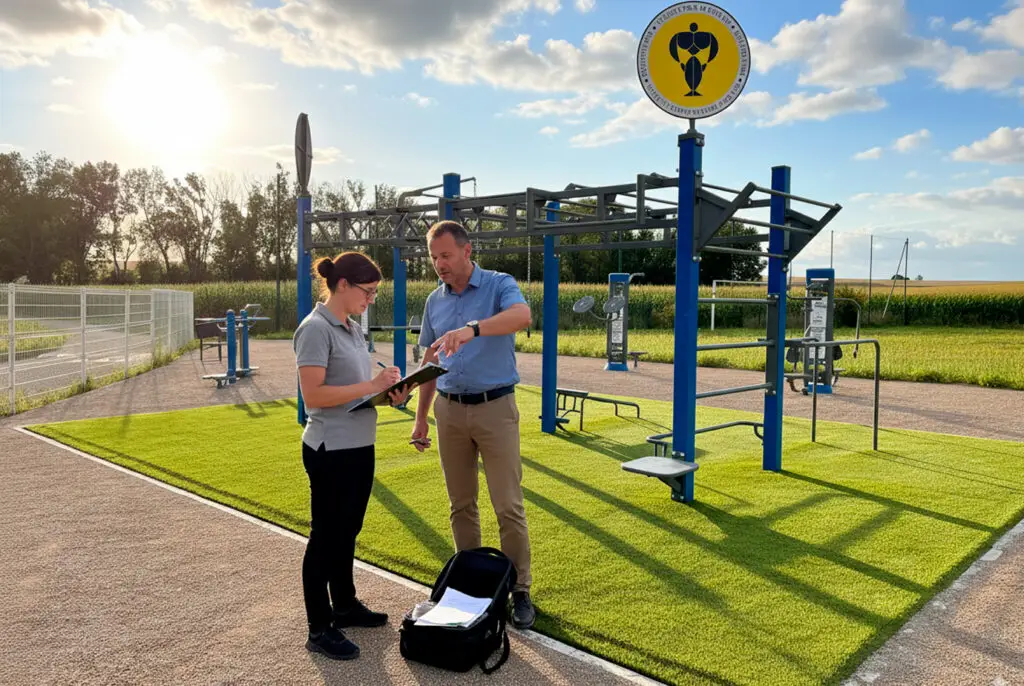
At Herkules Fitness we support project owners from the design stage, well before any equipment is ordered. That support covers site analysis, defining an EN 16630 compliant layout plan, drafting the technical specifications for your tender, and supervising installation through to delivery of the complete as-built file.
Our equipment is EN 16630 certified by independent notified bodies. We guarantee spare parts availability for at least 10 years and offer multi-year maintenance contracts sized to each area and how it is used.
Summary: the 8 mistakes to avoid, at a glance
| Mistake | Main consequence | How to avoid it |
| Skipping the site survey | Rework, planning non-compliance | Utility searches, ground survey, planning check up front |
| Equipment not EN 16630 certified | Public liability cover void | Require a notified body test report |
| Undersized safety zones | Non-compliance at handover | Calculate zones before any layout plan |
| Unqualified installer | Failing anchors, warranty void | Verified references, manufacturer supervision |
| Unprepared ground | Accelerated deterioration, fall risk | Shock-absorbing surface under active machines |
| No consultation | Area goes unused | Consult users before choosing equipment |
| No maintenance budget | Rapid deterioration, emergency costs | Set aside 5 to 8% of the net cost per year |
| Weak specification | Disputes at handover | Verifiable specs, mandatory as-built clause |
Frequently asked questions about installing an outdoor fitness area
Do you need planning permission to install an outdoor fitness area?
As a general rule, an outdoor fitness area with equipment no higher than 2.50 m does not require full planning permission. A prior notification of works is nonetheless required in most cases, and some protected zones (Natura 2000 sites, the surroundings of listed buildings, conservation areas) can impose additional constraints. Contact the municipality’s planning department at the feasibility stage.
What minimum area should you allow for a quality fitness space?
A functional area with 6 to 8 machines generally needs between 150 and 250 m² of usable space, safety zones included. Below 100 m², the number of machines that can be installed in line with safety zone requirements is very limited — often 3 or 4 at most — which may not justify the investment.
Can you install an outdoor fitness area on sloping ground?
Yes, subject to conditions. A slope of less than 3% is generally workable with no special treatment. Beyond that, earthworks and levelling are needed to guarantee anchor stability and user safety. A slope over 8% makes installing active fitness equipment inadvisable without significant earthworks.
How long does it take to install an outdoor fitness area?
Physically installing the equipment generally takes 2 to 5 days depending on the number of machines and the ground conditions. But the overall project, from order to handover, runs 6 to 12 weeks once you include manufacturing lead times, delivery, ground preparation and the handover inspection. Some manufacturers offer stocked ranges with lead times cut to 3 or 4 weeks.