
The shoulder press is one of the most complete muscle-strengthening exercises for the shoulder girdle. Its outdoor version, integrated into outdoor fitness equipment, offers all the benefits of classic exercise in an open environment, without the constraints of gym access. Whether you’re a beginner looking to strengthen your shoulders, or an experienced sportsman looking to maintain your level of fitness in the great outdoors, this comprehensive guide will show you which muscles to target, the best technique to adopt and the most common mistakes to correct.
What is an outdoor shoulder press?
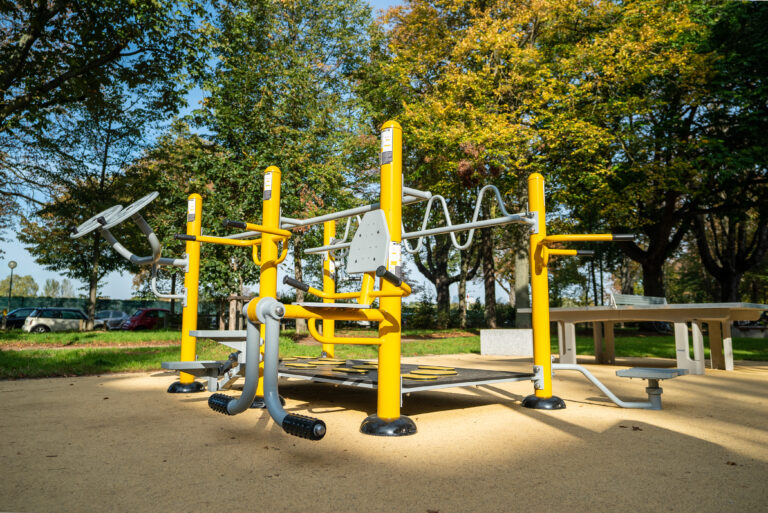
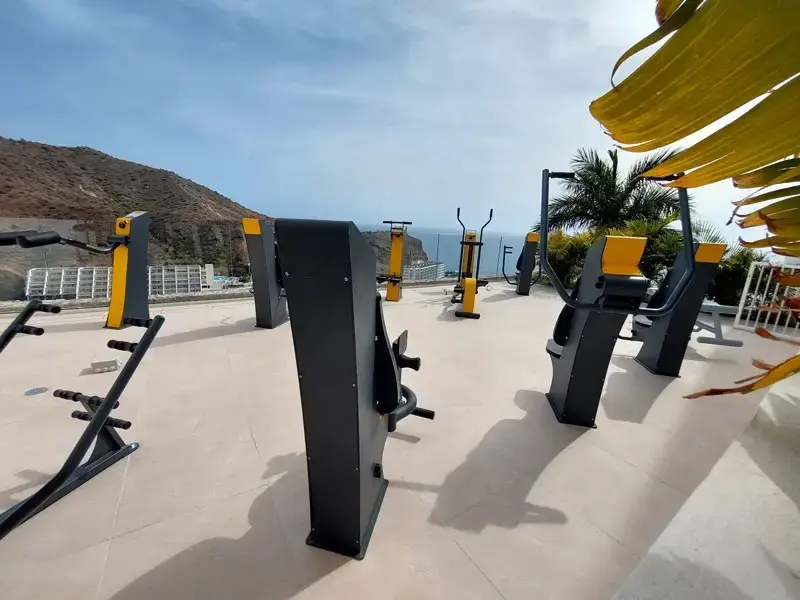
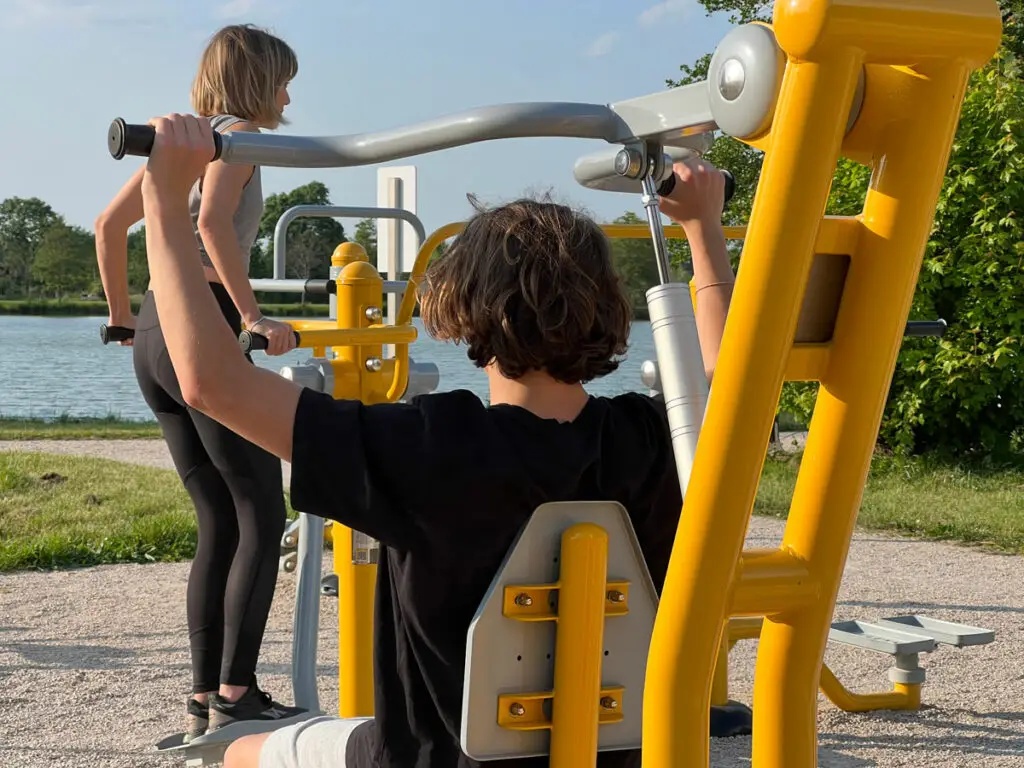
The outdoor shoulder press is an outdoor fitness machine that reproduces the movement of the shoulder press, a fundamental muscle-building exercise. The user is seated or in a stable position, with hands gripping handles located on either side of the head. The user pushes the handles upwards with full arm extension, then brings them back down in a controlled manner to the starting position.
Unlike indoor versions with dumbbells or bars, the shoulder press outdoor machine guides movement along a predefined arc, reducing the risk of imbalance and making it easier to learn the technique. Resistance is provided by the user’s body weight via a system of levers, cables or mechanical resistance, depending on the model, without the need for an adjustable load or power supply.
| ℹ️ Did you know?The shoulder press is one of the few exercises that involves all three chiefs of the deltoid muscle (anterior, lateral and posterior) in a single movement, while recruiting the stabilizing muscles of the rotator cuff. That’s why it’s considered the king of exercises for shoulder development. |
Which muscles work in the shoulder press?
The shoulder press is a multi-joint exercise that mobilizes a complex muscle chain involving the shoulders, arms and trunk. Understanding which muscles are involved enables you to adapt your training and target your efforts more effectively.
| Muscle / Group | Role in the movement | Solicitation intensity |
| Deltoids (anterior and lateral heads) | Main drivers of the upward thrust | Very high, priority target muscles |
| Deltoids (posterior head) | Shoulder stabilization in starting position | Moderate, active stabilization |
| Triceps brachii | Elbow extension during push phase | High, essential secondary engine |
| Upper trapezius | Shoulder elevation and stabilization | Moderate to high, depending on amplitude |
| Rotator cuff | Stabilizing the humeral head in the glenoid | High, joint protection |
| Great pectoral (upper fascicle) | Contribution to upper arm adduction | Low to moderate depending on angle |
| Serratus anterior | Stabilization and tilting of the scapula | Moderee, scapular sheathing |
| Abdominal and lumbar | Trunk sheathing, force transmission | Moderate, postural stabilization |
Focus on the deltoids: the target muscle
The deltoids are the shoulder-shoulder muscles that cover the shoulder joint. They are made up of three distinct heads with complementary functions. The anterior head (front of the shoulder) is the prime mover of forward arm flexion and vertical thrust. The lateral head (side of the shoulder) ensures arm abduction and gives developed shoulders their characteristic width. The posterior head (back of the shoulder) contributes to joint extension and stabilization.
The shoulder press primarily involves the anterior and lateral chiefs, making it the most effective exercise for developing shoulder volume and strength. Regular practice not only improves the aesthetic appearance of the body, but also enhances shoulder functionality in all everyday movements involving raising the arms.
The crucial role of the rotator cuff
The rotator cuff is a group of four small muscles (supraspinatus, infraspinatus, lesser ring and subscapularis) that surround and stabilize the glenohumeral joint. During shoulder presses, they work continuously to keep the humeral head centered in the glenoid cavity, thus preventing impingement (sub-acromial conflict) and recurrent injury. Progressive strengthening of the cuff using the external shoulder press is therefore beneficial to long-term joint health, provided the technique is perfect.
The correct posture: a step-by-step guide
Technique is the key to a safe and effective shoulder press. Poor posture reduces muscular benefits and exposes you to potentially serious injuries, particularly to the rotator cuff tendons. Here’s the complete guide to adopting the right position from the very first workout.
Starting position
1. Sit on the machine seat, with your back resting against the backrest if equipped, or with your spine in a neutral position if you are in a free position.
2. Feet are placed flat on the floor, hip-width apart, to ensure a stable base. Do not cross ankles or lift heels.
3. Grasp the handles with a firm but gentle grip. The wrists should be in line with the forearms, without flexing or overextending.
4. Elbows should form an angle of about 90 degrees in the starting position, at or slightly below shoulder level. Do not lower the elbows below the shoulders beyond what the machine naturally allows.
5. The shoulder blades are retracted (brought together) and lowered, with the shoulders away from the ears. This position protects the shoulder joint throughout the execution.
Thrust phase (climb)
6. Exhale as you push the handles upwards with progressive elbow extension. Breathing is fundamental: never hold your breath during exercise.
7. The movement is vertical and controlled. The arms move up symmetrically, without one side getting ahead of the other.
8. Stop extension just before the elbows are fully locked (leave a slight residual flexion). Full locking transfers the load to the joints rather than the muscles, increasing the risk of injury.
9. Throughout the ascent, the back must remain straight and the pelvis stable. No exaggerated lordosis or tilting of the trunk should compensate for the lack of shoulder mobility.
Return phase (descent)
10. Inhale, controlling the descent of the handles. The return should be slow and controlled, about twice as slow as the ascent (tempo 1-0-2).
11. Don’t let gravity pull the handles back: it’s in the eccentric phase (descent) that the muscle works most effectively to strengthen itself.
12. Return to the starting position, elbows at 90 degrees, shoulders above elbows, without bouncing or releasing muscle tension between reps.
| ✅ Golden rule of techniqueThink of“aiming for the ceiling” during the push-up: imagine you’re thrusting the handles into the sky with intent, feeling your shoulders and triceps working simultaneously. This mental cue immediately improves the quality of muscle recruitment and prevents compensation. |
The 8 most common mistakes and how to correct them
The shoulder press is a technical exercise whose effectiveness and safety depend entirely on the quality of the movement. Here are the eight most common errors observed on outdoor shoulder press equipment, and the immediate corrections to be applied.
| Frequent errors | Correction to be applied |
| Shoulders raised towards the ears during the push | Lower your shoulders before you start. Think ‘shoulders down’ as your mantra throughout the movement. The upper trapezius should not dominate the movement. |
| Excessive arching of the back (hyperlordosis) | Engage your abdominal muscles as if you were pulling in your navel. Press your lower back against the backrest if available. Excessive arching overloads the lumbar vertebrae and reduces deltoid work. |
| Elbows forward rather than on the ribs | Check that your elbows are in line with your shoulders, neither too far forward nor too far back. Forward elbows internalize the effort on the upper pectoral to the detriment of the deltoids. |
| Complete locking of upper elbows | Stop extension at 95% of movement, retain slight residual flexion. The lock transfers stress to the ligaments and articular cartilages rather than to the target muscles. |
| Downhill too fast (eccentric dropout) | Count 2 seconds on the descent. The controlled eccentric phase produces more muscle gains than the concentric phase and is often overlooked by beginners. |
| Incomplete amplitude (half-movements) | Go to full extension (without locking) and return to 90 degrees of elbow flexion. Half-movements limit muscle development and create imbalances in strength throughout the amplitude. |
| Blocking your breathing during exercise | Exhale on ascent, inhale on descent. Blocking the breath creates excessive intraocular and intracranial pressure, particularly risky in cases of hypertension. |
| Asymmetrical movements (one arm dominates) | Concentrate on the symmetry of the movement. If one side compensates, reduce resistance and work on technique before increasing effort. Chronic asymmetry creates muscular imbalances and pain in the medium term. |
Training programs: beginner and advanced
Beginner program : Building the foundations (6 weeks)
This program is designed for people who are new to outdoor shoulder press or who are returning to strength training after a long break. The aim is to anchor perfect technique, progressively strengthen shoulder tendons and ligaments, and build a solid muscular base before increasing intensity.
| Beginner Program : Weeks 1 & 2 | |||
| Phase / Exercise | Series x Reps | Tempo | Conseil cle |
| Shoulder warm-up | 2 x 10 reps | Slow | Shoulder rotations and arm circles before you start |
| Shoulder press technique | 3 x 8 reps | 1-1-2 | Absolute focus on posture. Pause 90 sec between sets. |
| Back to calm | 5 min | – | Deltoid and triceps stretching |
| Beginner Program : Weeks 3 & 4 | |||
| Phase / Exercise | Series x Reps | Tempo | Conseil cle |
| Dynamic warm-up | 2 x 12 reps | Slow | Arm circles, external rotations with light resistance |
| Shoulder press principal | 3 x 10 reps | 1-0-2 | Full amplitude, controlled descent |
| Isometric pause at top | 3 x 5 reps | Hold 3 sec | Hold up position for 3 seconds before descending |
| Back to calm | 5 min | – | Stretching the anterior and lateral fascicles of the deltoids |
| Beginner Program : Weeks 5 & 6 | |||
| Phase / Exercise | Series x Reps | Tempo | Conseil cle |
| Warm-up | 2 x 12 reps | Slow | Activation of shoulder rotators |
| Shoulder press principal | 4 x 10 reps | 1-0-2 | Perfect technique maintained on all series |
| Final descending series | 1 x max reps | Continuous | Perform as many repetitions as possible up to the technical limit (no pain) |
| Calming down + stretching | 8 min | – | Complete stretching of the shoulder girdle |
Confirmed program: Strength and hypertrophy (8 weeks)
This program is designed for athletes who have mastered the shoulder press technique and are looking to develop shoulder strength and volume. It incorporates advanced training techniques to maximize muscle stimulus.
| Confirmed Program: Block Strength (Weeks 1 to 4) | |||
| Phase / Exercise | Series x Reps | Tempo | Conseil cle |
| Neuromuscular warm-up | 3 x 5 reps | Explosive | Nervous system activation, highly explosive light repeats |
| Heavy shoulder press | 5 x 5 reps | 1-0-1 | Maximum effort on each set. Rest 2-3 min between sets. |
| Isometric pause at top | 3 x 6 reps | Hold 5 sec | Hold in extension for 5 seconds, work on stabilization |
| Ultra-slow descent | 3 x 6 reps | 1-0-5 | 5 seconds of controlled descent, reinforced eccentrics |
| Back to calm | 8 min | – | Deltoid, triceps and rotator cuff stretching |
| Confirmed Program: Hypertrophy Block (Weeks 5 to 8) | |||
| Phase / Exercise | Series x Reps | Tempo | Conseil cle |
| Warm-up | 2 x 15 reps | Moderate | Full amplitude activation |
| Shoulder press principal | 4 x 12 reps | 2-0-2 | Slow tempo, muscle-burning search. Rest 60-75 sec. |
| Superset: isometric pause | 3 x 8 reps | Hold 3 sec | Sequence shoulder press and isometric pause without rest |
| Serie a technical failure | 2 x max reps | Continuous | Stop as soon as technology deteriorates, not before |
| Finisher: partial reps | 1 x 20 reps | Fast | Upper half of movement only to burn deltoids |
| Stretching and recovery | 10 min. | – | Deep stretching, diaphragmatic breathing |
Complementary exercises for full shoulders
The shoulder press alone is not enough to develop balanced, functional shoulders. Here are complementary exercises to work all facets of the shoulder girdle, available on outdoor fitness equipment.
| Additional exercise | Target muscle and benefit |
| Rowing (horizontal pull) | Lats and rhomboids, pusher/runner balance, prevention of neck pain |
| Lateral elevation with resistance | Lateral head of the deltoid, shoulder width and visual definition |
| Pull-over | Serratus anterior and dorsalis major, reinforced scapular stabilization |
| External rotation with light resistance | Rotator cuff, prevention of long-term shoulder injuries |
| Dynamic gainage (plank and variations) | Abdominal strap, improved force transmission, enhanced posture |
| Dips (if available on the device) | Triceps and anterior deltoids, synergy with shoulder press |
Precautions and contraindications
The external shoulder press is a safe exercise when performed with the correct technique. However, certain situations require special precautions.
– Shoulder pain: any pain during or after exercise should be taken seriously. Consult a health professional before resuming exercise. Don’t confuse normal muscle burning (workout sensation) with joint or tendon pain.
– Rotator cuff tendinopathy: not recommended in the acute phase. In the chronic phase, a suitable progressive strengthening program can be prescribed by a physiotherapist.
– Subacromial impingement (shoulder impingement): avoid ranges close to the full vertical. A specialist can advise you on a safe working range.
– Uncontrolled hypertension: the shoulder press generates a significant increase in blood pressure during exercise. Medical advice is essential.
– Recent shoulder prosthesis: practice must be validated and supervised by the surgeon and physiotherapist before any resumption.
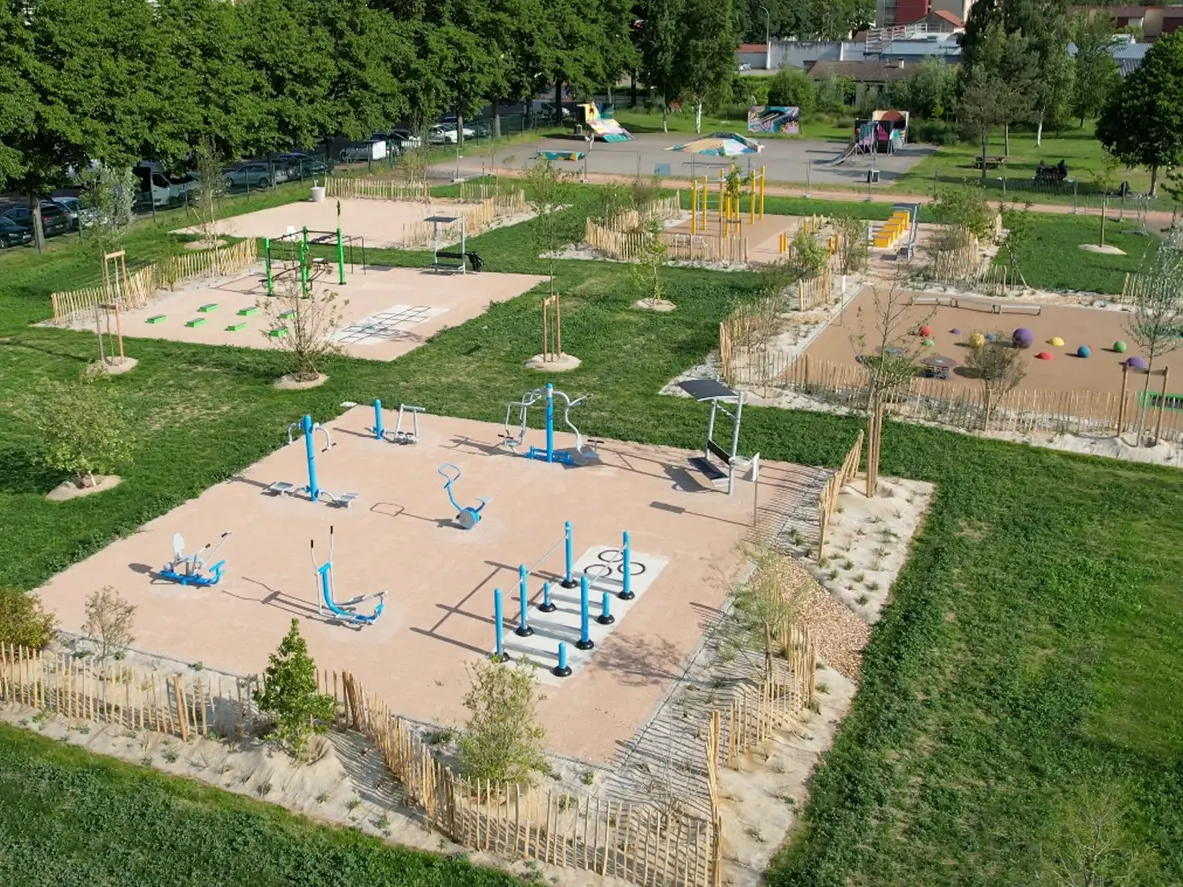
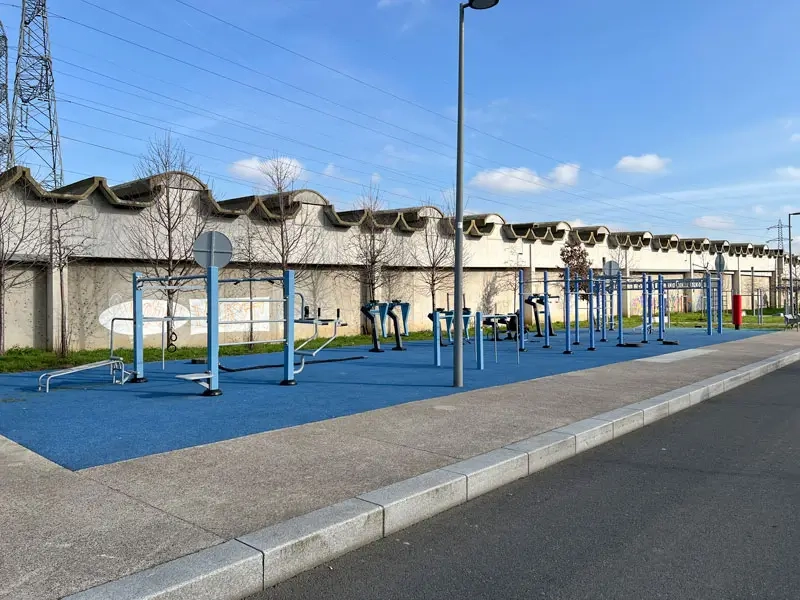
Shoulder press in a collective outdoor fitness area
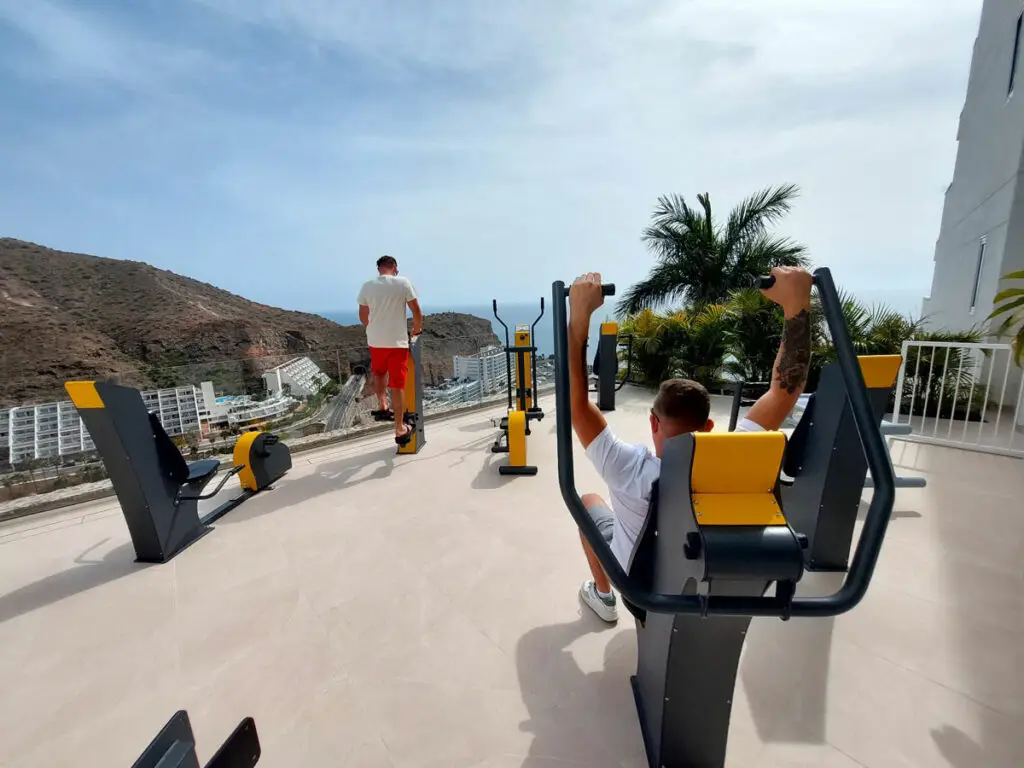
For local authorities, residence managers and developers of outdoor sports areas, the shoulder press is an essential piece of equipment for a complete outdoor fitness area. Its popularity with all age groups, from young adults looking to build muscle to seniors wishing to maintain their functional autonomy, makes it one of the most widely used pieces of equipment in parks and residences.
Combined with integrated educational signage illustrating correct posture and the main mistakes to avoid, the outdoor shoulder press becomes an exercise education tool that benefits all users, even those with no previous bodybuilding experience.Herkules Fitness offers a range of EN 16630-certified outdoor shoulder press equipment, manufactured in powder-coated galvanized steel for maximum durability in all conditions. Our teams will support you in the design of your fitness area, from project study to turnkey installation, including the creation of customized signage adapted to your audience.