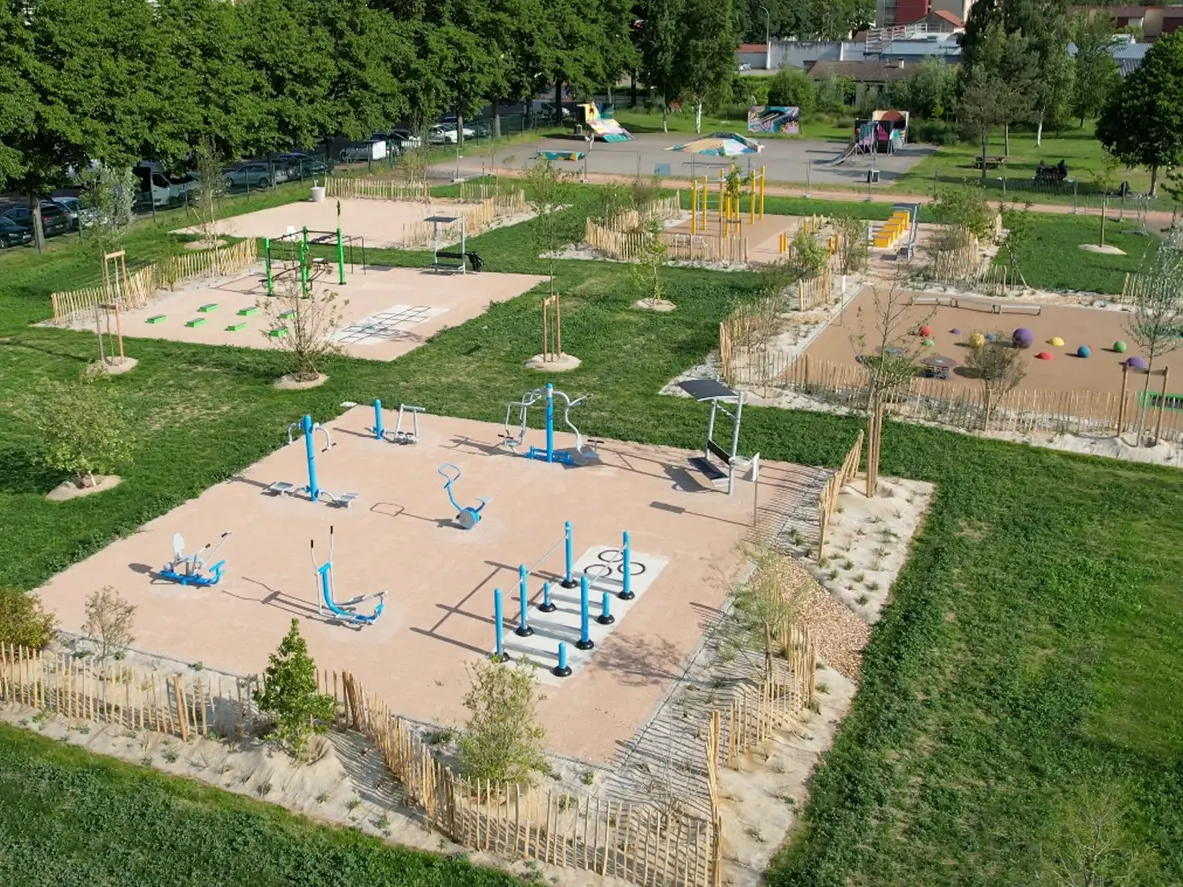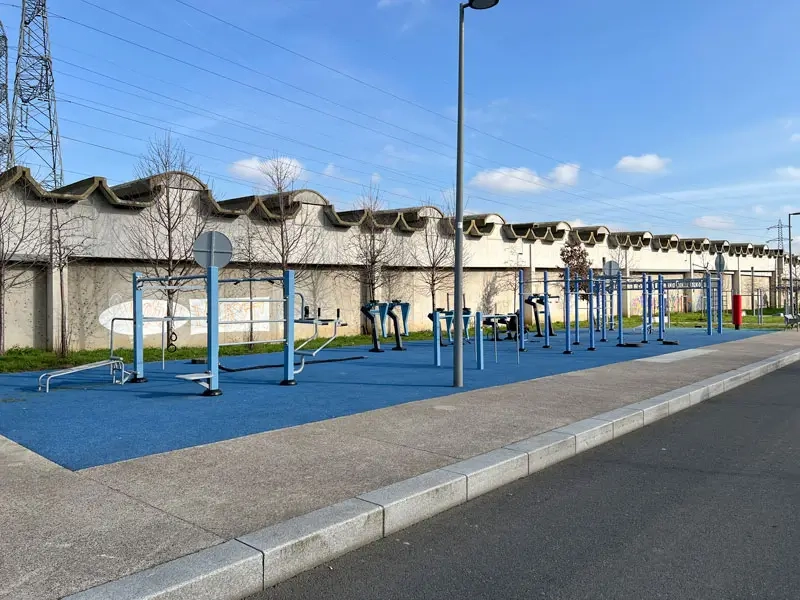

The outdoor lumbar bench is one of the most valuable pieces of outdoor fitness equipment for back health. At a time when lower back pain affects around 80% of adults in their lifetime, and is the leading cause of work stoppage in France, having equipment dedicated to strengthening the posterior chain in parks and sports areas represents a genuine prevention opportunity accessible to all. This comprehensive guide presents the targeted muscles, the most effective exercises with their detailed techniques, and training programs adapted to all levels to fully exploit the potential of this equipment.

What is an outdoor lumbar bench?
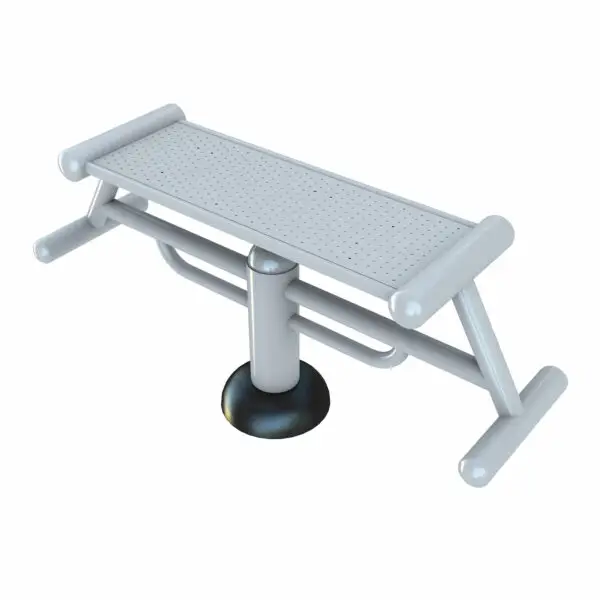
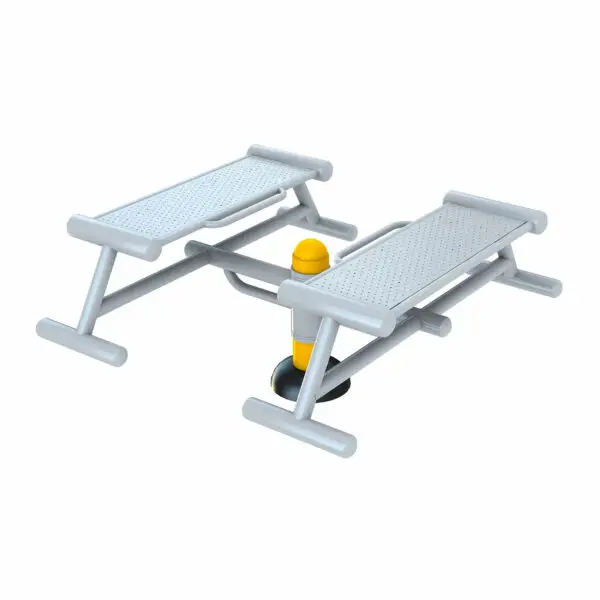
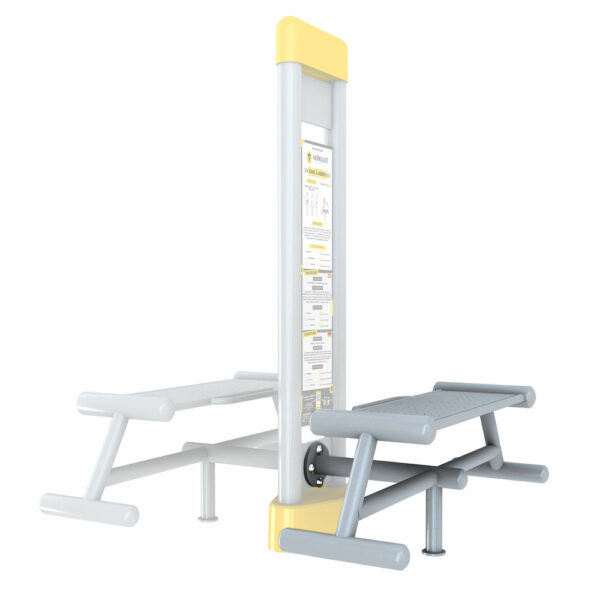
The outdoor lumbar bench, also known as a back extension machine or outdoor roman chair, is outdoor fitness equipment designed to isolate and strengthen the spinal extensor muscles, mainly the erector spinae and posterior chain muscles. The user is positioned face down, hips braced against a padded support or support structure, feet locked under safety bars. The upper body is then free to tilt downwards and straighten up against gravity, stimulating the muscles of the lower back in a progressive, controlled manner.
Outdoor models are made of galvanized steel, designed to withstand the elements and intensive use in public spaces. Some offer several levels of support height adjustment to suit users of different sizes. The absence of any additional load makes the outdoor lumbar bench a particularly safe piece of equipment, suitable for beginners and experienced athletes alike.
| ℹ️ Did you know?The lumbar bench is one of the pieces of equipment most recommended by physiotherapists and sports doctors for the prevention and rehabilitation of chronic low-back pain. Strengthening the erectors of the spine through regular lumbar extensions significantly reduces the frequency and intensity of painful episodes in chronic back pain sufferers. |
Which muscles work on the external lumbar bench?
The lumbar bench mobilizes a complex muscle chain extending from the lower back to the glutes and hamstrings. Understanding precisely which muscles are called upon enables you to direct your attention to the right areas and maximize the benefits of each repetition.
| Muscle | Location | Role in the exercise |
| Spinal erectors | Spinal columns (iliocostal, longissimus, spinous) | Main motor for trunk extension: priority target muscle |
| Large buttocks | Buttocks: upper and lower parts | Hip extension, motor assistance at end of movement |
| Hamstrings | Posterior thigh | Pelvic stabilization and hip extension |
| Lumbar squares | Lumbar lateral zone | Lateral stabilization of the spine throughout the movement |
| Multifides | Deep along the lumbar vertebrae | Fine segmental stabilization of the spine |
| Middle buttocks | Hip rib | Stabilizing the pelvis in the frontal plane |
| Latissimus dorsi (lower portion) | Lower back, flank | Contribution to extension in high position |
The posterior chain: why give it priority?
The posterior chain refers to all the muscles at the back of the body, from the nape of the neck to the calves. In our sedentary lifestyle, these muscles are chronically under-used and under-developed compared to the front muscles (quadriceps, pectorals, flexor abdominals). This muscular imbalance is the main biomechanical cause of back pain, poor posture and injuries during physical exertion.
Regular strengthening of the posterior chain through lumbar bench exercises restores muscular balance, improves sitting and standing posture, reduces mechanical stress on intervertebral discs and prevents recurrence of low-back pain. It’s an investment in health that produces measurable benefits from the very first weeks of regular use.
The best outdoor lumbar bench exercises
Exercise 1: Classic lumbar extension
The classic lumbar extension is the basic movement of the lumbar bench. It’s the exercise to start with, whatever your level, to master the sensations and technique before progressing to more demanding variations.
| Classic lumbar extension | |
| Targeted muscles | Erectors of the spine (priority), quadratus lumborum, gluteus maximus, hamstrings |
| Level | Beginner to confirmed: reference exercise |
| Recommended volume | 3 x 10 to 15 repetitions: Rest 60 seconds between sets |
| Technical points | Starting position: upper body hanging downwards at 45 degrees, arms crossed over chest or extended in line with body. Controlled ascent to horizontal alignment (not beyond). Pause for one second at the top. Slow, controlled descent in 2-3 seconds. |
| Mistakes to avoid | Do not overextend the spine beyond the horizontal: exceeding this point creates excessive compression on the facet joints and does not increase muscular benefit. The objective is alignment, not arching. |
Exercise 2: Lumbar extension with rotation
The variant with rotation adds a workout component for the obliques and multifidi, deep stabilizing muscles often neglected by standard exercises. It improves neuromuscular coordination of the posterior chain and prepares the back for the rotational movements of everyday life.
| Lumbar extension with rotation | |
| Targeted muscles | Erectors of the spine, obliques (internal and external), multifidi, squares of the lumbar region |
| Level | Intermediate: requires a good command of the classic extension |
| Recommended volume | 3 x 8 repetitions on each side (16 total) : Rest 75 seconds |
| Technical points | From the bottom position, ascend by rotating the trunk to the right, arriving at the top (right shoulder towards the sky). Return to neutral position. Alternate left and right with each repetition. The rotation movement must be initiated by the trunk, not the shoulders. |
| Mistakes to avoid | Don’t block rotation at the hips: rotation should start from the thoracic spine, not be compensated for by tilting the hips. Keep the hips stable and parallel throughout the movement. |
Exercise 3: Extension with outstretched arms (Superman)
The Superman is a variant that increases leverage by extending the arms in line with the body. It recruits the erector spinae more intensely and places greater demands on the stabilizing muscles of the shoulders and lats, creating a closed chain of muscles that is particularly beneficial for posture.
| Superman extension (arms outstretched) | |
| Targeted muscles | Erectors of the spine (reinforced solicitation), latissimus dorsi, rhomboids, posterior deltoids, glutes |
| Level | Intermediate to advanced |
| Recommended volume | 3 x 8 to 12 repetitions: Rest 75 seconds |
| Technical points | From the bottom position, arms straight out in line with the body (ears between the arms). Climb slowly to full extension, keeping arms straight and aligned with spine. Pause for 2 seconds at the top, “looking for the wall in front of you” with your hands. Controlled descent. |
| Mistakes to avoid | Do not raise the head in extension: the gaze remains on the ground, in line with the spine. Raising the head causes cervical compression and takes you out of optimal alignment. |
Exercise 4: The isometric Good Morning
The Good Morning isometric uses the lumbar bench for a maintained static contraction, which develops muscular endurance in the erectors of the spine. This endurance is exactly what the back needs to withstand long hours of sitting or standing without fatigue or pain.
| Good Morning isometric | |
| Targeted muscles | Spinal erectors (endurance), quadratus lumborum, multifidus, glutes |
| Level | Beginner to intermediate: accessible and highly effective for lumbar health |
| Recommended volume | 3 x 20 to 45 seconds hold: 60 seconds rest |
| Technical points | Position yourself in full extension (horizontal alignment) and hold the position statically. The abdominals are slightly contracted to protect the spine. Breathing is continuous and regular. Gradually increase the duration of the hold as you progress. |
| Mistakes to avoid | Don’t hold your breath while holding: blocking the breath in isometry creates excessive intraocular and intracranial pressure. Breathe slowly and regularly, counting the seconds. |
Exercise 5: Extension with pause and ultra-slow descent
This technical variant exploits the eccentric phase of the movement, the descent, which is biomechanically the most effective for developing muscular strength. By lengthening the descent time to 4 or 5 seconds, we create a high level of mechanical stress on the erectors, producing significant muscular adaptations.
| Slow eccentric extension (4-0-1) | |
| Targeted muscles | Spinal erectors (hypertrophy and strength), hamstrings, gluteus maximus |
| Level | Confirmed: reserved for those with a perfect command of classical extension. |
| Recommended volume | 4 x 6 to 8 repetitions: Rest 90 seconds to 2 minutes |
| Technical points | Raise in 1 second to full extension. Pause for 0 seconds. Descend in 4 seconds, controlling every centimetre of the descent to the bottom position. You should feel continuous muscular tension throughout the descent. Never release the tension before reaching the bottom position. |
| Mistakes to avoid | Do not accelerate the descent as fatigue sets in: if it becomes impossible to master the slow descent, end the series at this point. The quality of the movement takes precedence over the number of repetitions. |
Exercise 6: Extension with alternate rotation and pause
An advanced exercise combining rotation and time under tension, it simultaneously develops strength, endurance and coordination of the entire posterior chain. It simulates the real-life mechanical stresses to which the back is subjected in sports and professional activities involving combined movements.
| Extension rotation with pause (advanced level) | |
| Targeted muscles | The entire posterior chain: erectors, obliques, multifidi, glutes, hamstrings |
| Level | Confirm only |
| Recommended volume | 3 x 6 repetitions per side: Rest 2 minutes |
| Technical points | Rotate upwards (right shoulder up). Hold for 3 seconds, breathing deeply and feeling the chain stretch. Return to neutral position in 3 seconds. Pause for 1 second. Repeat on other side. Alternate sides with each repetition. |
| Mistakes to avoid | Don’t rush the upward hold: the 3 seconds of pause are not decorative, they are the exercise’s most effective stimulus for deep spinal stabilization. Count mentally. |
Training programs: from beginner to advanced
Beginner program : Prevention and discovery (4 weeks)
This program is designed for people new to the lumbar bench, for those returning to physical activity after a period of inactivity, and for chronic low-back pain sufferers wishing to begin progressive strengthening under medical supervision.
| ⚠️ Medical precautionIfyou suffer from acute low-back pain, a diagnosed herniated disc, spinal stenosis or any spinal pathology, consult your doctor or physiotherapist before starting this program. Lumbar strengthening is generally recommended in the chronic phase, but contraindicated in the acute phase. |
| Beginner program: 2 sessions per week | |||
| Exercise | Series x Reps | Tempo | Board |
| Classic extension | 3 x 10 reps | 1-1-2 | Technical focus. Same height at top and bottom. |
| Good Morning isometric | 3 x 20 sec | Maintenance | Continuous breathing. Increase by 5 sec each week. |
| Posterior chain stretching | 3 x 30 sec | Static | At the end of the session only. Flex forward, hips back. |
Intermediate program: Targeted reinforcement (6 weeks)
This program is designed for those who have already mastered classic extension and wish to progress towards more complete strengthening. It introduces rotation variants and eccentric work.
| Intermediate program: 3 sessions per week | |||
| Exercise | Series x Reps | Tempo | Board |
| Classic extension (warm-up) | 2 x 12 reps | 1-0-2 | Warming up the chain. Full amplitude. |
| Extension with rotation | 3 x 8/quote | 1-1-2 | Alternate left-right. Stable hips. |
| Good Morning isometric | 3 x 35 sec | Maintenance | Progression of 5 sec compared to the beginner program. |
| Superman extension | 3 x 10 reps | 1-2-3 | Pause 2 sec at top. Descend for 3 sec. |
| Stretching and mobility | 5 min | Static | Hamstring and gluteal stretching at the end of the session. |
Advanced program: Strength and performance (8 weeks)
This program incorporates advanced training techniques (reinforced eccentric, combined rotation-pause) for practitioners seeking to maximize the development of strength and endurance of the posterior chain.
| Confirmed program: 3 sessions per week | |||
| Exercise | Series x Reps | Tempo | Board |
| Classic extension (activation) | 2 x 15 reps | 1-0-2 | Neuromuscular warm-up. Don’t fail. |
| Slow eccentric extension | 4 x 6 reps | 1-0-4 | 4 seconds of controlled descent. Quality > quantity. |
| Extension rotation with pause | 3 x 6/side | 1-3-3 | 3 seconds up, 3 seconds down. Rest 2 min. |
| Good Morning isometrique max | 3 x 60 sec | Maintenance | 1 minute per set. Abdominals engaged at all times. |
| Eccentric Superman | 3 x 8 reps | 1-2-4 | 2 sec up, 4 sec down. Arms straight. |
| Mobility and active recovery | 8 min | Dynamics | Thoracic mobilization, hip flexor stretching. |
| ✅ Progress tipWhateveryour level, the golden rule is: master an exercise perfectly before moving on to the next variation. It’s better to perform 15 impeccable classic extensions than 8 poorly executed extensions with rotation. The back doesn’t forgive repeated technical compensations. |
Additional exercises to be performed in parallel
The lumbar bench mainly targets spinal extensors. For a complete and balanced strengthening of the trunk, it is essential to complement these exercises with abdominal muscle work (sheathing) and hip flexors, available on other machines in the park or on the floor.
– Front plank: 3 x 30 to 60 seconds. Strengthen the transversus abdominis and obliques, the stabilizing muscles that antagonize the erector spinae. Pusher/stabilizer balance is fundamental to a healthy spine.
– Lateral gainage (side plank): 3 x 20 to 45 seconds on each side. Targets the obliques and quadratus lumborum, essential muscles for stabilizing the spine at the front.
– Buttock bridge on floor: 3 x 15 repetitions. Strengthen the glutes and hamstrings as a complement to lumbar extensions. Easily performed on grass or soft ground in the park.
– Stretch the psoas and hip flexors: 3 x 30 seconds per side. These muscles, often shortened by prolonged sitting, pull the lower back forward and aggravate low-back pain. Stretching them regularly is just as important as strengthening the extensors.
– Rotational thoracic mobilizations: 10 repetitions on each side. Free up the often rigid thoracic spine, allowing stress to be distributed more evenly over the entire spine.
Precautions and contraindications
The lumbar bench is a safe piece of equipment when used correctly, but certain situations require special precautions or prior medical consultation.
– Acute low-back pain: practice is formally contraindicated in the acute phase. Wait for the episode to resolve completely before resuming, and consult a physiotherapist for a gradual reinsertion program.
– Herniated discs: extension movement may be beneficial in certain herniated configurations (posterior herniation in flexion), and contraindicated in others. Specialist medical advice is essential prior to use.
– Spondylolisthesis: lumbar hyperextension is generally contraindicated. Horizontal hasta extension may be performed under medical supervision, but never beyond.
– Severe osteoporosis: caution is advised, as vertebrae weakened by osteoporosis may be sensitive to the compression forces generated by extension. Medical advice is required.
– Pregnancy (second and third trimester): the face-down position becomes uncomfortable and potentially contraindicated. Prefer lumbar strengthening exercises in a standing or sitting position, approved by your doctor.
| 📌 General recommendationIfin doubt about the compatibility of an exercise with your state of health, systematically consult a health professional (doctor, physiotherapist, sports doctor) before starting. The benefits of lumbar strengthening are real and well-documented, but they can only be fully realized with a practice adapted to your personal situation. |
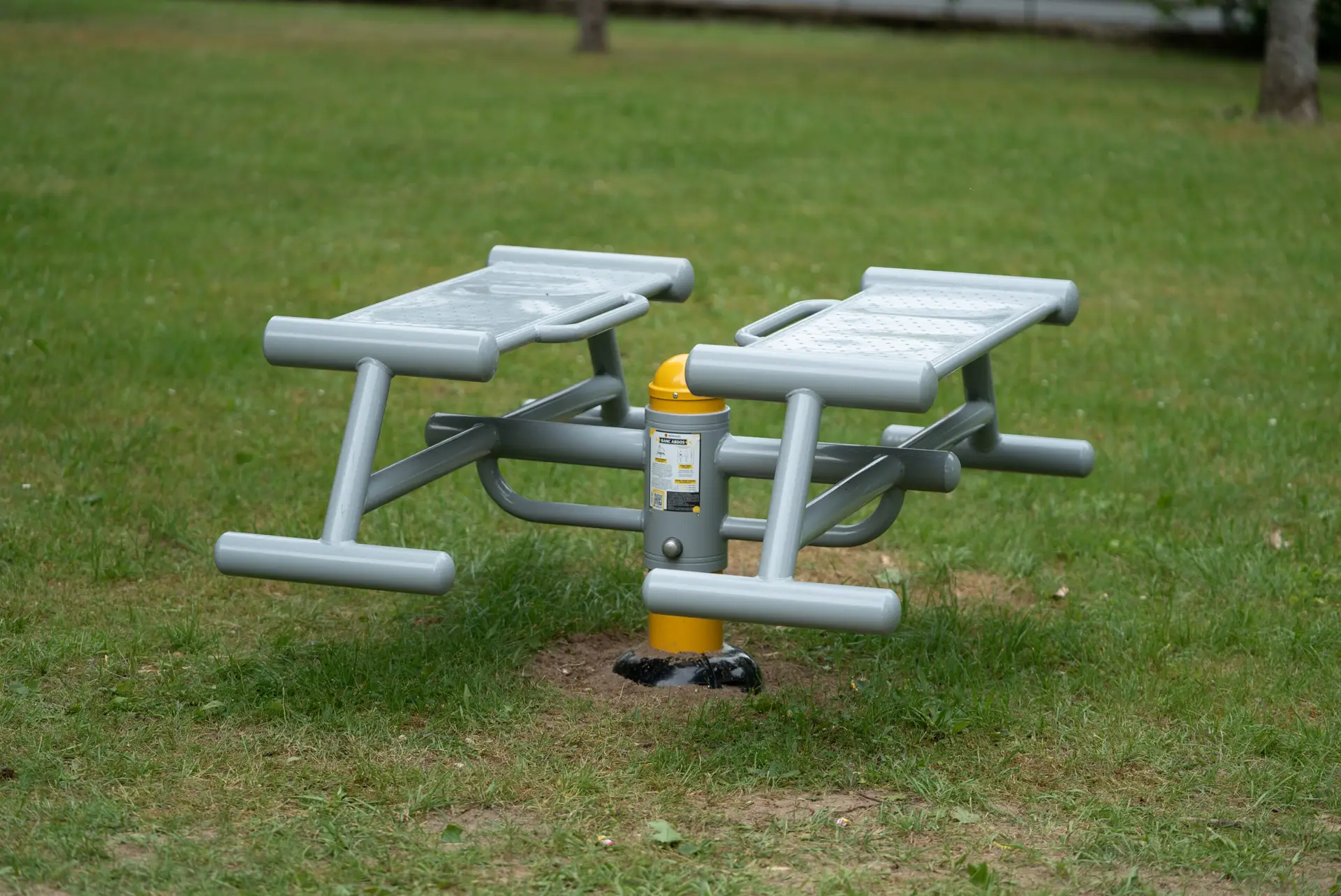
The lumbar bench in an outdoor fitness area: choice and installation
The lumbar bench is an essential piece of equipment in a complete fitness area for local authorities, home managers and developers of outdoor sports facilities. Its popularity with senior citizens, who are particularly concerned by lower back pain, and active adults makes it one of the most widely used pieces of equipment in public parks.
When choosing an outdoor lumbar bench, a number of technical criteria are decisive: the solidity of the structure anchoring it to the ground, the quality of the padding of the abdominal support (UV and humidity resistant), the possibility of adjusting the height to accommodate users of different sizes, and the presence of integrated signage illustrating the exercises and precautions to be taken.
Herkules Fitness offers a range of EN 16630-certified outdoor lumbar benches, manufactured in galvanized steel with UV-resistant PVC padding to withstand the harshest weather conditions. Available in a wide range of colors, these benches can be customized to match your space’s corporate identity, and come with integrated educational signage. Contact our team for a personalized project study and a free 3D visualization of your fitness area.
The outdoor lumbar bench is an exceptional strengthening tool for back health, accessible to everyone in parks and public sports areas. The six exercises presented in this guide, from classic extension to combined rotation-pause, cover the entire spectrum of needs, from beginners seeking to prevent low-back pain to experienced athletes wishing to maximize the strength and endurance of their posterior chain. The key to success lies in progressiveness, impeccable technical quality and regular practice. With three sessions a week over six to eight weeks, the benefits in terms of posture, pain reduction and overall physical performance are measurable and long-lasting.