

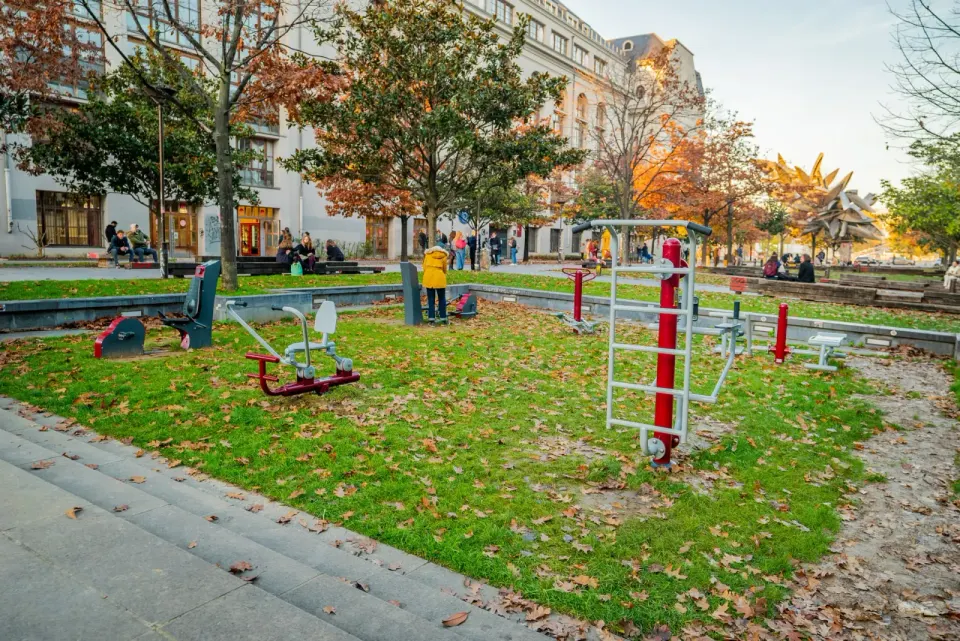
Installing a fitness or street workout area in a public park has become a recurring project for French local authorities. Popular with local residents, these facilities meet a growing demand for free, open-air sports activities. However, equipping an urban park is not something that can be improvised: the choice of equipment, the available surface area, the budget and the profile of future users all need to be considered in relation to the size of the community.
An oversized area in a village of 1,500 inhabitants will remain hopelessly empty, while two lost tow bars in a metropolis will never be enough to absorb the traffic. In this article, we detail good planning practices and equipment recommendations, from rural villages to large conurbations.

To remember:
- The sizing of a fitness area should always be based on the number of inhabitants and the potential for local use: a town with 2,000 inhabitants is not the same as a city with 50,000.
- On average, you should expect to pay €15,000 to €25,000 for a small area (3-4 fixtures), €40,000 to €80,000 for an intermediate area, and over €100,000 for a complete multi-area installation.
- The shock-absorbing floor accounts for 30 to 40% of the total budget: it is essential for safety and the durability of the installation.
- Several co-financing schemes exist (ANS, DETR, regional funds, “5,000 sports facilities” plan), covering up to 50-80% of the project.
- A successful project involves local residents from the outset (consultation, choice of equipment): this is the best guarantee of long-term use after inauguration.
Why equip an urban park with fitness equipment?
The installation of freely accessibleoutdoor sports facilities in public spaces meets a number of converging challenges. Firstly, from a health point of view, these areas encourage physical activity among an increasingly sedentary population, in a context where the WHO recommends at least 150 minutes of weekly activity for adults. They are of particular interest to people who are far removed from associative or commercial structures, such as teenagers, young workers and retired people.
On a social level, these facilities create links: they become intergenerational meeting points and structure neighborhood life. In terms of urban planning, they enhance the value of existing parks and green spaces, which are sometimes under-utilized, and contribute to the overall attractiveness of the community. Finally, from a financial point of view, the investment remains moderate in relation to the duration of use (15 to 20 years for quality facilities) and benefits from several public aid schemes.
Criteria for right-sizing your system
Before choosing a supplier or type of equipment, several parameters need to be carefully analyzed. They will determine the success and long-term use of the area.
Population and catchment area
The number of inhabitants is still the primary criterion, but it’s not enough. We need to think in terms of catchment areas: a commune of 3,000 inhabitants located close to other villages with no facilities may justify a more ambitious area, as it will attract users beyond its own administrative boundaries.
User profile
Different areas cater to different audiences. In rural or residential areas, users are often families, senior citizens or occasional sports enthusiasts: in these cases, the emphasis is on simple, accessible facilities. In dense, young and active urban areas, we aim for more technical facilities (street workout, calisthenics) to meet the demand for advanced practice.
Location and available surface area
The choice of site is crucial. Ideally, the site should be visible, accessible on foot or by bike, close to existing pathways, and in a popular park. Avoid isolated areas (vandalism, feeling of insecurity) and steep slopes. Allow at least 50 m² for a modest installation, and up to several hundred m² for a complete area.
Overall budget
The budget is never limited to equipment alone. It must include the shock-absorbing floor (often 30 to 40% of the total cost), signage, additional furniture (benches, litter garbage cans, water points), sometimes lighting, and of course design and installation costs. A realistic overall budget is between 1.5 and 2 times the cost of the fixtures alone.
Overview: recommendations by municipality size
The table below summarizes our recommendations based on the number of inhabitants. These orders of magnitude serve as a starting point, and need to be adjusted according to local conditions.
| Municipality size | Number of fixtures | Recommended surface | Indicative budget (incl. VAT) |
| < 2,000 inhab. | 2 to 4 fixtures | 50 to 80 m² of floor space | 10 000 – 20 000 € |
| 2,000 – 5,000 inhabitants | 4 to 6 fixtures | 80 to 150 m² of floor space | 20 000 – 35 000 € |
| 5,000 – 20,000 inhabitants | 6 to 10 fixtures | 150 to 300 m² of floor space | 35 000 – 70 000 € |
| 20,000 – 100,000 inhabitants | 10 to 15 apparatus + zones | 300 to 600 m² of floor space | 70 000 – 130 000 € |
| > 100,000 inhab. | 15 + apparatus, multi-zone | 600 m² and over | 130,000 and over |
Small towns (fewer than 5,000 inhabitants): focus on the essentials
In communities with fewer than 5,000 inhabitants, the challenge is to offer a simple, versatile and easy-to-maintain facility, without under-equipping. Visitor numbers will be occasional but regular, especially if the area is integrated into an existing course (park, lake, multi-sports field).
Recommended equipment
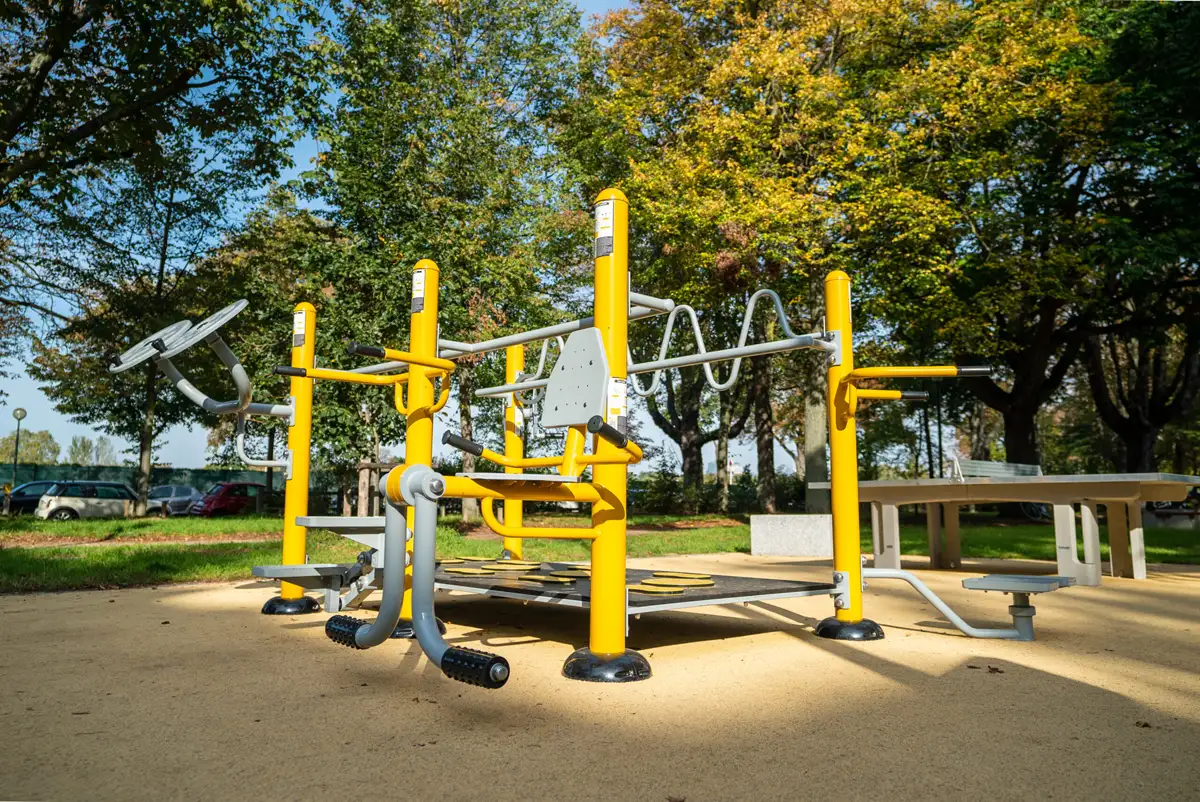
– A multi-functional combination station : pull-up bar, parallel bars, espalier, ideal for offering 4 to 5 basic movements on a single compact module.
– An abdominal/dorsal module : inclined bench, oblique board, or bench for abs and lumbar, accessible to all levels.
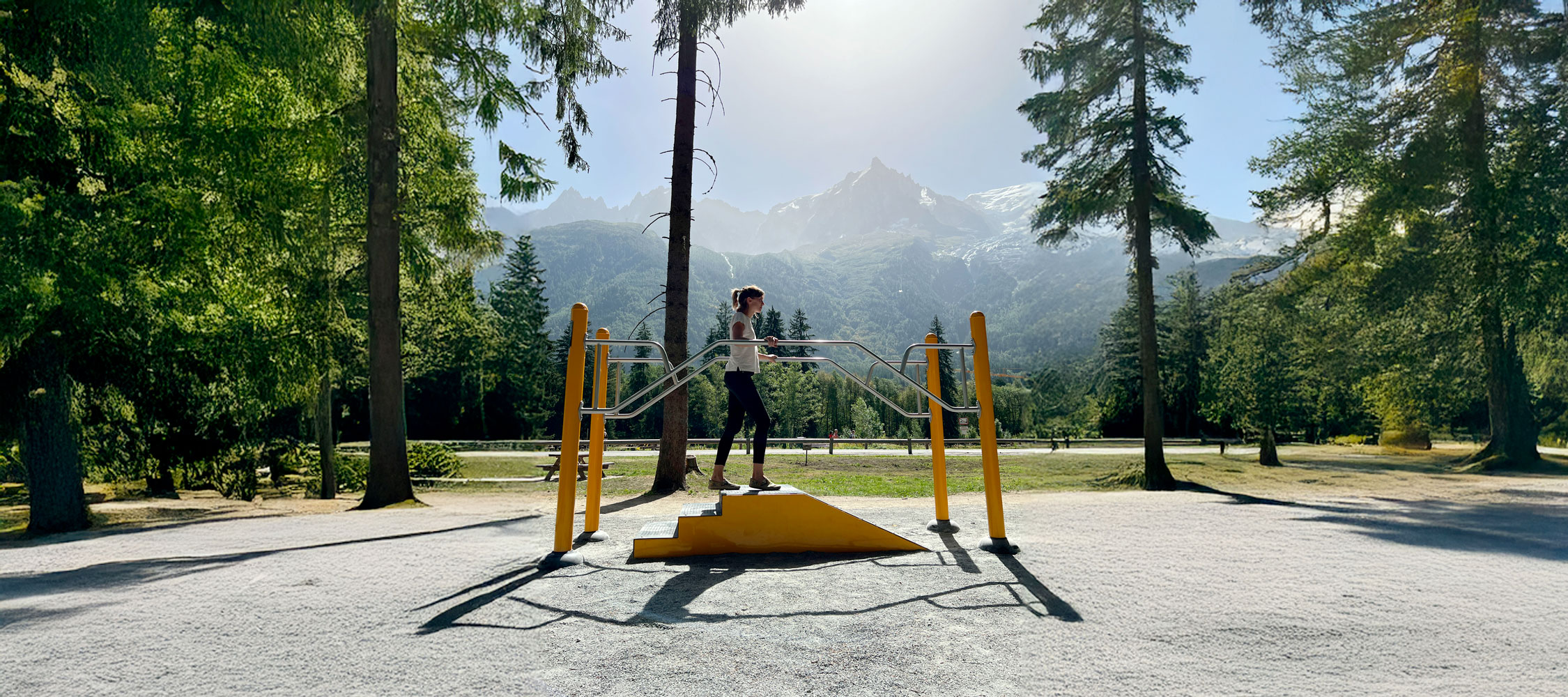
– A cardio machine , such as an outdoor elliptical or skier, is particularly popular with seniors.
– An information panel : instructions for use, examples of exercises, health benefits.
A budget of €15,000 to €25,000 (incl. VAT) covers all the equipment (apparatus + shock-absorbing floor + installation) for a surface area of 60 to 100 m². For very small communities (fewer than 1,500 inhabitants), a simple 2 or 3-station street workout station may suffice, provided it’s well-established.
Medium-sized towns (5,000 to 20,000 inhabitants): a diversified offering
In this stratum, the municipality often has several parks and a sufficiently large population to justify a structured area. The aim is to cater for several user profiles by offering both accessible equipment and more technical features.
Recommended equipment
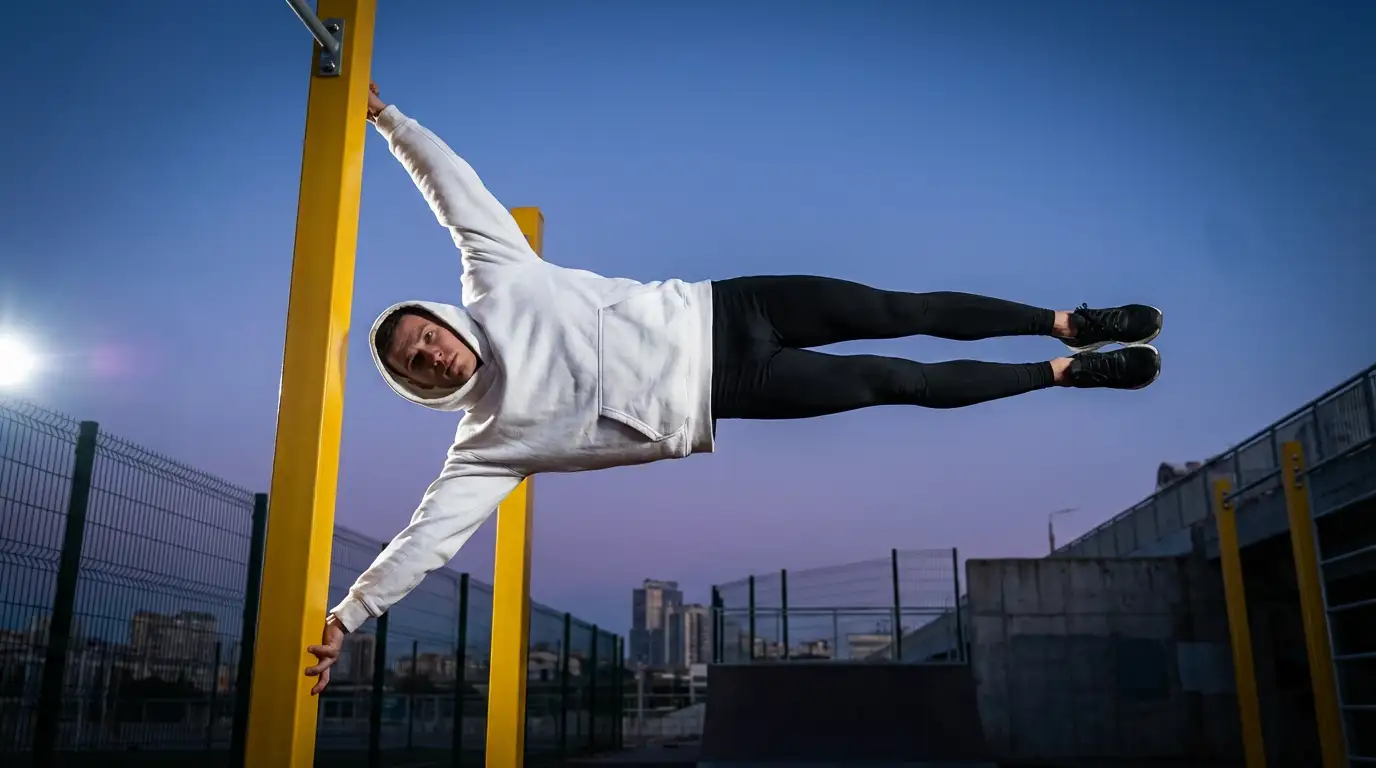
– A street workout/callisthenics area : a set of fixed bars at various heights, parallel bars, espalier, gymnastic rings.
– A gentle fitness zone : elliptical, rowing machine, twister, surfer, for seniors and beginners.
– A strengthening zone : abdomen benches, pectoral press, butterfly, outdoor leg press.
– Accompanying furniture : benches, water fountain, educational signs, bicycle racks.
Expect to pay between €35,000 and €70,000 inc. VAT for a 150 to 300 m² surface area. The idea is to create a truly identifiable and easily recognizable neighborhood “fitness hub”. For communities close to the upper limit (15,000 – 20,000 inhabitants), it may be advisable to plan two medium-sized areas spread throughout the community rather than one large one, to avoid travel and increase usage.
Large towns (20,000 to 100,000 inhabitants): think network
In cities of this size, we no longer think in terms of units, but in terms of networks. The aim is to irrigate the territory with several areas of varying size, adapted to each district, with at least one clearly identified flagship facility. The diversity of the public (students, families, advanced sportsmen and women, senior citizens) calls for a wide range of facilities.
Recommended equipment for main area
– A complete street workout park : modular multi-stations, variable-height bars, rings, parallel bars, plyo box, ideal for competitive or advanced practice.
– A fitness zone adapted for seniors and PRMs : apparatus accessible to people with reduced mobility, low-impact equipment.
– A cross-training area : body-building rigs, pull-up bars, suspension rings, modular structure for functional training.
– A health or mobility trail : balance modules, stretching zones, coordination ladder.
– Landscaping : shading, planting, recovery areas, advanced signage with QR codes to video tutorials.
The budget for the main area is between €70,000 and €130,000 inc. VAT, for a surface area of 300 to 600 m². To this can be added secondary areas (2 to 5 depending on the city), for a total program budget of up to €250,000 to €400,000. This network strategy is now favored by most major French cities.
Large conurbations (over 100,000 inhabitants): aiming for excellence
In metropolises, it’s no longer just a question of providing equipment, but of becoming a benchmark area for free sports. This requires emblematic areas, sometimes associated with events (street workout competitions, cross-training championships), and a dense network covering all neighborhoods.
Equipment strategy
– One or more flagship areas of more than 600 m², with a sophisticated design, night lighting, video surveillance and top-of-the-range equipment. Budget: €150,000 to €300,000 incl. VAT per site.
– A neighborhood network of intermediate areas (10 to 30 depending on the size of the metropolis), to ensure that every inhabitant has access within a 10-minute walk.
– Themed areas : senior health trails near nursing homes, hardcore calisthenics near universities, family fitness in central parks.
– A program of activities : municipal coaches, free events, partnerships with local clubs, dedicated mobile app.
The multi-year budget for an ambitious metropolitan program is in the millions of euros, but the impact in terms of public health, attractiveness and social cohesion is documented and recognized.
Cost and financing: what to expect?
In addition to the cost of the fixtures, there are a number of other items that make up the overall budget for a project. Here’s a typical breakdown.
– Apparatus and equipment: 40-50% of total budget.
– Shock-absorbing flooring (rubber tiles, synthetic turf, wood shavings): 30 to 40% of the budget. This is a mandatory, standardized item (standard NF EN 1176/1177).
– Installation and earthworks: 10 to 15%.
– Furniture and signage: 5 to 10%.
– Studies, project management, ancillary costs: 5 to 10%.
The main public funding mechanisms
– Agence nationale du sport (ANS) : the “5,000 sports facilities” plan finances up to 50% (sometimes 80% in QPVs or ZRRs) of outdoor fitness area projects.
– The DETR (Dotation d’équipement des territoires ruraux): a classic lever for municipalities with fewer than 20,000 inhabitants.
– Regional and departmental funds : many regions have specific “local sports facilities” lines.
– European funds (ERDF ): for projects promoting territorial cohesion.
– Local sponsorship : some companies or mutual insurance companies support this type of healthcare facility.
When two or three schemes are combined, it’s not uncommon for a municipality to bear only around 20-30% of the final cost, the rest being covered by subsidies.
Practical advice for a successful project
– Consult residents in advance : public meeting, online questionnaire, participatory workshop. An area chosen collectively will be better used than one imposed.
– Visit existing facilities : there’s no substitute for a site visit to a neighboring town to assess the actual quality of the equipment.
– Demand certification : NF EN 16630 for outdoor fitness equipment, NF EN 1176/1177 for floors. This is a guarantee of legal certainty for local authorities.
– Think about PRM accessibility : path, height of equipment, stable floor. Several manufacturers now offer inclusive ranges.
– Plan ahead for maintenance : annual inspection by an approved organization is mandatory, and an operating budget of 3 to 5% of the initial cost must be set aside each year.
– Communicate at the inauguration : local press, social networks, free animation session with a coach. The launch often determines the first months of use.
In just a few years, equipping an urban park with fitness equipment has become an essential project for local authorities concerned with the health and quality of life of their residents. Provided it is correctly sized, financed and supported, this type of development delivers long-term benefits that far outweigh its initial cost: public health, social ties, regional appeal, enhancement of green spaces.
The right approach is to start from the reality on the ground (population, user profiles, available space, available budget) rather than copying the neighboring municipality’s project. By cross-referencing this data with the recommendations presented in this article, you’ll have a solid foundation on which to build a relevant, well-calibrated project with lasting appeal.